Mon, Aug 3, 2026 -
Subscribe & never miss our best posts. Subscribe Now!
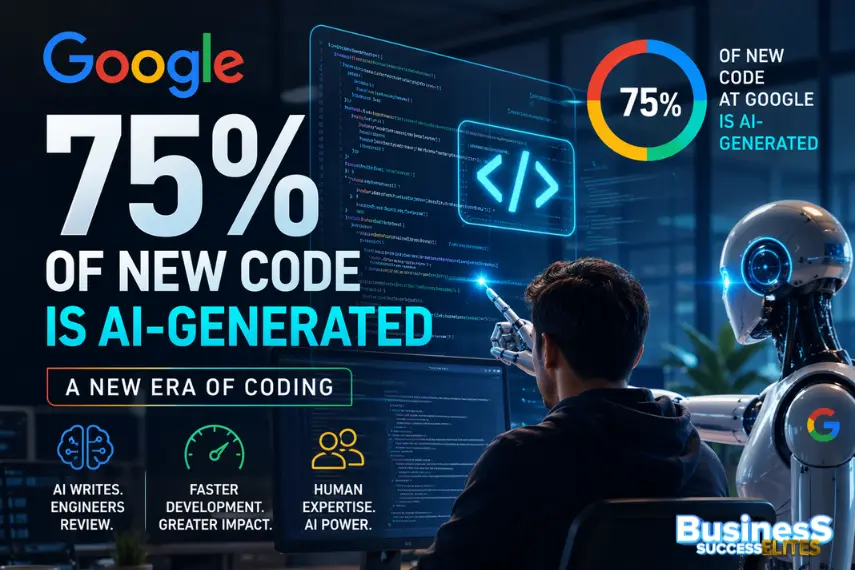
Google AI code generation is no longer a side experiment tucked away in research labs. It has become central to how one of the world’s largest technology companies builds its products. Google AI code generation now accounts for 75% of all new code written within the company. This figure signals a deeper transformation underway in the very nature of software engineering.
The disclosure came from Sundar Pichai during a recent cloud-focused event, where he outlined how artificial intelligence has steadily moved from being a productivity aid to a core operational layer inside Google. What once required teams of engineers writing code line by line is increasingly being handled by advanced AI systems. These systems are capable of generating, refining, and even testing code before a human reviews it.
The speed of this transition has surprised even industry observers. Not long ago, AI contributed to roughly a quarter of the company’s codebase. That share doubled within months and has now reached three-quarters. It reflects both rapid advances in large language models and the company’s willingness to integrate them deeply into its engineering workflows. The shift is not just quantitative but structural, changing how problems are approached and solved within engineering teams.
At the centre of this evolution is the rise of what engineers describe as “agentic” systems. Unlike earlier tools that simply suggested snippets, these AI agents can interpret broader objectives. They break them into smaller tasks, generate the necessary code, and iterate on it with minimal human prompting. The result is a development cycle that feels less like manual construction and more like supervision, with engineers guiding systems rather than typing out every instruction themselves.
This change is beginning to reshape the identity of the developer’s role. Coding, once seen as a hands-on craft, is gradually shifting towards orchestration and oversight. Engineers are spending more time evaluating outputs, refining logic, and ensuring reliability. On the other hand, AI handles much of the repetitive or time-intensive groundwork. The emphasis is moving from writing syntax to designing systems and verifying outcomes.
Beyond Google, the broader technology sector is moving in a similar direction, though at varying speeds. Companies across the industry are experimenting with AI-generated code, driven by the promise of faster deployment cycles and reduced operational costs. What distinguishes Google’s milestone is the percentage and scale at which it is being implemented. Also, it offers a glimpse into what large-scale AI integration can look like in practice.
Read more – Tim Cook Executive Chairman: Apple Hands CEO Role to John Ternus
Still, the transition is not without unease. Questions around code reliability, security vulnerabilities, and long-term skill development continue to surface as AI takes on a larger share of the workload. There is a growing recognition that while AI can accelerate output, it also introduces new layers of complexity that require careful human judgment. Engineers are not stepping away; they are stepping into a different kind of responsibility.
Seen in a wider context, the 75% figure is less about dominance and more about collaboration. It reflects a moment where human expertise and machine capability are beginning to blend in ways that were difficult to imagine just a few years ago. Software development is no longer solely about writing code; it is increasingly about shaping how that code is created, validated and trusted.
If this trajectory continues, the future of programming may not be defined by how quickly a person can code, but by how effectively they can work alongside intelligent systems. And in that evolving partnership, the role of the human developer, far from disappearing, may become more critical than ever.
Japan, US Yen Intervention Signals Historic Currency Truce
August 3, 2026