Mon, Aug 3, 2026 -
Subscribe & never miss our best posts. Subscribe Now!
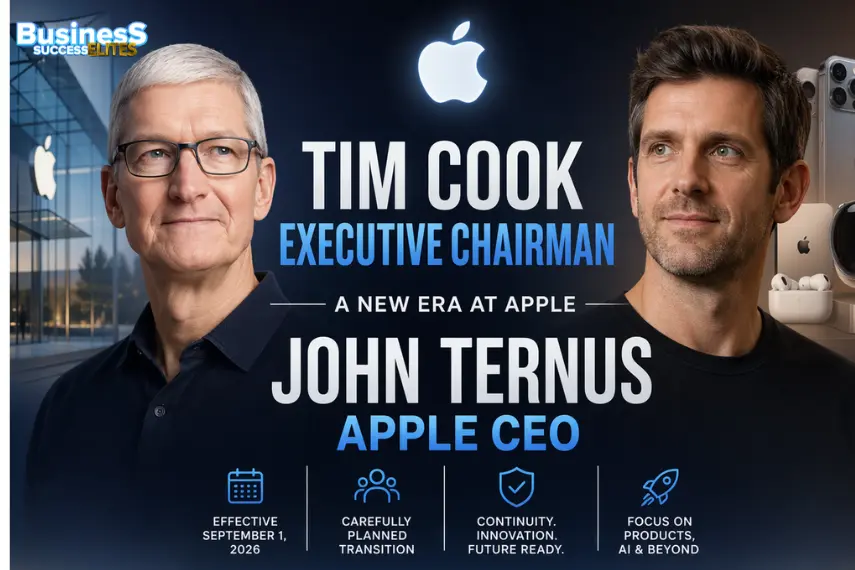
Tim Cook, Executive Chairman, the phrase marks the end of one of the most stable and profitable leadership eras in modern corporate history. Apple has formally announced that Tim Cook will step into the role of Executive Chairman, while John Ternus will take over as Chief Executive Officer from September 1, 2026.
The decision, approved unanimously by Apple’s board, is not a sudden shake-up but the outcome of a long-planned succession strategy, one that signals continuity rather than disruption at the world’s most valuable technology company.
Apple has framed this transition as a “thoughtful, long-term succession plan,” with Cook continuing as CEO through the summer to ensure a smooth handover.
Unlike the emotionally charged shift from Steve Jobs to Cook in 2011, this transition feels measured, almost clinical. Cook is not exiting the stage; he is simply moving to a role that allows him to focus on global policy, diplomacy, and strategic oversight, areas where he has quietly become one of Apple’s strongest assets.
As Executive Chairman, Cook is expected to remain deeply involved in high-level decision-making, particularly in navigating geopolitical tensions and regulatory frameworks that increasingly shape Big Tech.
If Cook was the operations mastermind, Ternus represents Apple’s engineering core. A company veteran since 2001, he currently serves as Senior Vice President of Hardware Engineering and has contributed to nearly every major product category, from iPhone and iPad to Mac and AirPods.
Ternus’s elevation signals a subtle but important shift: Apple is doubling down on product innovation, especially as it faces mounting pressure in artificial intelligence and next-generation computing.
Colleagues describe him as understated but decisive, a leader who prefers building over broadcasting. That profile may suit Apple at a time when execution, not spectacle, will define its next decade.
When Cook took over in 2011, Apple was already iconic. What he built, however, was scale.
Cook’s tenure was defined less by breakthrough invention and more by operational excellence that includes tight supply chains, global expansion, and a services ecosystem that now anchors Apple’s recurring revenue.
Yet, the transition also comes with unfinished business. Critics have pointed to Apple’s slower pace in AI compared to rivals, an area where Ternus will now face immediate pressure.
Initial market response has been calm, with Apple shares showing only marginal movement following the announcement, an indication that investors see this as continuity rather than disruption.
Industry peers have responded warmly. Sundar Pichai publicly congratulated Cook and expressed confidence in Ternus, reflecting the broader tech ecosystem’s respect for the transition.
Read more – OpenAI Product Chief Departures: Three Execs Exit at Major Shakeup
This leadership shift comes at a pivotal moment. Apple is no longer just a hardware company or a services giant; it is now expected to compete aggressively in AI, mixed reality, and next-generation computing.
Cook’s move upstairs ensures stability in global strategy, while Ternus’s appointment hints at a renewed focus on engineering-led innovation.
In many ways, this is Apple returning to a familiar formula:
With Cook still in the room and Ternus stepping forward, the company is attempting something rare in corporate history: a leadership transition that preserves institutional memory while quietly preparing for its next technological leap.
Whether that leap comes through AI, hardware reinvention, or something entirely unexpected will now depend on how effectively John Ternus writes the next chapter of Apple’s story.
Japan, US Yen Intervention Signals Historic Currency Truce
August 3, 2026