Mon, Aug 3, 2026 -
Subscribe & never miss our best posts. Subscribe Now!
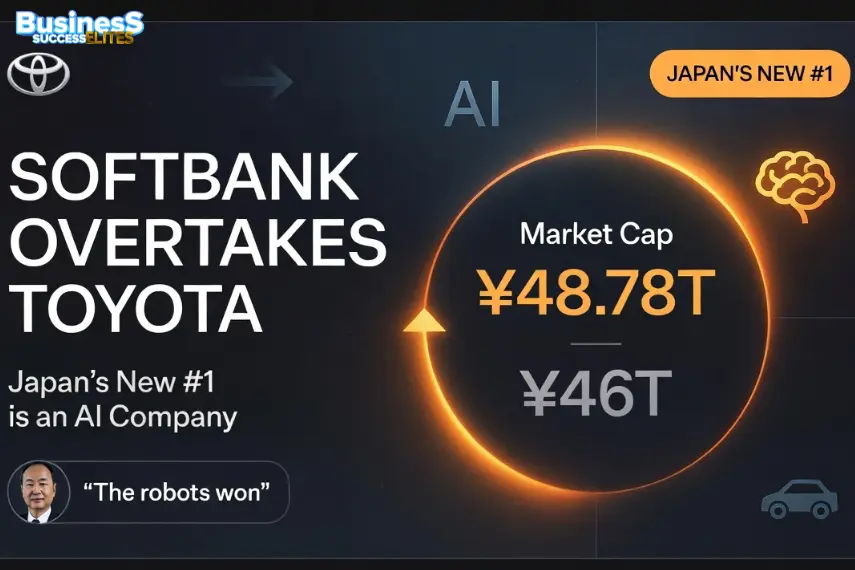
SoftBank overtakes Toyota as Japan’s most valuable company, and if you were watching the Tokyo Stock Exchange on June 2, 2026, you saw it happen in real time. Shares of the Masayoshi Son-led technology group climbed 14% in Tokyo trading, pushing its market capitalisation past Toyota’s for the first time in more than two decades. Twenty-two years of automotive supremacy, gone in a single session. The car guys lost to the AI guy. Japan’s corporate pecking order will never quite look the same again.
To be fair, this was not a sudden ambush. The rally has propelled SoftBank shares up more than 90% this year, pushing the company’s market value above ¥48 trillion, higher than Toyota’s around ¥46 trillion. Toyota shares, by contrast, have fallen more than 10% this year. When one stock is nearly doubling while the other quietly bleeds double digits, the crossover is not if but when. Monday was simply when.
The numbers that closed the argument: the Masayoshi Son-led company’s market cap reached ¥48.78 trillion (approximately $305.9 billion) on Monday, eclipsing Toyota’s. The crossover was confirmed mid-session on the Tokyo Stock Exchange. The last time SoftBank held this position was during the peak of Japan’s internet bubble in 2000. This time, at least, there’s actual revenue attached to the thesis. Probably.
SoftBank Group’s stock jumped 14% on Monday after CEO Masayoshi Son announced a €75 billion ($87 billion) AI data centre programme in France, the company’s largest European infrastructure commitment to date. Son confirmed the investment at France’s Choose France summit alongside President Emmanuel Macron, because when you are pledging the GDP of a small nation to build data centres, you do it with a head of state standing next to you for the photo opportunity.
The first tranche is not small. The first phase comprises an initial €45 billion investment to deliver 3.1 gigawatts of AI data centre capacity in the Hauts-de-France region by 2031. The sites, Dunkirk, Bosquel, and Bouchain, will serve AI companies, cloud providers, enterprises, public institutions, and research organisations. Son said he doesn’t think SoftBank is over-exposed to OpenAI in its investment portfolio, as the AI startup makes up just over 20% of the group’s net asset value, while British semiconductor design firm Arm is its largest holding, making up over 50% of its net asset value. Arm, incidentally, is also riding the same AI wave, so one could argue the exposure is more concentrated than Son is letting on. But Son has never been accused of excessive caution.
The OpenAI bet deserves its own paragraph because it is genuinely staggering in scale. SoftBank has ploughed more than $30 billion into OpenAI, with its investment gains in the company totalling $45 billion in the year ended March. SoftBank has committed to investing more than $60 billion in OpenAI for a stake of about 13%. That is not a diversified portfolio play; that is a conviction bet dressed up in conglomerate clothing. The group also remains a central partner in the $500 billion Stargate initiative alongside OpenAI, Oracle, and Abu Dhabi’s MGX to roll out data centres across the United States.
The market has taken notice of all of it. “SoftBank has concentrated its management resources on AI-related businesses and has successfully ridden the broader global tech rally,” Tomo Kinoshita, a global market strategist at Invesco Asset Management Japan, told Bloomberg. “Toyota, meanwhile, has been hit by rising oil prices stemming from the Iran war, which raises the cost of operating vehicles and weighs on global auto demand.” One company bet on the future of intelligence; the other makes things that burn fuel. The market has an opinion about which of those sounds more appealing right now.
“This epoch-making event symbolises the AI boom,” Kazuhiro Sasaki, head of research at Phillip Securities Japan, told Bloomberg, adding that expectations for major US IPOs were triggering a reshuffling of capital. The potential listings of OpenAI and SB Energy, both SoftBank portfolio bets, are increasingly cited as near-term catalysts that could push the stock further. Investors are pricing in not just what SoftBank owns today but what it might realise tomorrow.
“SBG’s overtaking of Toyota signifies the full-fledged arrival of the AI era,” Nikkei noted. That is high-minded language, but it is not entirely wrong. The shift carries symbolic weight beyond the headline numbers. Toyota has anchored the top of Japan’s market-cap rankings since 2003. Its displacement by Masayoshi Son’s technology-and-investment conglomerate marks, in market-architecture terms, the formal handover of Japanese corporate leadership from the post-war manufacturing-export model to an AI-investment-and-licensing model. Japan spent seven decades building itself around making things people could touch. SoftBank is now its most valuable firm, and its primary product is a percentage of someone else’s algorithm.
Read more – Taiwan Stock Market Overtakes India as World’s Fifth-Largest in Historic Milestone
Kioxia Holdings, the Japanese maker of NAND flash memory chips, has vaulted past Mitsubishi UFJ Financial Group to claim the third spot among Japan’s most valuable companies, with its market capitalisation sitting at around ¥40 trillion. The broader Nikkei 225 cleared 67,000 for the first time during the session, a milestone that would have seemed far-fetched twelve months ago.
None of this means the story ends here. SoftBank’s valuation now moves substantially with OpenAI’s implied valuation, with Arm’s listed-share price, and with hyperscaler AI capex sentiment more broadly. That is a polite way of saying: if the AI trade ever cools, SoftBank will feel it faster than most. Son himself has called the AI revolution “50 times bigger than the dot-com boom.” The dot-com boom, of course, also ended, which is why analysts at Seeking Alpha and elsewhere have attached caveats to the crown even while acknowledging it has been earned on the day.
For now, though, the scoreboard reads what it reads. Toyota still makes the world’s best-selling vehicles. It still posts profits that most manufacturers can only dream about. But on a Monday afternoon in Tokyo, Masayoshi Son held up a slightly larger number, and Japan’s corporate history quietly rewrote itself.
The robots won. The cars can keep the parking spot.
Japan, US Yen Intervention Signals Historic Currency Truce
August 3, 2026