Mon, Aug 3, 2026 -
Subscribe & never miss our best posts. Subscribe Now!
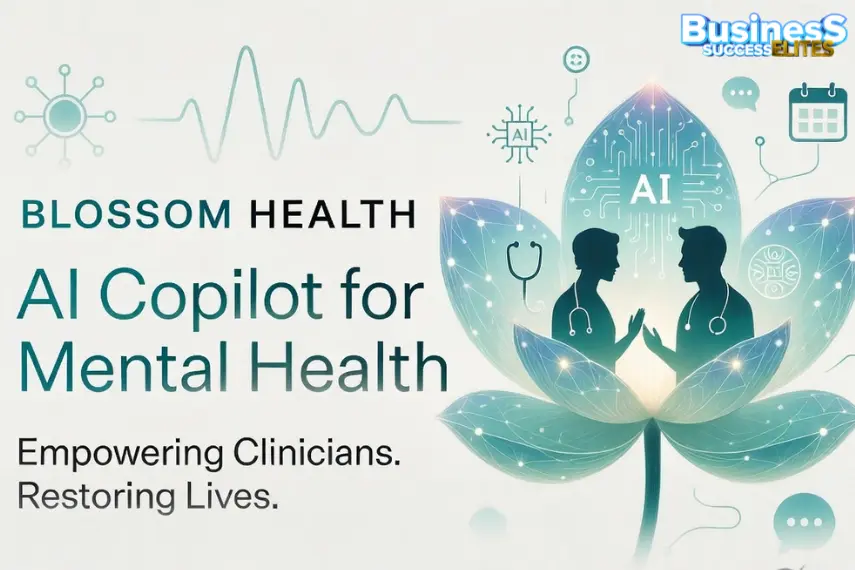
When John Zhao, founder of Blossom Health, an AI psychiatry startup mental health solution, started exploring healthcare technology nearly five years ago as product lead at Athelas, he noticed something troubling. Behind every successful healthcare operation were brilliant doctors, backed by armies of administrative staff drowning in paperwork. The irony deepened when he shifted his focus to mental health: the sector most burdened by a clinician shortage was simultaneously paralysed by administrative chaos.
“I watched clinicians spend 30 minutes on paperwork for every 30 minutes with patients,” Zhao recalls. “That’s not sustainable. That’s burnout waiting to happen.”
The numbers told an even grimmer story. Across America, mental health services faced an acute provider shortage. Psychiatrists, already in limited supply, were increasingly overwhelmed. Therapists juggled insurance forms, medication approvals, and scheduling—often working late into the evening just to handle the clerical load. Meanwhile, millions of Americans couldn’t access care within reasonable timeframes. The market wasn’t broken; it was fundamentally misaligned.
Most founders would have built another telehealth app. Zhao did something different. He asked clinicians what they actually needed.
That conversation shifted everything. Rather than launching with a polished product, Zhao spent months talking to psychiatrists about their actual workflow. What emerged wasn’t a consumer-facing app or a generic automation tool; it was Blossom Health, an “AI-native” operating system designed specifically for psychiatric practice.
The founding insight was elegant: instead of replacing doctors with AI (which nobody wanted), what if you empowered doctors with AI? By late 2024, the first version will be launched. The response was immediate.
Blossom built an all-in-one platform combining three critical components: clinical support tools powered by AI agents that assist with diagnosis, treatment planning, and medication selection; continuous patient engagement between sessions through AI-driven check-ins; and back-office automation that handles everything from insurance authorisation to billing, the unglamorous work that consumes 15+ hours from clinicians each week.
The patient experience reflected this care-first design, too. Through AI-assisted monitoring, a patient with postpartum depression didn’t wait a month for the next appointment. Instead, the system checked in through conversational text-based interactions, surfacing warning signs early and allowing clinicians to intervene proactively. Most patients were seen within 48 hours, often same-day.
“When we designed our tools, we didn’t create for scale. We created for care,” Zhao told investors during fundraising. “Everything else follows naturally.”
What separated Blossom from the usual healthcare startup playbook was execution speed. By partnering with Healthie, a clinical infrastructure platform, Blossom stood up functional virtual psychiatry services in just three months, an unusually fast timeline in healthcare where regulatory caution typically means years before patient one.
The team launched conservatively but deliberately. By October 2025, when the company emerged from stealth, Blossom had already proven something remarkable: hundreds of clinicians were willing to use the platform, and thousands of patients were getting faster, more attentive care.
Within months of emergence, word spread. Other clinics noticed their psychiatrists were happier. Burnout metrics improved. Provider satisfaction soared. Patients reported better outcomes because continuous monitoring caught problems earlier.
This wasn’t hype. It was evidence.
In March 2026, Blossom closed its first major funding round: $20 million in Series A financing led by Headline Ventures. The round included participation from Village Global, TA Ventures, Operator Partners, Correlation Ventures, and notably, operators from other healthcare companies (Flatiron Health, Sword Health, Zip, Elemy)—suggesting the startup had converted healthcare insiders into believers.
The metrics spoke louder than any pitch deck:
The company’s employee count remained lean: approximately 37 people as of early 2026, enabling ruthless focus on the core problem rather than expansion theatre.
Venture firms don’t deploy $20 million into year-old startups without reason. The investment thesis appeared straightforward on the surface but elegant in practice:
America’s mental health system faced a crisis rooted in economics and workflow, not disease. Most psychiatry practices operated inefficiently—not because clinicians were lazy, but because regulatory requirements, insurance navigation, and administrative burden had become the job. AI couldn’t replace judgment, but it could eliminate drudgery. If Blossom could demonstrate that AI-assisted psychiatry improves both access and clinician satisfaction, it could expand rapidly across a fragmented market eager for solutions.
The in-network insurance model proved crucial. Rather than targeting affluent patients willing to pay out-of-pocket, Blossom positioned itself as a cost-effective solution for major insurers. By reducing per-patient overhead through automation, the company could operate profitably at lower price points—exactly where market expansion happens.
Behind the metrics were stories. Patients with suicidal ideation are getting early intervention. Working parents with depression are accessing care the same day instead of waiting weeks. Psychiatrists practising medicine again instead of drowning in administrative drudgery.
One clinician noted in testimonials: “After a decade of training to care for people, I can finally do what I was called to do instead of being tied up with insurance paperwork.”
That’s not a startup pitch. That’s evidence of an actual problem getting solved.
Also read – Swish: The Late-Night Craving That Changed Everything
Blossom raised $20 million with a clear runway to expand beyond its initial markets. The infrastructure is proven, the economics work. The question now becomes how quickly Blossom can scale into underserved regions while maintaining the quality that made clinicians believe in the platform.
The mental health crisis won’t be solved by one startup. But Blossom Health demonstrated that thoughtful technology, built with clinical input and designed for workflow reality rather than venture fantasy, can move the needle materially in an entrenched market.
In a sector accustomed to failure, watching a young company actually improve patient outcomes while making clinicians’ lives measurably better is worth paying attention to. That’s not disruption theatre. That’s impact.
Japan, US Yen Intervention Signals Historic Currency Truce
August 3, 2026