Sat, Aug 15, 2026 -
Subscribe & never miss our best posts. Subscribe Now!
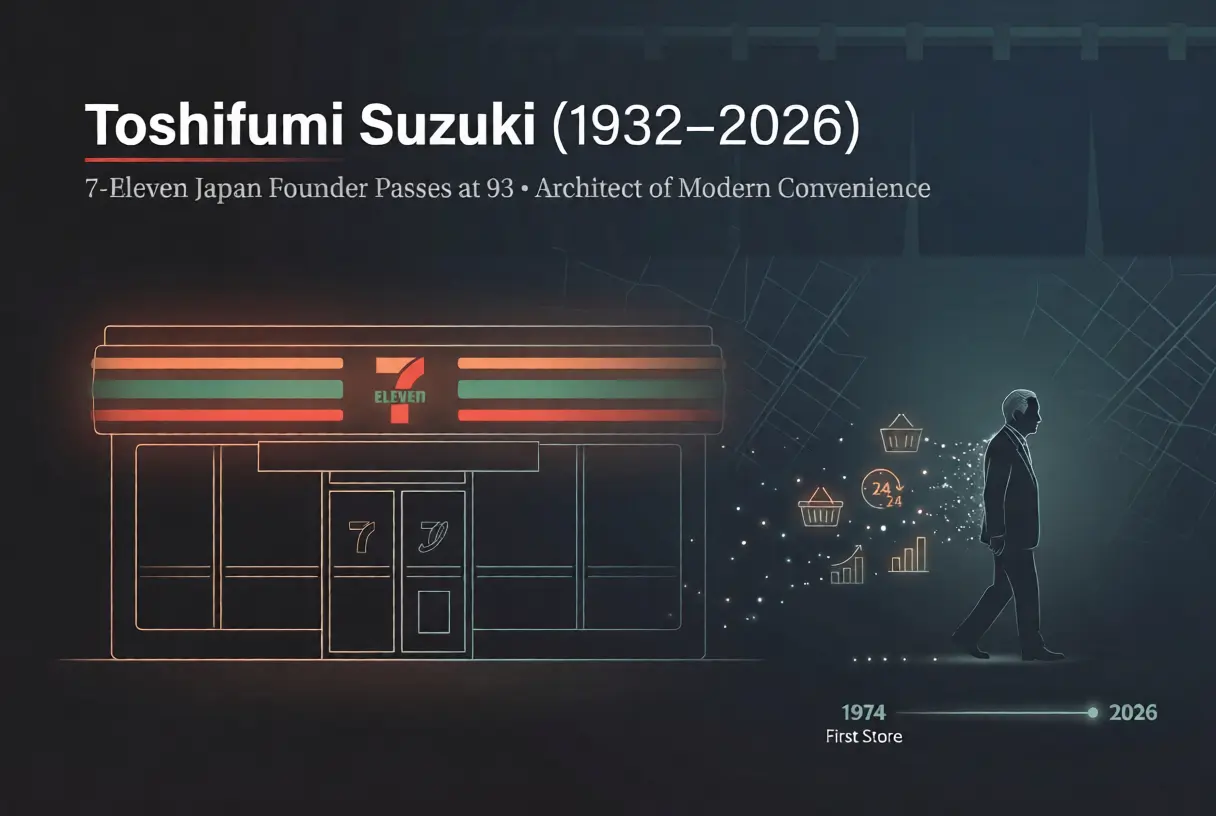
7-Eleven Japan founder Toshifumi Suzuki dies at 93, claimed by heart failure on May 18, according to Seven & i Holdings on Monday. The loss marks the end of an era for one of Asia’s most influential retail visionaries, a man who built convenience stores and fundamentally rewired how modern retail works.
To understand Suzuki’s death is to understand not merely the end of a lifespan, but the conclusion of a chapter that changed how millions of people shop, eat, and live their daily lives. Japan will feel his absence in ways that go far beyond boardrooms and balance sheets.
Toshifumi Suzuki was the pioneering retail executive who transformed Japan’s commercial landscape and built 7-Eleven into the world’s largest convenience store chain. But this description, while accurate, fails to capture what made him extraordinary.
Widely acclaimed as the father of Japan’s convenience store industry, Suzuki spearheaded a retail revolution that reshaped everyday life in Japan, turning convenience stores from small corner shops into an essential part of the country’s daily routine.
Think about what that means. Before Suzuki, Japan’s retail landscape was dominated by traditional mom-and-pop shops with limited hours and even more limited selection. Suzuki didn’t just introduce a concept, he fundamentally altered the rhythm of Japanese society.
Born on December 1, 1932, in Nagano Prefecture, Suzuki was the ninth of ten children of Jinshiro Suzuki, a dedicated public servant, and eventually served as the town’s mayor. His mother, Hisami, managed the family’s farm and ran a local silkworm business.
The Suzuki household was wealthy, but not indulgent. His mother was a disciplinarian who taught her children that “those who don’t work shall not eat”—the children would sweep the yard every morning before breakfast and were scolded for signs of laziness.
This upbringing planted seeds that would flourish decades later. Work ethic wasn’t just expected; it was foundational. The lesson would permeate everything Suzuki would eventually build.
After graduating from Chuo University in 1956 with a degree in economics and commerce, Suzuki joined Tokyo Shuppan Hanbai, a major book distributor. Suzuki joined retailer Ito-Yokado in 1963 after working at a book wholesaler.
Defying skepticism at the time, Suzuki partnered with Southland Corp, the US operator of 7-Eleven, to launch Seven-Eleven Japan in 1973, opening the first store in Tokyo the following year.
This wasn’t a straightforward decision. Suzuki founded Seven-Eleven Japan in 1973 and opened the country’s first 24-hour franchise outlet in Toyosu, Tokyo, in May 1974. In an era when Japan’s retail sector remained bound by tradition and convention, the idea of a 24-hour convenience store felt almost revolutionary, perhaps even reckless.
Yet Suzuki saw something others couldn’t. He understood that modern life didn’t follow traditional shop hours. People needed to eat, buy necessities, and handle errands at odd hours. The first store wasn’t just profitable; it was prophetic.
What truly separated Suzuki from other retail executives was his obsession with data, something that wouldn’t become fashionable in business until decades later.
He pioneered the use of data to tailor inventory and built a business model centered on ready-to-eat meals and rapid inventory turnover, helping transform convenience stores into a cornerstone of Japan’s retail landscape.
Perhaps his most forward-looking achievement was Seven-Eleven Japan’s integrated data systems, whose up-to-the-minute sales, customer, inventory, and supply-chain information dramatically improved productivity, profitability, and responsiveness to consumer needs.
Long before Silicon Valley startups were talking about artificial intelligence and consumer analytics, Suzuki was quietly building the infrastructure that would make modern retail possible. He didn’t use buzzwords—he used precision, observation, and relentless attention to what customers actually wanted.
By the 1990s, Suzuki’s vision had transcended Japan. Suzuki also led the successful restructuring and rescue of Southland in the early 1990s after the 7-Eleven parent filed for bankruptcy due to massive debt from a leveraged buyout.
This wasn’t simply financial maneuvering. Suzuki believed in the concept so firmly that when Southland, the original 7-Eleven parent company, faced existential crisis, he stepped in to save it. His confidence in the 24-hour convenience store model, a model he’d perfected in Japan—proved justified.
In September 2005, Suzuki launched Seven & i Holdings by integrating Seven-Eleven Japan, Ito-Yokado and Denny’s Japan Co., and assumed the posts of chairman and CEO. This consolidation created one of the world’s largest retail conglomerates.
But Suzuki’s ambitions didn’t stop at physical stores. In 1999, Ito-Yokado started selling online through a unit now known as Seven Net Shopping, and in 2001, Suzuki started a financial-services unit, now called Seven Bank Ltd, that gets most of its revenue from fees charged at ATMs inside 7-Eleven stores.
With prescient timing, Suzuki diversified before diversification became essential for survival. The modern 7-Eleven wasn’t just a place to buy snacks—it was a financial hub, a parcel delivery center, and a digital commerce node, all rolled into one neighborhood store.
What distinguished Suzuki from his peers was his personality. As a leader, Suzuki was known for defying the stereotype of the traditional, consensus-driven Japanese executive. He was notoriously demanding of his staff, famously urging them to constantly ‘adapt to change’ and ‘listen to the customer.’
This wasn’t softly-spoken instruction, this was relentless, almost fierce devotion to improvement. Suzuki didn’t accept complacency, didn’t tolerate mediocrity, and expected his team to feel the same urgency about customer needs that he did.
Yet his commitment to his vision never wavered. Even into his 80s, Suzuki regularly visited 7-Eleven stores on weekends to buy and inspect merchandise. He didn’t just theorise about retail from corner offices, he walked the aisles himself, observing how customers moved, what they bought, and what they left behind.
Read more – Overseas Travel Spending Indians Plummets 16% to $1.09 Billion in March: RBI Data Signals Downturn
Although Suzuki had a good relationship with Ito, the founder and major shareholder did not agree with Suzuki’s proposal in 2016 to replace the president of Seven-Eleven Japan. With the board also voting against the plan, Suzuki was forced to step down.
After more than four decades shaping retail strategy, this boardroom defeat must have stung. Yet even in stepping back, Suzuki remained an advisory presence at Seven & i Holdings, reflecting to his continuing influence even after formal power slipped away.
The scope of what Suzuki built remains staggering. Seven & I Holdings now operates over 83,000 stores worldwide, including 7-Eleven shops in 19 countries, about a quarter of them in Japan, and the Speedway convenience store chain in the United States.
But numbers don’t capture the essence of his legacy. Suzuki didn’t just create jobs or generate profits, he fundamentally altered how hundreds of millions of people structure their daily routines. The ubiquity of 24-hour convenience stores, now present in nearly every major city globally, represents the spread of his vision.
His approach, combining data analytics with obsessive attention to customer behavior, merging physical and digital commerce decades before anyone used the word “omnichannel,” and maintaining relentless focus on operational excellence, became a template that technology companies would later study and attempt to replicate.
In his memoir, Suzuki reflected on his journey with characteristic pragmatism: “I’ve been very lucky as a businessman, but I’ve always felt that luck is on the side of those who do everything they can to achieve their goals.”
There’s wisdom in that statement. Luck, in Suzuki’s formulation, wasn’t random chance, it was the intersection of preparation and opportunity. He prepared meticulously, stayed alert for opportunities, and then seized them with conviction.
Seven & i Holdings announced in its official corporate statement: ‘We would like to express our deepest gratitude for the kindness and support shown to him during his lifetime, and respectfully inform you of his passing.’
Toshifumi Suzuki’s death closes a remarkable chapter in retail history. He was 93 when he passed, having spent more than five decades reshaping his industry. His stores now line the streets of Tokyo, Bangkok, Singapore, and beyond, quiet monuments to his vision.
The next time you slip into a 7-Eleven at midnight to grab a hot meal, pay a utility bill, or withdraw cash, you’re experiencing the world that Toshifumi Suzuki built. That may be the most enduring legacy of all, not a company or a fortune, but a fundamental shift in how modern life actually works.
Rest in peace, Toshifumi Suzuki. The convenience store landscape and the daily lives of billions of people, will forever bear your imprint.
Kalpesh Chauhaan, COO, Arham Secure | Business Success Elites
August 14, 2026Demis Hassabis Exit Google DeepMind | BSE Report
August 14, 2026Video Marketing: Why Returns Are Falling in 2026
August 13, 2026Bank of America Jio Credit Deal: $1.9 Billion India Bet
August 13, 2026