Fri, Aug 14, 2026 -
Subscribe & never miss our best posts. Subscribe Now!
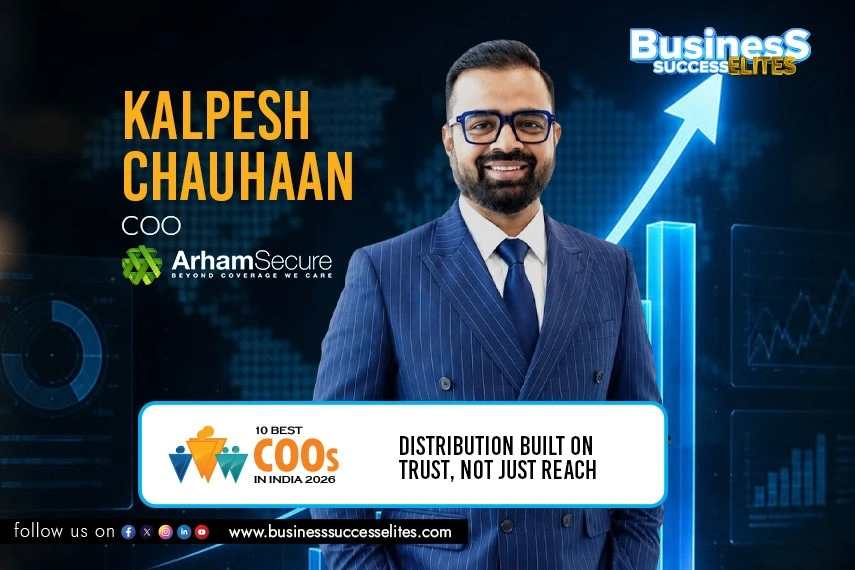
Distribution Built on Trust, Not Just Reach
In an industry where policies are sold on paper but bought on faith, few understand the distance between the two as intimately as Kalpesh Chauhaan, COO of Arham Secure. Across a career in insurance, distribution strategy, and corporate risk, he has built his reputation not on the fine print of coverage documents but on something harder to quantify: the confidence a client feels that someone will show up at the moment it matters most.
Now leading a business unit still writing its own playbook, Kalpesh brings a rare mix of humility and conviction, shaped partly by an early misstep that changed how he views enterprise risk. He speaks with Business Success Elites about distribution, the culture he is building from scratch, and how AI is redrawing his role without replacing the human at its center.
You bring experience across insurance, distribution strategy, and corporate risk. Which discipline has shaped your operating style the most?
Distribution strategy, without question. Insurance gives you product depth, and corporate risk gives you the discipline to stress test decisions, but distribution is where it all meets reality, real customers, real advisors, real market friction. It forces you to think in terms of reach and repeatability rather than theory.
At its core, distribution is a people business. Finding the right people and genuinely empowering them to decide separates a network that scales from one dependent on a few individuals. You cannot be everywhere, so the real work is building teams you trust and giving them room to deliver.
Standing up a new division means building a culture from scratch. What are you deliberately trying to create at Arham Secure?
A culture of ownership and trust, where people feel accountable for outcomes, not just tasks. A new division offers a rare chance to set the defaults, so I hire for attitude and integrity first, skills second, because skills can be taught but character cannot.
I want a team that stays close to the customer and advisor, treats problems as its own, and raises issues early. Insurance is ultimately about trust; if we are not transparent internally, we cannot ask clients to trust us with their financial security. The culture rests on three pillars, ownership, transparency, and service.
Corporate insurance and enterprise risk are relationship-heavy businesses. What early misstep reshaped your approach?
I over indexed on the technical strength of a proposal, the pricing, the coverage structure, the fine print, and assumed the best designed solution would naturally win. I lost a large corporate account despite what I believed was a superior program, and it forced an uncomfortable realisation: the client was not buying a policy, they were buying confidence in the people who would stand by them at the moment of a claim.
The incumbent broker had spent years embedded with the client’s CFO and risk team, with a track record of showing up when something went wrong. I had a better spreadsheet; they had a better relationship, and that trust is the actual product a broker sells.
That lesson reshaped my approach in three ways. I stopped leading with products and started with discovery. I began building relationships across the organisation, not just the buyer. And I learned to sell the claims experience as hard as the coverage, since that is what clients remember.
How is technology, from direct to enterprise platforms to AI driven underwriting, changing what a broking COO’s job looks like?
It is reshaping the mechanics, not the essence. My job used to be heavily about throughput, processing, placement, servicing, and AI and platforms are steadily absorbing that load. Direct to enterprise platforms compress the transaction, embedded insurance moves cover to the point of need, and AI driven underwriting delivers risk insight in hours that once took weeks.
But we are still in an era where people need a face. Insurance is bought in moments of uncertainty and tested in moments of loss, and no algorithm has replaced the reassurance of a person who will stand by you at the claim. The modern broking COO’s job is orchestrating that balance, letting technology do what it does best while elevating the human touch that matters most.
What advice would you give someone entering operations leadership at a new venture inside an established group?
Respect the paradox you are standing in. You have a startup’s freedom but an established group’s backing and expectations. Move fast, build your own defaults, but do not burn the credibility you have been handed; goodwill is capital, spend it wisely.
Get clarity on what success looks like and align it with leadership early. Invest in people before the process, hiring slowly for attitude and empowering them hard. Protect focus ruthlessly, since a new division gets pulled in every direction, and saying no to good ideas is what lets you win at the few that matter. Build bridges, not walls, leveraging the parent group’s strengths, and stay honest about what is not working.
Stay close to the customer. The venture exists because there is a client problem worth solving, and that is where real learning happens.
Kalpesh Chauhaan, COO, Arham Secure | Business Success Elites
August 14, 2026Demis Hassabis Exit Google DeepMind | BSE Report
August 14, 2026Video Marketing: Why Returns Are Falling in 2026
August 13, 2026Bank of America Jio Credit Deal: $1.9 Billion India Bet
August 13, 2026