Sat, Aug 15, 2026 -
Subscribe & never miss our best posts. Subscribe Now!
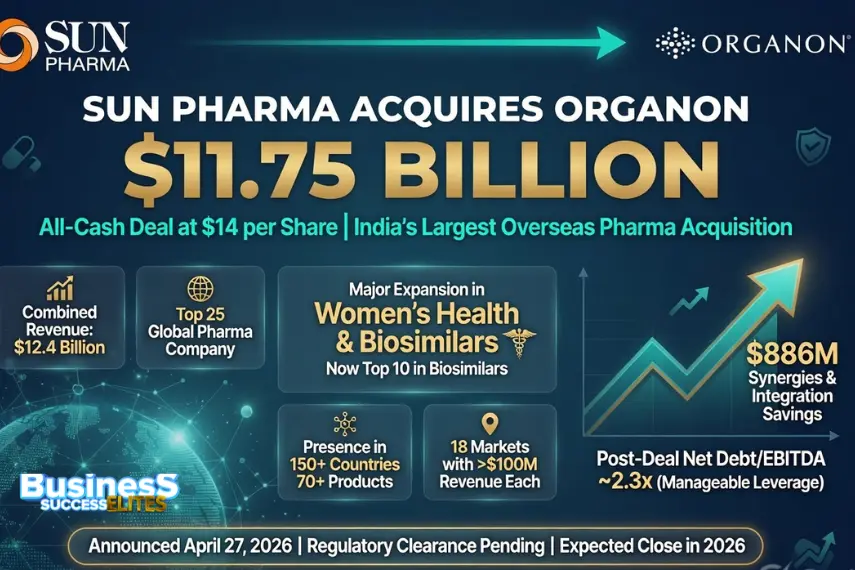
Sun Pharma acquires Organon in a $11.75 billion all-cash deal, and just like that, Indian pharma found itself playing in a different league.
The deal, announced on April 27, 2026, sees Sun Pharmaceutical Industries sweeping up New Jersey-based Organon & Co. at $14 per share. Both companies’ boards have signed off. Regulatory approvals and an Organon shareholder vote are the last hurdles before the transaction closes, and most expect those to go through without serious drama.
Organon is not a household name outside of healthcare circles, but in the pharmaceutical world, it carries real weight. Spun off from Merck (MSD outside the US) back in 2021, the company carved out a niche across women’s health and biosimilars. The company is selling more than 70 products in 140 countries. In 2025, it posted revenues of $6.2 billion and an Adjusted EBITDA of $1.9 billion, solid numbers for a company that the market had been valuing at a significant discount.
That discount was partly driven by Organon’s heavy $8.6 billion debt load, which made buyers nervous. Sun Pharma clearly ran the numbers and decided the underlying business was worth the baggage.
The deal gives Sun Pharma something it has been quietly building toward for years. For the company, it’s a serious foothold in women’s health, entry into biosimilars at a real scale, and sharply higher exposure to developed markets like the US, Europe, and Canada. These are the markets where margins are structurally better than in generics-heavy emerging economies.
The combined company will be a different animal from what Sun Pharma is today.
Combined revenues are projected at around $12.4 billion, enough to place the entity comfortably among the top 25 pharmaceutical companies globally. The group will operate across 150 countries, with 18 individual markets each contributing over $100 million in annual revenue. That kind of geographic diversification is genuinely hard to build organically; it typically takes decades.
The share of innovative medicines in Sun Pharma’s revenue mix climbs from 20% to 27%. That matters because innovative medicines, drugs with active substances that haven’t been authorised before, command stronger pricing power. Also, they are far more defensible against generic competition. Sun Pharma already has products in dermatology, ophthalmology, and onco-dermatology. Organon expands the canvas considerably.
And in biosimilars, a segment where Sun Pharma had minimal presence, the company moves into the global top 10 in one transaction. Given that dozens of major biologics are set to lose patent protection over the next decade, this is arguably the most strategically valuable piece of the deal.
The one thing analysts keep coming back to is leverage. Post-transaction, the combined net debt to EBITDA sits at approximately 2.3 times. That is manageable, but it is nothing, and it leaves Sun Pharma with less room for error than it had before.
Sun Pharma plans to fund the deal through a mix of internal cash and committed financing from Citigroup, JPMorgan Chase Bank, and MUFG Bank. Macquarie analysts, who have an outperform rating on the stock, believe the company can return to a near-debt-free position within three to four years. That timeline will be watched closely.
Also read = Paramount Warner Bros Merger Approved: Shareholders Say Yes, But Reject Zaslav’s $887M Payday
Sun Pharma shares fell ahead of the official announcement, dropping over 3% when deal rumours began circulating, before bouncing back sharply, gaining as much as 7% on the day the deal was confirmed. Organon’s stock had surged roughly 31% the Friday before closing, after the Economic Times reported the deal was imminent at around $13 billion. The final $11.75 billion price came in below that, which partly explains why Sun Pharma investors breathed a little easier.
Dilip Shanghvi, Sun Pharma’s Executive Chairman, called it an opportunity to build “a stronger and more diversified platform.” Managing Director Kirti Ganorkar was more direct; he called it “a logical next step.”
On the Organon side, Executive Chair Carrie Cox said the board ran a full review of alternatives before concluding this deal offered the best outcome for stockholders.
There will be integration challenges ahead; there always are with deals of this magnitude. But if Sun Pharma pulls it off, this acquisition could define Indian pharma’s global standing for the next generation.
Kalpesh Chauhaan, COO, Arham Secure | Business Success Elites
August 14, 2026Demis Hassabis Exit Google DeepMind | BSE Report
August 14, 2026Video Marketing: Why Returns Are Falling in 2026
August 13, 2026Bank of America Jio Credit Deal: $1.9 Billion India Bet
August 13, 2026