Sat, Aug 15, 2026 -
Subscribe & never miss our best posts. Subscribe Now!
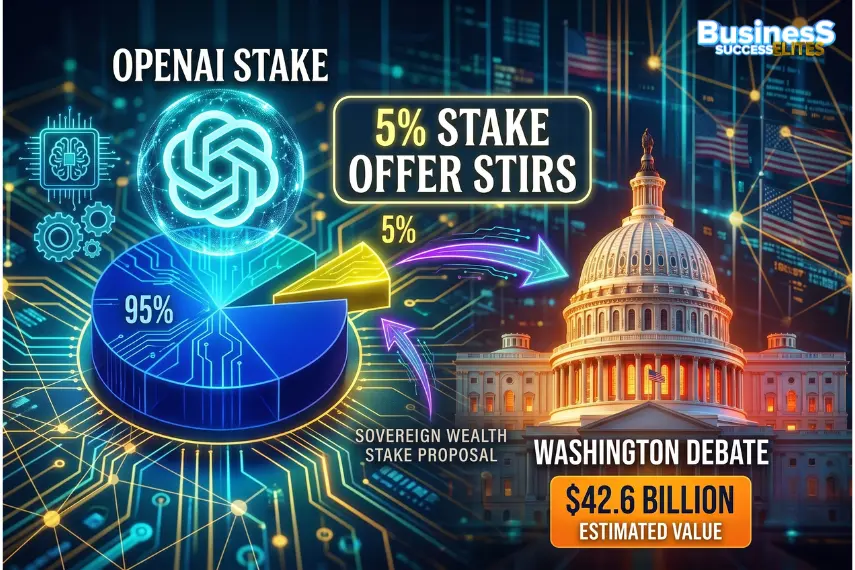
An OpenAI 5% stake in the hands of the US government sounds like the plot of a Silicon Valley satire, except this one is playing out in real boardrooms and, apparently, in Donald Trump’s inner circle. According to a Financial Times report that broke Thursday, Sam Altman has been quietly floating the idea with the White House for months, and the number being discussed is a tidy 5% cut of OpenAI’s equity.
Do the maths and that stake would be worth roughly $42.6 billion, going by the eye-watering $852 billion valuation OpenAI locked in during its March funding round. That’s not pocket change, even for a government that recently walked away with a chunk of Intel.
Here’s the twist, though. Altman isn’t just offering up OpenAI’s own shares. Per the FT’s sources, he’s pitching a broader structure where America’s biggest AI players, think Anthropic, Google, and Meta, would each hand over a similar slice to a sovereign wealth vehicle. The comparison being thrown around is the Alaska Permanent Fund, that decades-old setup where Alaskans get an annual cheque from the state’s oil wealth. Swap oil for AI chips, and you get the gist of what’s being proposed.
Reportedly, Altman has taken this pitch directly to President Trump, Commerce Secretary Howard Lutnick, and Treasury Secretary Scott Bessent. He’s also apparently spoken with Senator Bernie Sanders, who, incidentally, has his own competing idea floating around Congress, a bill proposing 50% public ownership of US AI firms alongside $1,000 direct dividends to citizens. So clearly, the appetite in Washington for a piece of the AI pie isn’t limited to one party.
Whether any of this actually happens is a different story altogether. Sources describe the talks as “conceptual” and still in early days, and there’s a fairly obvious catch: any such arrangement would likely need an act of Congress to become real. That’s no small hurdle in an election-adjacent political climate.
It’s also worth asking why OpenAI would volunteer nearly $43 billion of its own value. Cynics might say this is less about generosity and more about staying on the right side of a government that’s been leaning harder on AI companies lately. Just days before this report surfaced, OpenAI reportedly delayed the full rollout of GPT-5.6 after Washington asked it to hold off. Anthropic, for its part, had its Claude Fable 5 and Mythos 5 models pulled offline worldwide last month under fresh export control rules, the first time such restrictions have targeted an AI model rather than hardware. Access was only restored this week.
Against that backdrop, offering the government a seat at the table, quite literally through equity, looks like a savvy way to smooth things over. It wouldn’t be the first time Washington has taken a direct stake in a major tech or industrial player, either. The government already holds close to 10% of Intel after converting CHIPS Act grants into stock last August, and both Nvidia and AMD agreed to hand over 15% of their China chip revenue in exchange for export licences.
Notably, not everyone is convinced this is a good look. Reuters reported that the Trump administration and Anthropic haven’t even discussed a stake, suggesting the idea, at least for now, is very much an OpenAI-led initiative rather than an industry-wide consensus. And on the investor side, reactions have been mixed. Tusk Ventures’ CEO reportedly called the whole plan borderline nonsensical, while others on Wall Street see it as a shrewd hedge against regulatory friction.
There’s also the small matter of timing. OpenAI confidentially filed draft IPO paperwork with the SEC back in June, and word is advisers are already weighing whether to push that listing out to 2027. Locking in a government stake before any public float would fix Washington’s position early, before a wider shareholder base complicates the picture.
For now, nothing is signed, sealed, or delivered. But if this OpenAI 5% stake proposal does go anywhere, it could reshape how Washington relates to the AI industry, which has been trying to both nurture and rein in at the same time.
Kalpesh Chauhaan, COO, Arham Secure | Business Success Elites
August 14, 2026Demis Hassabis Exit Google DeepMind | BSE Report
August 14, 2026Video Marketing: Why Returns Are Falling in 2026
August 13, 2026Bank of America Jio Credit Deal: $1.9 Billion India Bet
August 13, 2026