Sat, Aug 15, 2026 -
Subscribe & never miss our best posts. Subscribe Now!
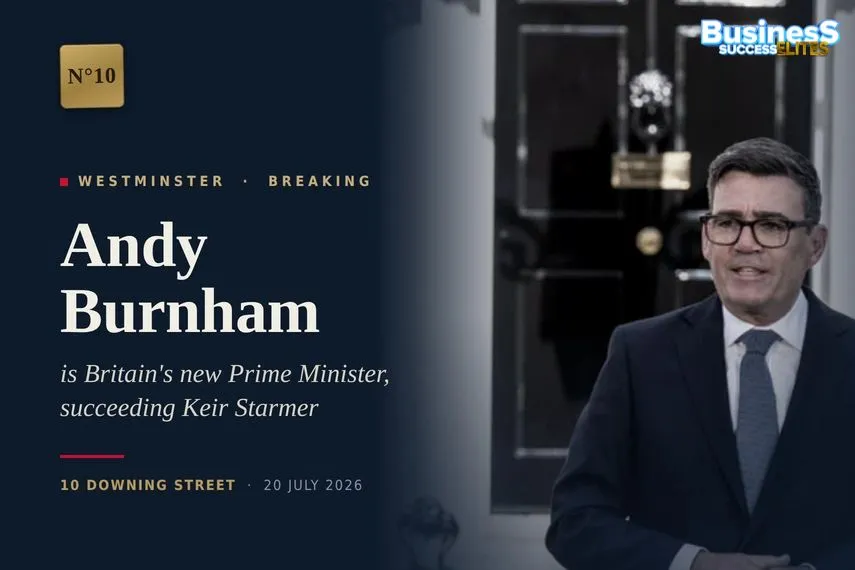
Andy Burnham is Britain’s new Prime Minister. He took charge on Monday, and the handover already feels routine. After all, he’s the seventh person to walk through the door of 10 Downing Street in just a decade.
He replaces Keir Starmer, whose exit comes barely two years after Labour’s landslide election win. So how did Britain get here again, so soon?
Monday followed a script the country now knows by heart. First, Starmer gave a farewell speech outside his official residence. “My work is done,” he told the country, before heading to Buckingham Palace to resign.
Next, Burnham met King Charles III in the ceremonial audience known as “kissing hands.” There, the King formally asked him to form a government. Finally, Burnham made the short drive back to Downing Street for his first speech as premier.
He called the moment a “circuit breaker” for a country he says has drifted off course since the 1980s.
Starmer had announced his resignation as Labour leader on June 22. Two years of missteps had worn him down, and poll numbers kept sliding as Reform UK pulled ahead. Then, disastrous local election results in May proved to be the final straw.
Burnham ran unopposed. As a result, he was declared Labour’s new leader on Friday, backed by 379 of 403 Labour MPs.
His path back to frontline politics is unusual, though. Consider the timeline:
That northern base is exactly where his nickname comes from: “King of the North.”
Burnham wasted no time reshaping his top team. Ed Miliband now takes over as foreign secretary, replacing Yvette Cooper. Meanwhile, John Healey moves into the Treasury as finance minister. Shabana Mahmood, however, stays on as home secretary, one of the few holdovers from Starmer’s line-up.
Beyond Britain, the reception was mixed almost immediately. Markets registered some unease: gilt yields climbed, and the pound slipped as traders priced in a leader seen as further to the left than his predecessor.
Across the Atlantic, the friction was even sharper. President Trump wasted no time weighing in, dismissing Britain as a “poverty-stricken disaster” within hours of Burnham taking office. It was hardly the warmest welcome for a government trying to project stability.
So far, Burnham has framed his premiership around everyday economic pain, not grand ideology. He says cost-of-living measures will follow as early as Tuesday. Among his stated priorities:
Still, big questions remain. Can any of this survive a sluggish economy, a cost-of-living squeeze worsened by wars in Ukraine and the Middle East, and public services stretched thin?
Burnham himself seems aware of the stakes. His generation of politicians, he told supporters, needs to “raise our game.” In other words, hope alone won’t keep him in the job longer than the six men who came before him.
Kalpesh Chauhaan, COO, Arham Secure | Business Success Elites
August 14, 2026Demis Hassabis Exit Google DeepMind | BSE Report
August 14, 2026Video Marketing: Why Returns Are Falling in 2026
August 13, 2026Bank of America Jio Credit Deal: $1.9 Billion India Bet
August 13, 2026