Sat, Aug 8, 2026 -
Subscribe & never miss our best posts. Subscribe Now!
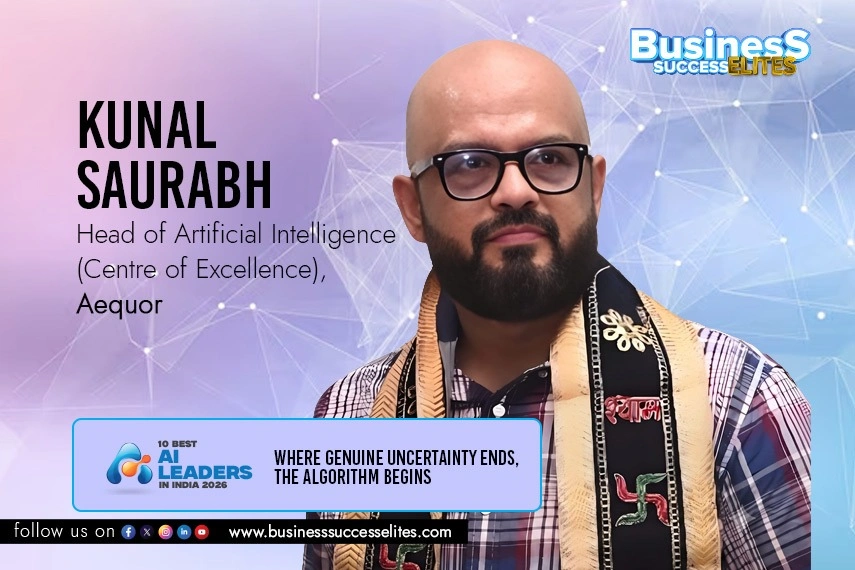
Where Genuine Uncertainty Ends, the Algorithm Begins
Some careers begin in glass towers. Kunal Saurabh began nearly a kilometre below the earth’s surface, in the sealed-off tunnels of Indian coal mines, where a wrong sensor reading could cost a human life. It is an unlikely origin story for a man who now leads Aequor‘s AI Center of Excellence in India, building agentic systems that move healthcare professionals from paperwork to patient care. In this conversation, Saurabh traces the arc from underground field engineer to enterprise AI leader, and explains why the best AI system, in his words, is invisible infrastructure that quietly gets essential people where they are needed.
My entry into AI did not happen in a corporate lab; it happened underground, and almost by accident. I started as a project assistant at CSIR-CIMFR, under Dr. S. K. Chaulya, my professional mentor, and Dr. Rajshekhar, who guided me through everything else. I was an electronics engineer building IoT solutions for a mining company in Dhanbad, and we had gathered mountains of mining data with no clear purpose for it. One day, Dr. Chaulya simply asked what we could actually do with that data. I was reluctant at first, but it was that question, and Dr. Rajshekhar’s push to answer it, that set everything in motion. Over the next five years, I built gas-concentration prediction for sealed-off areas, vision-improvement devices for near-zero-visibility conditions, and dust-suppression systems for air quality, in an environment where a wrong reading is not a bad dashboard metric; it can cost a life. The defining moment came when our deep-learning model predicted gas concentration in a sealed-off mine section, work we later published in Soft Computing. That was when AI stopped being a technology for me and became a responsibility, a debt I still owe to the two men who first asked me the right question, and a principle that runs through everything I have built since, from a granted US patent for real-time driver monitoring to enterprise agentic systems.
The arc has three chapters: research and field engineering at CSIR-CIMFR, learning to build AI that survives dust, heat, and real physics, where our patents became commercialised devices, not paperwork; enterprise scale, at HCL and then Pyramid Consulting, moving from single-purpose models to platforms, including multimodal RAG for BFSI and insurance, GAN-based synthetic medical imaging, and a driver-monitoring system granted as US Patent 12,450,924 B2; and leadership, building Aequor’s AI CoE in India from the ground up. The pivot that mattered most was the shift into generative and agentic AI, from building models to building systems that make decisions. That shift changed the question from how accurate is my model to can I trust this system to act.
Deliberately unglamorous. Before writing a single agent, I wrote the rules. We handle HIPAA-sensitive credential data for US healthcare and special-education staffing, so the CoE began with governance: data-privacy controls, PII-redacted audit logging, role-based access, and a production-guardrails standard covering source grounding, prompt-injection safety, write-guards, and cost controls. Second, I codified an engineering doctrine that still governs everything we ship: use an LLM only where genuine uncertainty exists, deterministic Python everywhere else. Third, I picked one flagship problem, credentialing, because it was painful, document-heavy, and measurable, and designed it human-in-the-loop from the start.
Four filters: the uncertainty test, since hype chasing usually begins with a language model where an if-statement belongs; measurability, a baseline number we intend to move, as with our special-education lead-enrichment pipeline, which replaced a manual baseline of 20 to 30 records a week against roughly 17,000 US school districts; tolerance for review, favouring cases where a human can verify output faster than produce it; and the failure question, what happens when the AI is wrong. If that answer is unacceptable, the use case needs a gate, not a green light. Hype chasing optimises for the demo; real use cases optimise for the eleventh month, when only the numbers remain.
AequorAI, our multi-agent credentialing automation pipeline, is still very much a work in progress. It is a nine-stage agentic system covering intake, credentialer assignment, requirement mapping, document reconciliation, gate validation, communication, order management, and submission, integrated with Bullhorn ATS and nine VMS portals. Two design choices stand out. The first is a GPT-4o vision reconciliation engine that reads every credential document, verifying holder name, issuer, and dates against the assignment window, and assigns a deterministic 0 to 100 confidence score; that took document-type mismatches from five to zero on our validation set. The second is a verify-and-repair pattern with a human-in-the-loop review cockpit, where reviewer corrections are captured in an audited ledger and become training data. It matters most because every day shaved off credentialing is a nurse reaching a ward, or a special-education professional reaching a classroom, sooner.
Sales Automation: The Data Behind the 2026 Shift
August 7, 202610 Best AI Leaders in India 2026
August 6, 2026RBI Repo Rate Steady At 5.25%: What It Means For You
August 6, 2026