Sat, Aug 15, 2026 -
Subscribe & never miss our best posts. Subscribe Now!
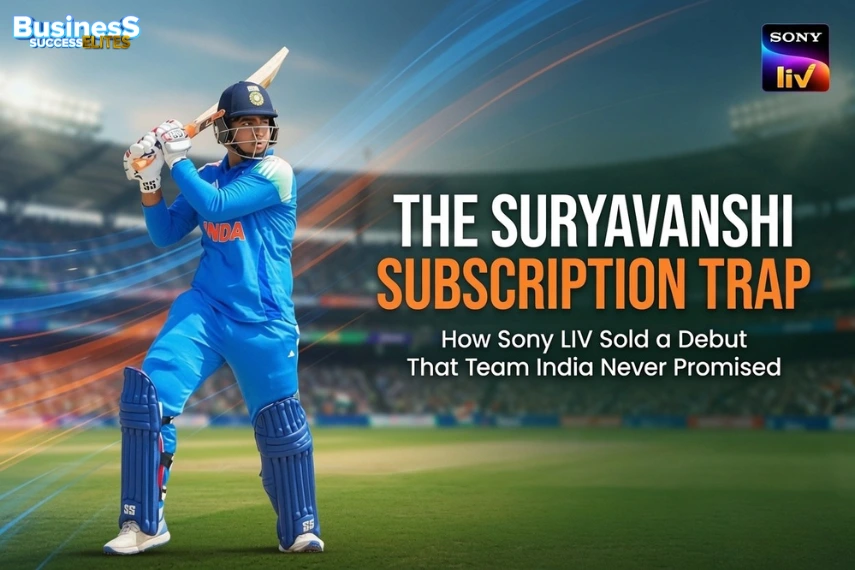
How Sony LIV Sold a Debut That Team India Never Promised
The marketing pitch was irresistible. A 15-year-old boy wondered, fresh off an IPL season for the ages, standing on the threshold of becoming India’s youngest-ever international cricketer. All you had to do was subscribe to Sony LIV, because that, and only that, was where history was going to happen.
Except, as it turned out, history had other plans. And so did Gautam Gambhir.
When the first India vs Ireland T20I kicked off in Belfast on June 26, Vaibhav Sooryavanshi didn’t get the chance to make his debut. Millions of fans who had paid up for a Sony LIV subscription, many of them teenagers who had never subscribed to a streaming service in their lives, stared at their phones waiting for the moment that never came. The 15-year-old sat in the dugout, tracksuit on, cap pulled low, watching senior players bat India to a 34-run defeat against a side ranked considerably below them in the ICC pecking order.
It was, by any honest reckoning, one of the more brazen acts of subscription-bait in the recent history of Indian sports broadcasting.
Sony Pictures Networks India had officially secured the exclusive television and digital broadcasting rights for the India tour of Ireland 2026. For a broadcaster, a two-match bilateral series against Ireland, a cricket nation that barely registers on India’s prime-time radar, is ordinarily a hard sell. The inventory is thin, the audience is niche, and advertisers generally treat such properties as filler between marquee events.
Not this time.
According to Akshay Agrawal, Head of Linear Ad Sales at Sony Pictures Networks India, speaking to Adgully: “With Vaibhav Suryavanshi expected to make his India debut in Ireland, the series is generating tremendous excitement among viewers as well as advertisers.” The word “expected” is doing a lot of heavy lifting in that sentence, functioning less as a journalistic caveat and more as a marketing guarantee.
Sony had already onboarded brands including Amazon, Kamla Pasand, Fogg, Puro, and Roff for the India-Ireland T20I series, reflecting advertiser confidence in even a short-duration bilateral property. Over 50% of brands reportedly bought India-Ireland and India-England packages together “because they don’t want to miss out on the excitement around Vaibhav Suryavanshi’s expected debut.”
The broadcaster was not quietly hoping for a debut. It was actively selling one. Sony Sports Network’s official Twitter handle posted a video of Sooryavanshi training with the senior squad, captioned: “Vaibhav Sooryavanshi in full preparation mode. A senior team debut just around the corner. Watch the Ruthless Boss Baby in action in the 1st T20I, tomorrow at 5:30 PM, LIVE on Sony Sports Network & Sony LIV.”
That tweet was posted on June 25, 2026, one day before the match. One day before Sooryavanshi sat in the dugout and watched.
The Indian team management, it turns out, was operating on an entirely different frequency from the Sony marketing department.
At the toss, captain Shreyas Iyer said clearly that Sooryavanshi is a very talented player, but the team did not want to change a winning combination. He said India’s experienced players had done well in recent matches and would be backed again. Batting coach Sitanshu Kotak reinforced the point before the match, saying that players who are already scoring runs should not be dropped just to give someone a debut, calling it a “thin line” between giving chances and being unfair to other players who are performing well.
The management did not want to disturb the combination that had fetched India the T20 World Cup 2026 only a few months back. In other words, the team was thinking about cricket. Sony was thinking about clicks.
This is the structural problem at the heart of the controversy. A broadcaster sold a product, Vaibhav Sooryavanshi’s international debut, that it did not own and could not guarantee. The BCCI selects squads. Team management picks the playing XI. Sony LIV streams the match. These are three separate entities with three separate mandates. Only one of them was running a Suryavanshi debut campaign, and it was the one with the least authority to deliver it.
As per a report by Media Research Users Council (MRUC) and the Broadcast Audience Research Council (BARC), Indian cricket delivers some of the highest digital subscription conversion rates in the world during high-interest series. The Suryavanshi debut narrative was not merely marketing fluff; it was a measurable driver of subscription revenue for Sony LIV in the days leading up to June 26.
The irony, of course, is that Ireland, the team Sony was using as a backdrop for its subscription pitch, had no interest in being anyone’s backdrop. Ireland captain Lorcan Tucker set the foundation for a 34-run win against India in the opening T20I in Belfast. In the embarrassment that followed, the Suryavanshi debate went from “should Sony have hyped this more?” to “should Sony be held accountable for hyping it at all?”
The defeat intensified the spotlight: Shreyas Iyer’s reign as T20I captain began with a chastening loss, and the clamour for teenage sensation Sooryavanshi to be unleashed grew louder after India’s batting collapsed.
Sony LIV, in a masterclass of unintended consequences, had created a situation where its own subscription pitch was now being used as an argument by fans demanding that the team management correct its selection error.
The second T20I against Ireland was broadcast on Sony Sports Network and streamed live on the Sony LIV app and website. The match saw T20I debuts for Prince Yadav and Suryansh Shedge, neither of whom had been the subject of a single Sony marketing tweet. Sooryavanshi, once again, waited.
The message from team management was unmistakable: the debut will happen on India’s terms, not the broadcaster’s editorial calendar.
What happened with Sooryavanshi and Sony LIV is not unique to this series. It reflects a broader tension in Indian sports broadcasting, where OTT platforms, under intense pressure to grow paid subscriber bases, increasingly treat selection speculation as a monetisable commodity.
As per a report by the Internet and Mobile Association of India (IAMAI), India’s OTT market is projected to cross ₹25,000 crore by 2027, with live sports accounting for the fastest-growing segment of paid subscriptions. In this environment, the temptation for broadcasters to blur the line between “expected to debut” and “will debut” is enormous, and the regulatory framework to police it is virtually non-existent.
The Advertising Standards Council of India (ASCI) has guidelines around misleading advertisements. Whether Sony LIV’s pre-series campaign constitutes a violation is a question that no one in the cricket establishment appears eager to ask, publicly, at least.
Meanwhile, somewhere in Belfast, a 15-year-old boy is still waiting to bat for India. The hype, for once, is not his fault.
Kalpesh Chauhaan, COO, Arham Secure | Business Success Elites
August 14, 2026Demis Hassabis Exit Google DeepMind | BSE Report
August 14, 2026Video Marketing: Why Returns Are Falling in 2026
August 13, 2026Bank of America Jio Credit Deal: $1.9 Billion India Bet
August 13, 2026