Tue, Jul 21, 2026 -
Subscribe & never miss our best posts. Subscribe Now!
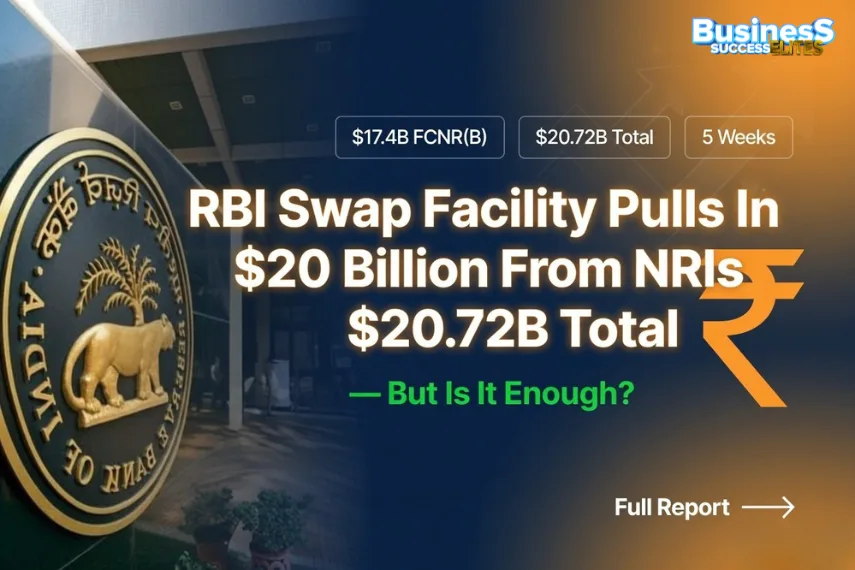
The RBI swap facility has crossed the $20 billion mark, and the central bank wants everyone to know it worked. Data released on Monday puts the total at $20.718 billion mobilised as of July 17, just over five weeks since the window opened for business. For a scheme that some traders had already started writing off as a slow starter, that’s a number worth pausing on.
Here’s the breakdown. Of the $20.72 billion, a lion’s share, $17.406 billion, came through fresh FCNR(B) deposits, the foreign currency accounts non-resident Indians use to park money back home without worrying about rupee volatility eating into their returns. Overseas Foreign Currency Borrowings added another $1.97 billion, and External Commercial Borrowings brought in $1.34 billion. The RBI first announced the measures on June 5 and switched the window on three days later, on June 8.
To put this in context: the facility for fresh FCNR(B) deposits stays open until September 30, while the ECB and OFCB windows run until the end of December. That leaves roughly ten more weeks for the deposit scheme to do its heavy lifting, and banks are betting on a last-mile sprint. State-run lenders have quietly pencilled in estimates closer to $30 billion by the time the window shuts, according to bankers who spoke to news agencies on condition of anonymity. The finance ministry, for its part, has gone a step further and handed out mobilisation targets directly to public sector banks, a sign of how much political capital is riding on this number climbing higher.
The pitch to the diaspora is straightforward: park your dollars in an FCNR(B) deposit, and banks, freed from the usual interest rate ceiling under this scheme, can offer rates that put regular fixed deposits to shame. Some private lenders in GIFT City have gone further still, layering leverage products on top of these deposits so that NRIs willing to take on more risk can chase returns north of 40% annualised. HSBC and Standard Chartered have both jumped into this leveraged-deposit race, competing hard against SBI and other domestic players for diaspora dollars flowing in from Singapore, Hong Kong, West Asia, the UK and the US.
Not every market voice is cheering. Veteran investor Shankar Sharma has been among the more vocal sceptics, arguing publicly that the scheme mostly buys the rupee time rather than fixing what’s pulling it down in the first place, namely, persistent foreign institutional investor outflows from Indian equities and debt. His argument, echoed by a few economists, is that swapping in NRI dollars papers over the cracks without addressing why foreign funds keep heading for the exits.
There’s also a gap between promise and delivery worth flagging. When the scheme was unveiled in June, early chatter around trading desks put the potential haul as high as $70 billion, with at least one bank economist suggesting $50 billion was realistic. At $20.72 billion five weeks in, the pace has cooled expectations considerably, even if bankers insist the real rush typically comes in the final weeks before a deadline, as depositors race to lock in rates before the window closes.
This isn’t the RBI’s first rodeo with this exact tool. Back in 2013, under then-governor Raghuram Rajan, the central bank ran an almost identical FCNR(B) swap window to defend a rupee that had crashed past 68 to the dollar amid a broader emerging-market selloff. That scheme, open for three months, eventually raised close to $34 billion and is still remembered as one of the more effective firefighting moves in the RBI’s recent history. The parallels this time are hard to miss: a currency under pressure from external shocks, in this case, elevated oil prices and steady FII selling, and a central bank reaching for the same NRI-deposit lever that worked once before.
Whether history repeats itself depends largely on what happens between now and September 30. Banks say interest from NRIs is real and growing, not manufactured, and that FCNR(B) collections tend to be lumpy, quiet for weeks, then a flood as the deadline nears. The RBI, meanwhile, has kept its tone upbeat, describing the response so far as steady and consistent since the June 8 launch. For a rupee that has spent much of this year fighting to hold its ground, $20 billion is a meaningful cushion. Whether it’s enough of one is the question the next ten weeks will answer.
Hyundai EV Charging Points Hit 30,000+ On myHyundai
July 20, 2026Lamine Yamal Completes Football, Argentina Fail Messi
July 20, 2026