Mon, Aug 10, 2026 -
Subscribe & never miss our best posts. Subscribe Now!
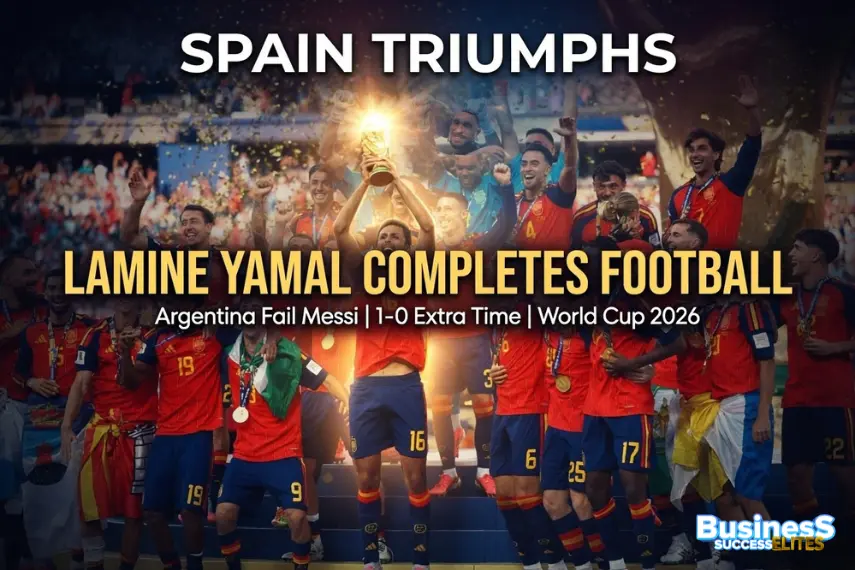
Lamine Yamal completes football. That is the phrase doing the rounds after Spain’s 1-0 extra-time win over Argentina in Sunday’s World Cup final, and it is hard to argue with it. At 19 years and six days old, the Barcelona forward has now won a European Championship and a World Cup before most footballers have even settled into a first-team squad.
The final itself, played in front of a raucous crowd at MetLife Stadium in New Jersey, was tense, scrappy, and ultimately decided by one moment of Argentine indiscipline. Enzo Fernández picked up a second yellow card in the third minute of stoppage time for a reckless foul on Pau Cubarsí. That sent Argentina into extra time with ten men, and Spain made them pay.
Ferran Torres, on as a 62nd-minute substitute, struck from close range in the 106th minute to settle it. He had barely 20 minutes on the pitch when he became a World Cup winner. “The goal belonged to 47 million people,” he said afterwards, and few Spaniards would disagree.
Argentina’s night, though, unravelled well before that goal went in. Tempers frayed after halftime when Leandro Paredes shoved Rodri to the turf without the ball anywhere near them, drawing a yellow card and setting the tone for a bad-tempered second half. By full time, remarkably, Argentina had not managed a single shot. Emiliano Martínez kept them in the game almost single-handedly, making 11 saves, the most by any goalkeeper in a World Cup final in six decades. Even that wasn’t enough once his side was down to ten men.
This was billed as Lionel Messi’s last World Cup, and it deserved a better ending than this. His side offered him almost nothing to work with. Messi finished with just 54 touches, among the fewest of any World Cup start in his long career. Manager Lionel Scaloni was in tears afterwards and admitted he is uncertain about his own future with the team.
There is a real sense among Argentine fans that their team let Messi down rather than the other way round. A red card, zero shots in 90 minutes, and a midfield that lost its discipline at the worst possible moment: none of that reflects what Messi, at 39 and in what may be his final act on this stage, deserved from his teammates.
Yamal, for his part, went straight to Messi at the final whistle. The two embraced, a moment that instantly recalled the famous 2007 photograph of a young Messi bathing a six-month-old Yamal at a charity event in Argentina. Nearly two decades later, they stood on opposite sides of a World Cup final separated by 20 years and 19 days, the widest age gap between starters in the history of the fixture.
Yamal’s tournament figures back up the eye test. He completed 30 successful dribbles across the World Cup, more than any other player, and rated 7.3 in the final itself with a key pass and a big chance created. He is only the third-youngest player ever to start a World Cup final, behind Pelé in 1958 and Giuseppe Bergomi in 1982, and the first teenager in history to win both the Euros and the World Cup.
Spain’s defence was arguably the real story of the tournament. They conceded just one goal in eight matches, the fewest ever by a champion, and kept seven clean sheets, a new World Cup record. Coach Luis de la Fuente, 65, became the oldest man to lead a nation to the trophy. “We are world champions,” he said simply. “It was together we reached this stage.”
For Messi, the future is unclear, and Sunday’s defeat will sting for a long time in Argentina. For Yamal, this is just the beginning. He turns 20 next July and already has two of football’s biggest prizes in his cabinet. If Sunday proved anything, it’s that the sport’s next great era has already started, and it started while Messi was still on the pitch.
Trump Names Will Scharf White House Counsel
August 10, 2026Sales Automation: The Data Behind the 2026 Shift
August 7, 202610 Best AI Leaders in India 2026
August 6, 2026