Thu, Aug 6, 2026 -
Subscribe & never miss our best posts. Subscribe Now!
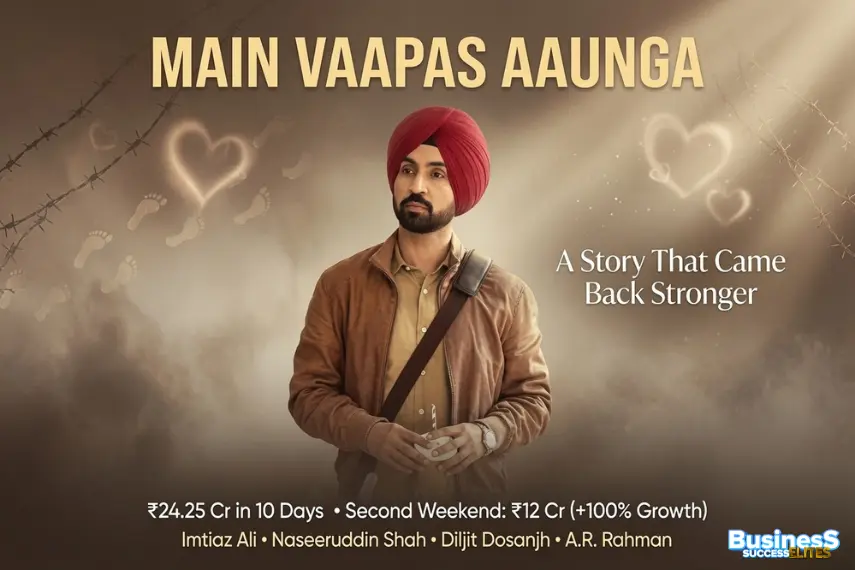
Main Vaapas Aaunga did something remarkable: It arrived quietly, got written off early, and then refused to leave.
Nobody in the industry was calling it a hit on the morning of June 13, 2026. The previous day’s opening numbers were out, ₹1.15 crore net. In the age of Instagram verdicts and Twitter trade analysts who declare a film dead before the second show ends, Imtiaz Ali’s latest seemed headed exactly where the spreadsheet said it should. Nowhere particularly fast, and nowhere particularly far.
Then, the audiences walked out of the theatres and started talking.
That is the part nobody can bottle, manufacture, or buy with a marketing budget. Viewers who watched the film began recommending it to others, social media conversations picked up, and theatres gradually started filling up. The response became so strong that shows were added in several cities, with many screenings running houseful. By the second weekend, something genuinely unusual was happening at the box office, the kind of thing that trade pundits have a category for in theory but rarely see in practice.
Main Vaapas Aaunga recorded its best individual days at the box office yet, netting ₹4.35 crore on Saturday and ₹5.75 crore on Sunday of its second weekend, taking the second weekend total to an estimated ₹12 crore. That figure is not just good. It is almost miraculous in context: the second weekend jump represented over 100 percent growth from the opening weekend, matching almost the exact total the film had accumulated across its entire first week. The film’s total domestic net after 10 days stood at ₹24.25 crore.
A film that earned ₹1.15 crore on Day 1 had essentially matched its entire first week’s business in a single weekend by Week 2. That is not a box office trajectory. That is a resurrection.
Shekhar Kapur Calls It What It Is
The industry noticed. Filmmakers who had stayed politely quiet while the opening weekend numbers trickled in began to speak up. Veteran director Shekhar Kapur, the man who gave India Mr India and Bandit Queen, took to social media with a message directed squarely at Imtiaz Ali. He wrote: “Thank you, Imtiaz Ali. With your film Main Wapaas Aaunga, you busted the myth that the first week’s box office defines the future of your film. You proved that what counts is a great story well told. What counts is respect for your audiences.”
It landed. Because Kapur wasn’t just congratulating a colleague, he was naming something the industry has quietly operated on for decades: the belief that if a film doesn’t open big, it doesn’t get to exist. Screens get pulled. Distributors panic. Trade journalists write post-mortems before the body is cold. Filmmaker Siddharth Anand also shared his support, writing: “Just booked my tickets for Tuesday night for Main Vaapas Aaunga! After Dhurandhar, I booked tickets for this one in ADVANCE!! So happy that diverse genres like these are working with our audience even today! Power of a storyteller!! Full power to you, Imtiaz Ali!!”
This is nothing. Siddharth Anand makes the kind of films that open to ₹50 crore weekends. His enthusiasm for what is, at its core, a quiet Partition drama with no action sequences and no item numbers says something about what this film appears to have achieved, a rare cross-aisle appreciation.
Main Vaapas Aaunga, which translates to “I Will Return”, is a romantic drama set across two timelines. In the present day, 95-year-old Ishar Singh Grewal, played by Naseeruddin Shah, suffers a stroke and is on his deathbed. Despite failing health and advanced dementia, he refuses to let go of life, desperately muttering about returning to his ancestral home in Sargodha, Pakistan. His grandson Nirvair, played by Diljit Dosanjh, acts as his caregiver and attempts to make sense of his grandfather’s disjointed ramblings.
The film is less interested in borders and more interested in what happens after they are drawn. Through the old man’s fractured memories, a love story gradually emerges, one that was interrupted not by misunderstanding or circumstance, but by the violent redrawing of a nation in 1947. Imtiaz Ali has always understood love as something that does not end when circumstances do. His best films are about people who carry feelings across years, across distances, across versions of themselves they no longer recognise. Main Vaapas Aaunga is the most literal expression of that theme he has ever attempted, and when it works, which is often, it is devastating in the best possible way.
At its premiere at the Attari-Wagah border, where A.R. Rahman performed live, Imtiaz Ali summed up his intent with characteristic simplicity. He said: “I am privileged to be a part of this troupe, and it is magical that this event is around Main Vaapas Aaunga, a film that originates from the making of the border during the Partition of 1947. Not only homes and lives were lost, but hearts were broken as well. We bring a message of love because, ultimately, only love sustains us.”
Naseeruddin Shah reminds audiences why he remains one of India’s finest actors. His performance is filled with restraint and emotional intelligence. He does not play nostalgia as grand tragedy. Instead, he presents it as something more intimate and painful: a lifelong ache that never fully leaves. Every glance and pause carries the weight of memories that have survived for decades.
NDTV’s Saeed Naqvi described it plainly: Naseeruddin Shah delivers a “masterclass” performance in a heartbreaking narrative. The Hindu’s Anuj Kumar went further, calling the film “an evocative exploration of memory, loss and longing.”
What perhaps lingers most is that Main Vaapas Aaunga isn’t really a film about Partition or even lost love. It is a film about memory itself, about the people and emotions that refuse to leave us, even when everything else begins to fade.
No Imtiaz Ali film arrives without a soundtrack that deserves its own conversation. The three coming together, Imtiaz Ali, A.R. Rahman, and lyricist Irshad Kamil, was a masterstroke. Along with outstanding singers and superb musicians, they have created a masterpiece of a soundtrack.
The album opens with “Kya Kamaal Hai,” rendered by Diljit Dosanjh. The song starts gently, with Diljit almost whispering the words, accompanied by a string section played by the Budapest Scoring Orchestra and a flute section by Ashish Venkateswaran. Rahman’s tune is unpredictable and endearing at the same time. A.R. Rahman and Irshad Kamil deliver one of the rare albums of recent times where every single song works.
The background score is equally discussed. The BGM is almost like another character in the film’s journey. Rahman is in top form in Main Vaapas Aaunga.
Read More – The Illusion of Intelligence: What Advaita Vedanta Reveals About Artificial Intelligence and Consciousness
Main Vaapas Aaunga is not the first film to have a slow start and recover. But it may be the most dramatic recent example of word-of-mouth doing what no opening-weekend marketing blitz could. In a theatrical landscape where a film’s fate is essentially decided within 72 hours of release, screens allocated, shows trimmed, OTT windows rushed, this kind of revival disrupts an entire industry assumption.
Imtiaz Ali’s films don’t typically explode on Day 1. Both Tamasha and Love Aaj Kal 2 saw the same kind of slow start, but then word of mouth built them up. What is different this time is the scale of the second-week recovery, and the speed with which the industry itself began to acknowledge it.
The film has become one of those rare releases that means different things to different people, while remaining deeply personal to all of them. Audiences are not just watching it, they are debating it, recommending it, and arguing about it. That is the oldest and most reliable form of marketing in cinema’s history. It just happens to be one Bollywood forgot to put in its opening-weekend forecast.
Main Vaapas Aaunga opened slowly. It gathered itself. And then, like the old man at its heart, it came back.
Omnichannel Marketing: Why It Now Defines Business Growth
August 4, 2026Japan, US Yen Intervention Signals Historic Currency Truce
August 3, 2026