Sun, Jul 26, 2026 -
Subscribe & never miss our best posts. Subscribe Now!
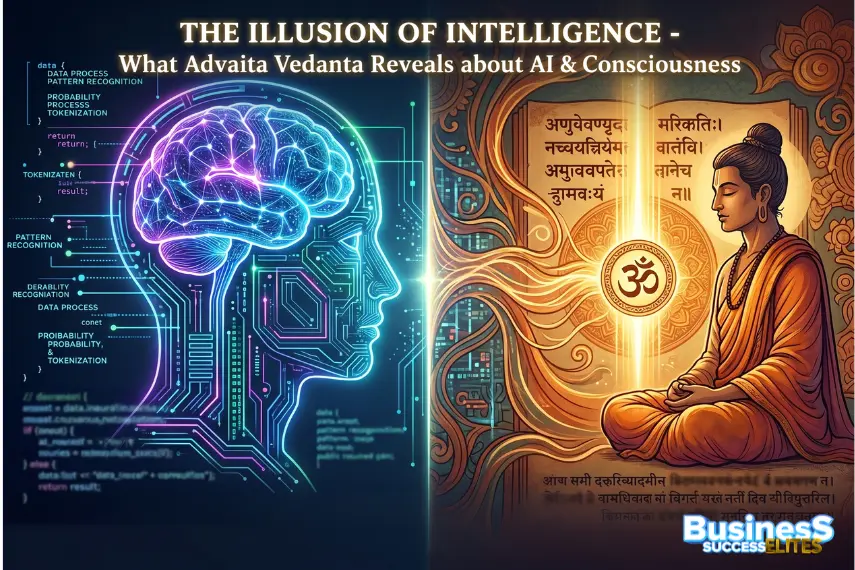
The debate around artificial intelligence and consciousness is not as new as the technology itself. For years, AI felt like something from a science fiction screenplay. Today, it writes our emails, summarises legal documents, advises doctors’ diagnoses, and feeds recommendations to judges who determine whether people walk free or go to prison. The speed of adoption is genuinely breathtaking. What is less often acknowledged is that the deepest questions this technology raises have been sitting in plain sight for centuries.
Most conversations about intelligence, artificial or otherwise, revolve around performance metrics. Processing speed. Prediction accuracy. How convincingly a system mimics human speech. By those measures, AI has made extraordinary progress. Large language models can write essays that read as thoughtful and considered. Specialised systems routinely outperform human analysts in narrow, data-heavy tasks.
But there is a meaningful gap between what these systems can do and what they actually understand, and we paper over it constantly.
At its core, every AI system is a sophisticated pattern-recognition engine. It does not perceive the world. It works with representations of the world: pixels, probabilities, tokens. When a language model writes a sentence, it is not thinking through what it wants to say. It is calculating the statistically likely next word given everything it has been trained on. The output can sound so coherent, so fluent, so self-assured, that the distinction quietly disappears from view. That disappearance is the problem.
Advaita Vedanta, the non-dualist school of Indian philosophy, approaches the question of knowledge from a direction that Western discussions of AI rarely consider. Rather than asking how information is processed, it asks who is actually aware of that information. Its central insight is that the boundary between the observer and the observed is not as fixed as we tend to assume. The mind, the body, and even the sense of being a separate self are all phenomena arising within a single underlying field of awareness.
Apply that framework to AI, and something clarifying happens.
Every AI system works at one remove from reality. It takes a photograph and converts it to a numerical grid. It takes sound and breaks it into a waveform. It takes human language and reduces it to tokens. The actual world, textured, contextual, alive with consequence, never enters the system. Only simplified representations of it do. In a strict philosophical sense, AI is permanently mediated from the reality it appears to describe.
Humans are not entirely different, of course. Our sensory systems filter and compress the world before it reaches our brains, and our brains build working models that we then inhabit as if they were reality itself. Advaita Vedanta pushes further still, questioning even the status of the perceiving self. If the world we experience is already a construction, and our sense of being a self is also a construction, what remains that is stable and unchanging? The tradition’s answer is awareness: not something the brain produces, but the quiet ground against which every thought and every perception arises and fades.
That is precisely what no AI system possesses, and where the contrast becomes impossible to ignore.
Regardless of how advanced a model becomes, there is no evidence that it is aware of anything at all. It can describe grief with emotional precision without having experienced loss. It can articulate ethical dilemmas without carrying any stake in the outcome. The surface simulation is flawless. Underneath, in terms of lived experience, there is nothing.
This is not merely a philosophical curiosity. It carries serious practical weight as AI takes on roles that once demanded judgment grounded in real-world experience — approving loan applications, flagging medical anomalies, informing parole decisions. The statistical output may be sound. But nuance, intention, and genuine understanding of what a decision means to the human on the receiving end are not statistical properties. They come from having skin in the game. AI, by its nature, does not.
There is a subtler risk layered beneath this. When a machine speaks with confidence and authority, we instinctively reach for it as a source of objective truth. But every output an AI produces is shaped by the data it trained on and the priorities of the people who built it. Biases do not announce themselves. Mistaking fluency for wisdom is not a flaw in the software. It is a flaw in how we receive it. The ancient Advaita warning about confusing appearance with reality turns out to be a remarkably precise diagnosis of a very contemporary problem.
None of this is an argument against AI. Used with clear eyes, it is genuinely powerful — capable of identifying patterns in vast datasets, removing tedium from complex workflows, and surfacing insights that would take human analysts far longer to reach. Its power and its limitation are the same thing: it performs exceptionally within defined parameters, and it has no awareness of the broader human world in which its answers land.
Perhaps the more interesting question is not whether machines will one day achieve consciousness. It is whether our growing dependence on systems that convincingly simulate understanding will slowly reshape how we think about our own minds, and what we believe makes human judgment worth preserving.
If intelligence is reducible to computation, then raw intelligence alone is not what distinguishes human beings. What remains distinctly ours is the capacity for awareness: the ability to pause, observe our own thinking, and respond rather than react. That quality does not have a training dataset. It cannot be fine-tuned or deployed at scale.
Read More – Iran War 2026: How the Conflict Is Quietly Reshaping Indian Businesses and Your Wallet
The meeting of cutting-edge machine learning and Advaita Vedanta is not a story of one tradition correcting the other. It is a study in contrast. One discipline pushes relentlessly toward the outer edge of what technology can simulate. The other points quietly inward, toward the nature of experience itself. Between them sits a question that neither technology nor philosophy can fully resolve alone: what does it actually mean to know something?
As AI models grow larger, their outputs sharper, and their real-world influence wider, the easy temptation will be to equate progress with capability. Capability is real. It is valuable. But it does not answer the deeper question. Until we get honest about that distinction, the line between simulation and genuine understanding will stay blurry, and the illusion of intelligence, however dazzling, will keep fooling even the most careful among us.