Wed, Jul 1, 2026 -
Subscribe & never miss our best posts. Subscribe Now!
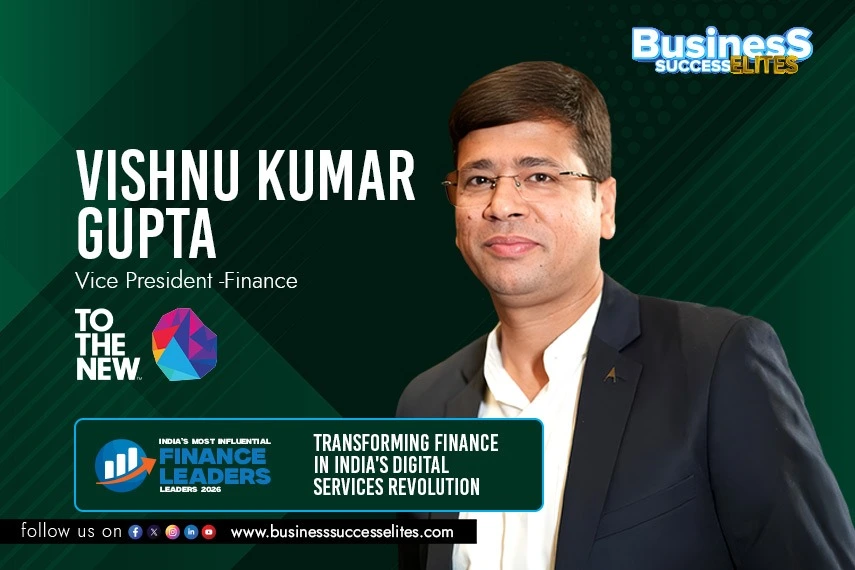
Financial leadership in the high-velocity world of digital services and technology consulting looks nothing like it did a decade ago. Traditional finance: spreadsheets, compliance checklists, and cost controls were designed for stable, linear businesses. But today’s tech companies operate in constant flux: rapid scaling, uncertain project timelines, evolving client demands, and the relentless pressure to invest in innovation while maintaining profitability. This is where most finance leaders stumble. They default to caution, treating growth as a threat rather than an opportunity, and become gatekeepers instead of architects.
Vishnu Kumar Gupta has chosen a different path. As Vice President of Finance at TO THE NEW, one of India’s leading digital transformation companies, he has fundamentally reshaped how financial leadership operates in the technology services space. His approach transcends traditional accounting and compliance, the domains where he built his foundational expertise. Instead, he has become a strategic architect, understanding that future-ready organisations require finance leaders who can bridge business strategy, technological innovation, and financial discipline.
What sets Vishnu apart is his refusal to see financial discipline and business growth as opposing forces. Over his career, spanning automotive, healthcare, manufacturing, and now technology services, he has learned that sustainable growth is only possible when anchored in financial fundamentals. Yet at TO THE NEW, he has navigated a more nuanced challenge: how to enable a technology company to scale aggressively, invest in digital transformation, and compete globally while maintaining the financial rigour that ensures long-term resilience. His journey demonstrates a critical insight for India’s tech services sector that financial mastery in the digital age is not about controlling costs, but about unlocking value.
Vishnu spoke about his journey, achievements, challenges, strategies and vision in a candid conversation with Business Success Elites magazine.
What drew you into the technology and digital services sector?
My foundation has always been in finance, taxation, and compliance, but the transition toward technology happened naturally through the growing need for automation and data-led decision-making. I realised that finance leadership is no longer just accounting; it’s deeply integrated with technology, business intelligence, and process transformation.
The real motivation came from seeing how technology could enhance governance, internal controls, and business agility. Working across diverse industries, including automotive, healthcare, manufacturing, and telecom, I implemented ERP systems like SAP and Oracle, and more recently, I’m leveraging AI to automate routine tasks and improve forecasting. A key turning point was moving from traditional finance operations into strategic business Partnering, where I contributed to profitability improvement, cost optimisation, and process automation. That’s when I understood that future-ready organisations need finance leaders who bridge business strategy, compliance, and technology.
How do you balance financial discipline with enabling aggressive business growth?
This is the central question for finance leaders in technology services. My philosophy is simple: financial discipline and business growth are not opposing forces; sustainable growth requires strong financial fundamentals. A finance leader’s role is not to control costs or protect margins in isolation, but to act as a strategic business partner enabling informed and responsible growth.
Strong controls, transparent reporting, effective working capital management, and compliance frameworks provide the stability required for organisations to invest confidently in expansion and innovation. However, excessive conservatism slows decision-making and limits growth potential. The balance comes from understanding commercial realities and aligning finance with operational and strategic goals.
At TO THE NEW, I focus on identifying areas where operational efficiency and profitability improve simultaneously, process automation, better cash flow planning, tax efficiencies, and stronger internal controls create resources that can be reinvested into business expansion. Finance should support initiatives that generate long-term value, not focus solely on short-term cost savings.
How do you measure financial success beyond profitability?
Profitability is important, but true financial success is broader and more sustainable. A financially strong organisation demonstrates resilience, operational efficiency, governance strength, and long-term value creation.
I focus intensely on cash flow health and working capital efficiency. Many businesses appear profitable on paper but struggle with liquidity. Effective cash management, timely collections, and disciplined capital allocation are critical indicators of stability. Equally important is the quality of governance. Strong internal controls, transparent reporting, and ethical practices build credibility with stakeholders, investors, and employees.
I also measure success through the organisation’s ability to invest in future growth while maintaining financial discipline, technology adoption, capability building, and innovation. People and culture matter too. A successful finance function empowers teams, encourages accountability, and supports cross-functional collaboration. When employees understand business objectives and financial priorities, organisations become more aligned and agile.
How do you ensure that financial strategy resonates with non-finance teams?
One of my core responsibilities is making financial strategy meaningful for operations, sales, procurement, and production teams. Finance should never operate in isolation; it should serve as a business partner, helping every function understand how its decisions impact organisational growth.
I simplify financial concepts into business language. Rather than discussing budget variances, I explain how process improvements and cost optimisation support business expansion and create room for future investments. When people understand the “why” behind financial decisions, they become more engaged.
I also rely heavily on collaborative decision-making and meaningful data visualisation. Clear dashboards, focused KPIs, and real-time reporting help non-finance leaders understand performance without financial complexity. Most importantly, I foster a culture where finance is viewed as an enabler of growth rather than a barrier to execution.
India’s Most Influential Finance Leaders 2026
July 1, 2026Record M&A Deals Turn 2026 Into Boardroom Ego Trip
July 1, 2026