Thu, Jun 25, 2026 -
Subscribe & never miss our best posts. Subscribe Now!
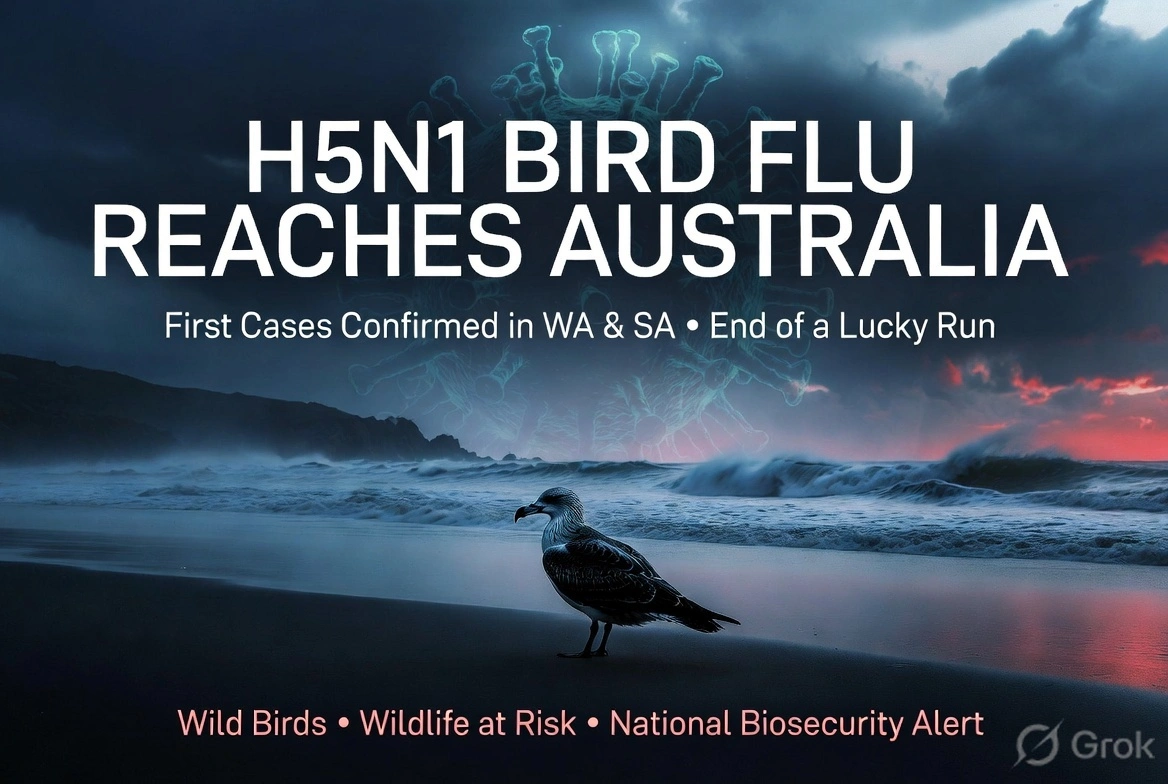
H5N1 bird flu in South Australia and Western Australia has arrived with the subtlety of a seabird crashing onto a remote beach, which, as it turns out, is precisely how it got here. On 20 June 2026, the CSIRO Australian Centre for Disease Preparedness confirmed the first detection of the highly pathogenic H5N1 strain on the Australian mainland, a single brown skua, a migratory seabird, found sick and later died at Cape Le Grand National Park near Esperance in southern Western Australia. No fanfare, no forewarning. Just a dead bird, a lot of lab tests, and the beginning of a very uncomfortable national conversation.
Australia had, until this moment, held the rare distinction of being the last major landmass on earth to remain free of HPAI H5N1 clade 2.3.4.4b, the strain that has been tearing through wildlife populations, poultry farms, dairy herds, and an alarming list of mammal species across every other continent since 2021. Australia had previously been one of the only regions of the world free from the virus. That’s gone now.
A second migratory bird, a giant petrel found exhausted in the same Esperance area, was also undergoing confirmatory testing at the time of the initial announcement. Samples from both birds were sent to the CSIRO to confirm the first Australian cases of H5N1 — specifically the clade 2.3.4.4b H5N1 lineage.
Then, within days, the virus crossed state lines. Federal Agriculture Minister Julie Collins confirmed a first case in South Australia on Wednesday, as Western Australia simultaneously confirmed it was testing a third bird suspected of having the virus. The SA case followed that state beginning to test dead migratory seabirds amid fears of the arrival of the deadly avian flu — and it is the first detection of the virus in South Australia, after the two confirmed WA cases.
South Australian Premier Peter Malinauskas said the case was a southern giant petrel found 10 days ago at Knights Beach on the Fleurieu Peninsula — more than 2,000 kilometres from where the WA birds were found. He added that the bird had travelled to the state via Antarctica. Two thousand kilometres apart. Via Antarctica. As if Australia’s remoteness was supposed to protect it, and the virus politely read the map and rerouted anyway.
Despite being present in Asia since the 1990s and in Antarctica since 2024, HPAI H5N1 had not been detected in Australia until now. This is largely because there are no duck species that routinely migrate between Australia and Asia, and none that migrate through Antarctica, the key long-distance transmission routes seen elsewhere.
But the virus found its way regardless. Available evidence suggests that birds like gulls, skuas, and giant petrels may have taken on the role of long-distance virus carriers in the Antarctic and subantarctic, effectively substituting for the migratory ducks that did the job on every other continent. The virus hitched a ride on birds nobody thought were particularly dangerous vectors, from a continent that most people don’t think about at all, straight onto Australian shores. Classic.
The industry response was swift , perhaps too swift, if you ask the Papua New Guinea authorities. A temporary ban on all Australian poultry products, imposed by Papua New Guinea’s National Agriculture and Quarantine Inspection Authority, was later lifted after being put in place on Monday. Meanwhile, at home, major poultry producer Inghams announced it would lock down its WA sites to mitigate against any potential risks, even as Australia’s poultry and agricultural sectors remain free from the flu, with all confirmed cases limited to wild birds.
More than 100 reports of potentially sick birds have been made to the national emergency hotline since the first H5N1 detection. To put that in grim perspective: more than 200 million chickens have been culled in the US since the virus arrived there. Australia is not there yet, not even close, but the trajectory of what “not taking this seriously early” looks like has been well documented internationally.
Federal Agricultural Minister Julie Collins confirmed that the government’s emergency biosecurity response has been enacted and that her department is working closely with state and territory counterparts to monitor the spread of the disease. South Australian Premier Peter Malinauskas, for his part, said he wanted to “reassure South Australians that we are well prepared and responding swiftly,” adding that South Australia had “invested significantly in surveillance, workforce capability and response planning to prepare for the possible arrival of H5 bird flu.” Admirable foresight. Shame about the timing.
Here is where the story stops being about eggs and starts being genuinely alarming. Avian flu has driven a global animal pandemic, causing catastrophic loss in more than 500 bird and 60 mammal species. Experts warn that unique Australian species like the black swan, the Australian sea lion, and the Tasmanian devil are highly vulnerable and could be significantly impacted by the virus.
Scientists have known for years that bird flu kills every black swan it infects, making H5N1 an existential threat to the species, giving the phrase “black swan event” a painfully literal meaning. The Invasive Species Council has warned that this strain could have catastrophic impacts on native birds and may lead to local extinctions of species like black swans.
Tasmanian devils face a separate nightmare. The Commonwealth Chief Veterinary Officer has specifically identified Tasmanian devils as a species at risk, warning that H5N1 could push the species closer to extinction. Tasmanian devils are scavengers, and scavengers are known to be at particularly high risk of contracting H5N1 through eating infected birds or carcasses. Devil facial tumour disease has already wiped out around 80% of the Tasmanian devil population based on the last comprehensive survey in 2024. The species that survived a contagious facial cancer may not survive a visit from an infected seagull.
Threatened Species Commissioner Fiona Fraser identified vulnerable animals ranging “from mammals such as the Tasmanian devil” to critically endangered birds including the orange-bellied parrot.
Read more – Why You Feel Different Inside an Indian Temple, Science Has a Reason
Now that HPAI H5N1 has been found on mainland Australia, it will not necessarily establish itself and spread across the continent into other birds and mammals, including livestock. Given that skuas and giant petrels are marine rather than freshwater species and do not occur on land in large numbers outside the breeding season, there is still a chance it may not spread further.
The critical variable? Ducks. The biggest risk is that infected, sick birds are eaten or scavenged by native birds and mammals, which could transmit the virus to ducks. Once in ducks, the likely spread of the virus would increase dramatically, and the outlook would be grim. But for now, Australia remains a few critical steps away from that happening.
Globally, 33–47% of all adult northern gannets died in 2022 due to HPAI H5N1, and on subantarctic Heard Island, 13,000 baby southern elephant seals died due to HPAI during the 2025–26 summer. Australia now sits inside that story. What shape its chapter takes depends, in large part, on whether a sick seabird and a local duck ever end up in the same place at the same time.
The government’s advice for now: do not touch dead or sick birds. Report unusual wildlife deaths to the Emergency Animal Disease Hotline on 1800 675 888. And perhaps do not get too comfortable with the word “isolated.”
LIC CFO Sunil Agrawal Resigns, Exit Set for July 14
June 25, 2026