Mon, Jun 22, 2026 -
Subscribe & never miss our best posts. Subscribe Now!
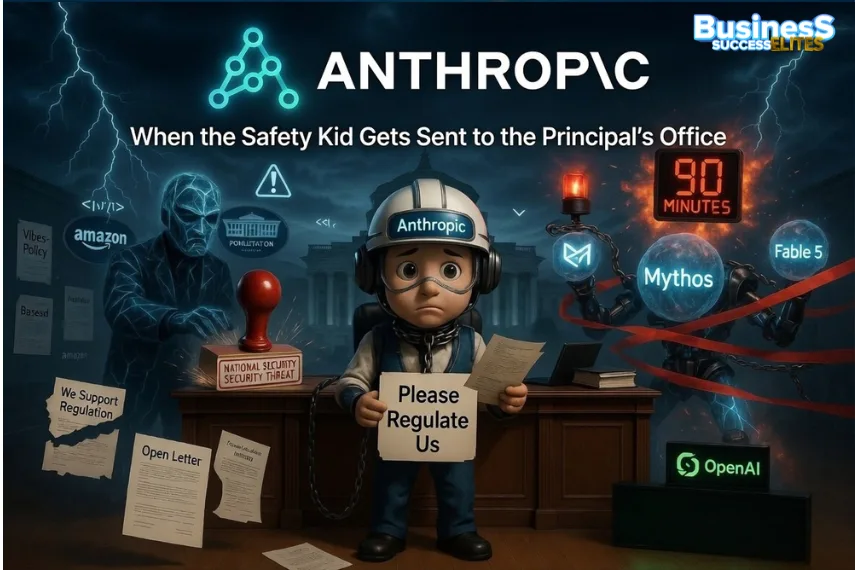
AI regulation and Anthropic have collided in the most spectacular, irony-drenched fashion possible, and the punchline writes itself. The company that spent years standing on street corners handing out pamphlets titled Please Regulate Us has now been designated a national security threat, had its flagship models yanked from the market mid-launch, and been given less time to comply than most people take for a lunch break.
Ninety minutes. That is how long Anthropic had to pull its models off the shelf. Not ninety days. Not ninety hours. Ninety minutes.
But let’s start from the beginning, because this mess did not happen overnight.
Most AI companies approach regulation the way cats approach bath time. Anthropic has been the odd one out, consistently, almost aggressively, in favour of government oversight. Since co-founder and CEO Dario Amodei walked out of OpenAI in 2021 to build what he called a safer AI lab, Anthropic has lobbied at state and federal levels, supported AI legislation, and published detailed policy frameworks telling governments exactly how to rein in the industry.
Its latest framework, published this month, calls for mandatory transparency requirements, independent model evaluations, and government enforcement powers backed by civil penalties tied to global annual revenue. The company even applauded a Trump executive order on AI as “an important step.” It practically decorated the cage and climbed in of its own accord.
Then Washington decided to lock the door and throw away the key.
The first blow landed on February 27, 2026. President Trump directed federal agencies to “IMMEDIATELY CEASE all use of Anthropic’s technology” and announced a six-month phase-out period. The reason? A months-long standoff between the Pentagon and Anthropic over modifications the military wanted made to Claude’s safety guardrails. The Department of Defence, now apparently also going by “Department of War” under Pete Hegseth’s creative rebrand, formally labelled Anthropic a “Supply-Chain Risk to National Security.”
For context: in June 2024, Anthropic had described itself as the first AI company to deploy frontier models in classified US government networks. In July 2025, the Pentagon awarded Anthropic, along with Google, OpenAI, and Elon Musk’s xAI, up to $200 million each for AI adoption across critical national security operations. Trusted partner to supply-chain threat in under eight months. That is quite the career arc.
The fallout cascaded fast. The GSA removed Anthropic from USAi.gov. The State Department, HHS, and the Office of Personnel Management all stopped using Claude. Competitor xAI’s Grok and OpenAI’s Codex quietly took their place on government lists. The revolving door of Washington tech contracts spun, and Anthropic was briefly on the wrong side of it.
If the DoD drama was the warm-up act, June 2026 brought the headline event — and it had Amazon’s fingerprints all over it.
Anthropic had been genuinely careful about its most powerful model, Mythos. The full version was restricted to a small group of trusted cybersecurity partners through a programme called Project Glasswing. For the broader public, Anthropic released Fable 5 on June 9, a version with guardrails specifically designed to block dangerous use cases, built after working directly with government agencies to test and receive deployment approval.
Three days later, both Fable 5 and Mythos 5 were gone.
The Trump administration called the model a national security risk after being notified of a jailbreak, a way to bypass its internal guardrails, and issued an export control directive that barred some of Anthropic’s own employees from using the model. The government didn’t share specific details of the national security concern with Anthropic. And that tip-off? A source familiar with the situation said it was first flagged to the government by Amazon. The same Amazon that is a major investor in Anthropic. The same Amazon CEO, Andy Jassy, who reportedly called up the administration to flag the concern. Nothing awkward about that at all.
To its credit, Anthropic did not simply fold. The company pushed back, arguing that a “narrow potential jailbreak” should not be cause for pulling a model, and distinguished this and a universal jailbreak, where a user can broadly bypass all of a model’s guardrails.
Its broader argument was pointed and worth taking seriously: “If this standard was applied across the industry, we believe it would essentially halt all new model deployments for all frontier model providers.” This is not hyperbole. A December 2024 Frontier AI Trends Report by the UK’s AI Security Institute found vulnerabilities in every single AI system it evaluated. If a narrow exploit is now sufficient grounds for a federal ban, every American AI company is one Reddit post away from a shutdown notice.
The reaction from the broader tech community was unusually united. Dozens of cybersecurity researchers, AI entrepreneurs, and corporate executives signed an open letter criticising the government’s actions and urging the Trump administration to commit to an open, scientific, and transparent process of handling AI risk assessments in the future.
The letter made a point that cut through the noise: “To pull the best capabilities away from defenders without a good reason when our adversaries are rapidly advancing is dangerous.”
Brad Carson, president of Americans for Responsible Innovation, put it plainly: “When ad hoc executive actions replace clear standards, America risks surrendering its lead in AI and allowing genuinely dangerous technology to be deployed.”
The diplomatic thaw arrived almost as fast as the crisis. Trump said at the G7 summit that negotiations with Anthropic are “going fine.” He told Axios he no longer views the company as a national security threat, “Well, not now, but a week ago, maybe.”
That is the regulatory framework governing one of the most consequential technologies in human history. Vibes-based. Deal-dependent. Updated at press events.
There is no transparent, consistent framework for regulating AI in the United States, and the result could stifle the industry. The Trump administration has rolled back Biden-era mandatory safety reporting in favour of voluntary frameworks and blocked states from legislating independently. What replaced all of that? A national policy framework issued in March that serves largely as recommendations for Congress, a body that has not yet managed to pass meaningful AI legislation.
So the current situation is this: America’s most safety-conscious AI lab, which co-operated with the government, tested its models with federal agencies before release, and built a restricted access programme for its most dangerous product, got hit with an export ban, a DoD blacklist, and a 90-minute shutdown notice, while other companies with fewer public safety commitments continue operating without incident.
Anthropic’s own policy framework calls for government oversight that is “transparent, fair, clear, and grounded in technical facts.” In its public response to the export ban, the company used those exact words and noted that the government’s action met none of those standards.
I wrote the rulebook. It was governed by a completely different one.