Mon, Aug 3, 2026 -
Subscribe & never miss our best posts. Subscribe Now!
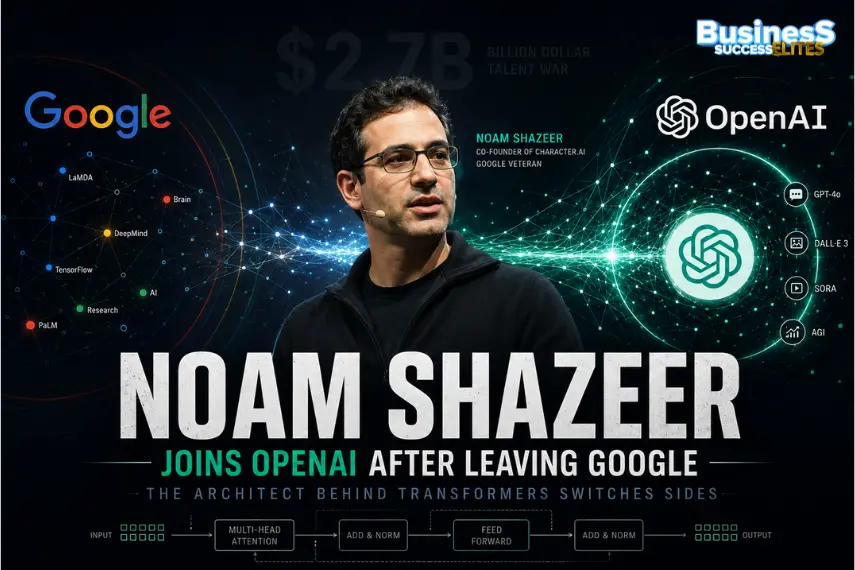
Noam Shazeer joins OpenAI and, in doing so, hands Google what may be the most expensive goodbye gift in Silicon Valley history. Less than two years after the search giant paid approximately $2.7 billion to lure him back from Character.AI, Shazeer announced on June 18, 2026, via a post on X, that he is packing his transformer weights and heading straight to ChatGPT’s creator. Google, ever the gracious loser, said it was “grateful for Noam’s meaningful contributions.” Sure, Google. Nothing to see here.
The departure of Shazeer, Vice President of Engineering and co-lead of Google Gemini, is being called the most consequential individual talent move in AI in recent memory. And that is not hyperbole. This is the man who co-authored the “Attention Is All You Need” paper in 2017, the foundational blueprint behind virtually every major large language model you have heard of, including the very GPT models that OpenAI built its empire on. The irony practically writes itself.
To understand why this move shakes the industry to its core, you need to understand who Noam Shazeer actually is. He first joined Google way back in 2000, working there for over two decades before co-authoring the paper that redefined computing. The “Attention Is All You Need” paper, published in 2017 alongside seven colleagues, introduced the transformer architecture that now underpins GPT-4, Gemini, Claude, and practically every serious AI system on the market. If the modern AI boom had a constitution, Shazeer helped write it.
He walked away from Google in October 2021 after the company reportedly refused to release a conversational AI chatbot called Meena that he had built. Apparently, one of the most significant researchers in the company’s history was not too happy about that. He walked and co-founded Character.AI, a conversational AI startup that went on to attract over 20 million monthly active users and a billion-dollar valuation. Google watched from the sidelines.
In August 2024, Google made what was widely described as a panic move dressed up as a strategic partnership. The company signed a licensing deal for Character.AI’s technology worth approximately $2.7 billion, as reported by The Wall Street Journal, which conveniently also brought Shazeer and fellow researcher Daniel De Freitas back into Google’s DeepMind unit to co-lead Gemini development. Google framed it as a technology acquisition. Everybody else called it what it was: spending $2.7 billion to rehire someone they should never have let leave.
For the next year and a half, Shazeer worked to close the gap between Gemini and OpenAI’s ChatGPT, and by multiple accounts, he succeeded. Gemini’s progress under his leadership was significant. Google credited him as a central figure behind the model’s improvements. Reports from early 2026 suggested Google had even consolidated its consumer-AI strategy around leaders like Shazeer. Then came June 18.
In his X post, Shazeer was diplomatic, warm, and characteristically understated. He wrote that joining OpenAI was something he was excited about, adding that it was “a difficult decision to move on.” He expressed genuine pride in the Google team and described the experience there as an honour. Sam Altman, OpenAI’s CEO, responded with a tease that the results would “be worth the wait.” Safe to say, Altman is not exactly mourning Google’s loss.
Google’s official response to Reuters was brief: the company said it was grateful for his contributions. No elaboration. No counter-offer was revealed publicly. Just a one-liner from a company that had just watched someone it paid $2.7 billion to recover walk out the door to its biggest competitor.
This is not just another VP-level hire. When a co-inventor of the transformer architecture moves from the team leading Google’s flagship AI product to the company running the world’s most widely used AI chatbot, the implications ripple across research roadmaps, architectural priorities, and benchmark trajectories for years. Analysts and practitioners will be watching OpenAI’s preprint filings, training infrastructure announcements, and model releases closely for any fingerprints of Shazeer’s influence.
The move also lands at a particularly sensitive moment for OpenAI. The company is reportedly preparing for a potential IPO, navigating an increasingly competitive landscape against Google, Anthropic, Meta, and a rapidly growing field of Chinese AI labs. Adding the co-architect of modern deep learning to your bench just before you go public is the kind of signal that investors tend to notice.
For Google, the timing stings. The company has spent the last two years in an aggressive campaign to reassert dominance in AI following early stumbles with Bard. Losing Shazeer, again, to the same rival it has spent billions trying to match, suggests that the talent war in AI is far from settled and that writing cheques, however large, does not guarantee loyalty in a market where researchers can effectively choose their next frontier.
Shazeer’s move is the latest in a pattern of high-profile exits and cross-company migrations that have come to define the AI talent market in 2025 and 2026. Researchers who built the foundations of modern AI are not sitting still, and the organisations they choose to work with carry enormous signalling weight. The “Attention Is All You Need” paper had eight co-authors. Several of them have gone on to found or join competing AI companies. The tribe of people who genuinely understand the deepest architecture of modern AI is surprisingly small, and every single one of them is being aggressively recruited.
What Noam Shazeer’s joining OpenAI ultimately represents is not just a talent acquisition; it is a statement of direction. OpenAI, despite the turbulence of recent years, remains capable of attracting someone who could work anywhere in the world, on any problem, with nearly unlimited resources. That is its own kind of credibility, and no press release could manufacture it.
Google, for its part, will rebuild and carry on. It has the talent, the compute, and the capital to do so. But somewhere in Mountain View, someone is staring at a $2.7 billion line item on a spreadsheet, and the number is not getting any easier to justify.
Hitesh Agarwal, COO, ACE | Business Success Elites
August 1, 2026