Mon, Aug 3, 2026 -
Subscribe & never miss our best posts. Subscribe Now!
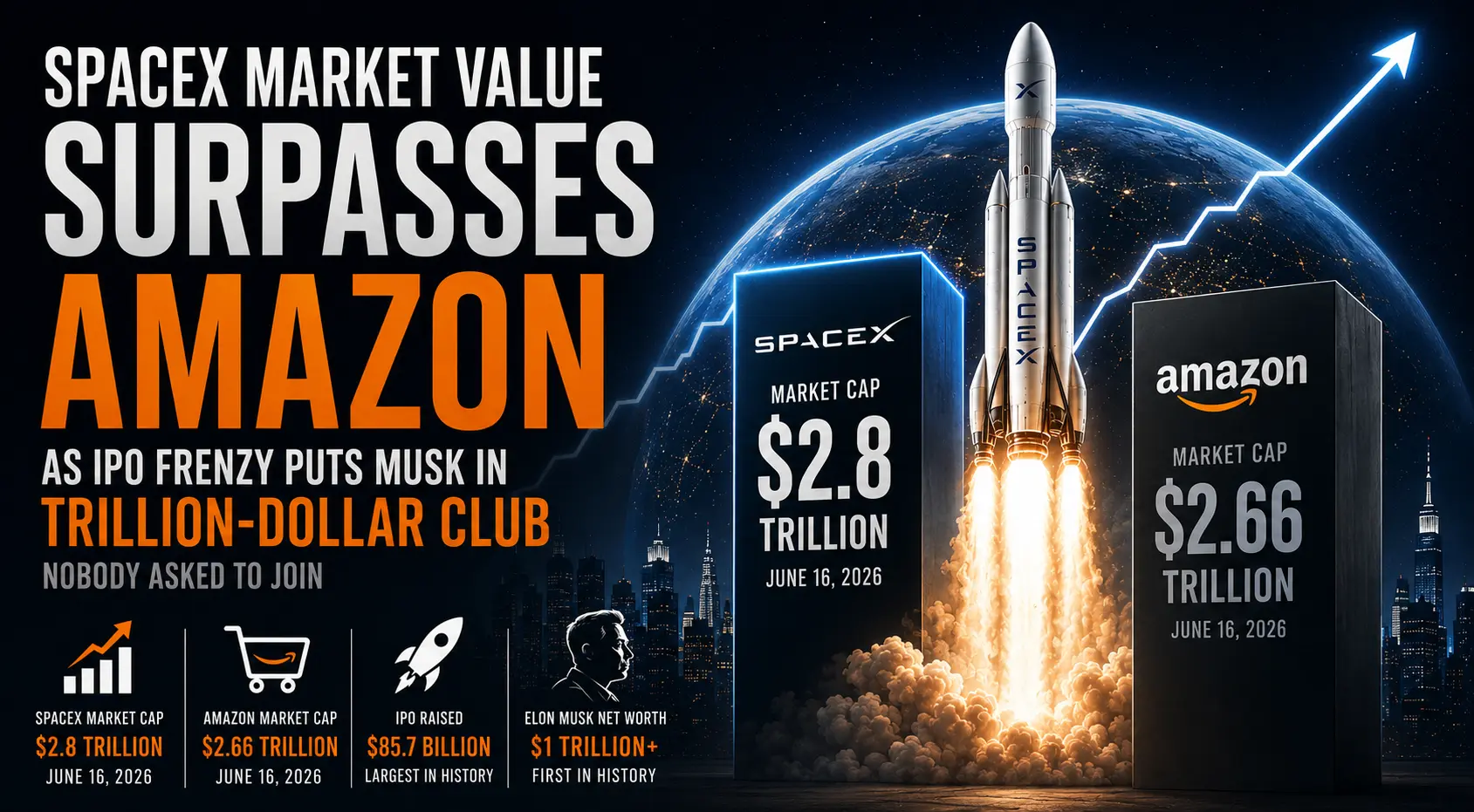
SpaceX market value surpasses Amazon, and Wall Street has evidently decided that rockets, satellites, and Elon Musk’s Twitter presence are worth more than one of the largest e-commerce and cloud empires ever built by a human being. Just four days after going public on June 12, 2026, SpaceX stock shot past $208 per share, handing the Hawthorne-based rocket company a market capitalisation of approximately $2.8 trillion, roughly $140 billion more than Amazon’s $2.66 trillion. Take that, Jeff Bezos.
What started as the largest initial public offering in recorded stock market history somehow managed to keep getting bigger, louder, and more absurd with each passing trading session.
SpaceX debuted on the Nasdaq Stock Exchange under the ticker SPCX at $135 per share on June 12, 2026. By lunchtime that day, shares had already opened at $150, a cool 11% premium over the offering price before most retail investors had even finished their morning chai. The stock closed its debut session at $161.11, a 19% jump that added over $300 billion in value to the company in a single trading day. Theatrics, all of it.
In total, SpaceX raised $85.7 billion through the IPO by selling 555.6 million shares, smashing Saudi Aramco’s previous record of $29 billion raised in 2019, and doing so without selling a single barrel of oil. The company’s initial valuation at listing stood at roughly $1.77 trillion, already making it one of the most valuable companies to ever go public. And then it just kept going.
By June 16, literally four trading days in, SpaceX shares had surged to $212.50 per share in intraday trading, representing a gain of over 57% from the IPO price. That’s the kind of return most mutual funds fail to deliver in a decade, achieved here in under a week. The two-day run alone (June 13–14) added $412 billion in market value, more than Nike, McDonald’s, and Starbucks combined. Combined. Just let that sink in.
The implications for Elon Musk personally are, to put it diplomatically, obscene. By Friday, June 13, the first full trading day after the IPO, Musk’s net worth crossed the $1 trillion mark, making him the first individual human being in history to hold that distinction. He is now worth more than four times the second-richest person on the planet.
The Globe and Mail and several financial commentators were quick to ask the obvious question no one else seemed to want to touch: is it a bad look for capitalism when one man’s personal fortune rivals the GDP of entire nations? The answer, of course, depends heavily on whom you ask and whether they own SPCX stock.
SpaceX reported revenues of $18.7 billion, a genuinely impressive figure for a company that was still largely private a week ago. Analysts are projecting $25 billion in revenue for the full year 2026, with Musk himself suggesting the company could be generating $1 trillion in annual revenue by 2030. The market, clearly enchanted by this possibility, is currently pricing the stock at roughly 107 times its revenue — a multiple that makes even the frothiest tech valuations of the dot-com era look like conservative accounting.
For comparison, Amazon trades at a fraction of that revenue multiple and Amazon, lest we forget, is not burning $5 billion a year in operational losses. SpaceX is. Analysts with cooler heads have noted that the valuation makes “absolutely no sense today,” in the clinical phrasing of one sceptic cited by Reuters, but the market, as usual, does not care about today.
What it cares about is Starlink, SpaceX’s satellite internet service, which now operates over 10,000 active satellites in orbit. It cares about the Starship programme, orbital data centres, and the romantic notion that Musk will colonise Mars before Amazon can figure out its satellite network. Amazon’s competing Project Kuiper, also known as Amazon Leo, has approximately 180 satellites in orbit. The scoreboard is not flattering.
If institutional investors brought the money, retail investors brought the energy and apparently their entire net worth. According to Vanda Research, retail buyers purchased as much SpaceX stock in the first two trading days as they bought across the entire US market the previous week. All of it. The entire market. One stock.
SpaceX’s listing was described by Nasdaq itself as the most anticipated IPO in Wall Street history when it rang the opening bell from both Nasdaq MarketSite in New York and SpaceX’s Starbase headquarters in Texas simultaneously. A Starship vehicle was parked outside the New York exchange, because subtlety is for smaller IPOs.
Options trading on SPCX shares began shortly after, fuelling a further surge as traders piled into calls. The addition of derivatives trading added rocket fuel — metaphorically, although with SpaceX, you genuinely cannot be sure- to an already red-hot secondary market.
Not everyone is celebrating, of course. The Economist called it “Wall Street’s undignified SpaceX mania.” Semafor raised concerns about a valuation bubble. Techdirt went further, raising pointed questions about the overlap between Musk’s political relationships and SpaceX’s government contracts, a topic that, remarkably, did not appear to dampen investor enthusiasm in the slightest.
The Barron’s headline said it all: “SpaceX Rockets Toward $3 Trillion Market Cap. Just Wait for the Landing.” A fair point. SpaceX is currently the world’s fifth-most valuable public company, sitting behind Apple, Microsoft, Nvidia, and Alphabet, and is closing in rapidly on Microsoft’s position.
It is also worth noting that SpaceX holds 18,712 Bitcoin on its balance sheet, valued at approximately $1.29 billion as of March 31, 2026. Because of course it does.
Being overtaken in market value by a company that didn’t exist as a public entity 96 hours ago is exactly the kind of thing that makes for an awkward board meeting. Amazon, with its AWS cloud dominance, Prime membership empire, and logistics network spanning continents, was left watching a rocket company sprint past it on the stock market leaderboard.
To be fair, Amazon is hardly in crisis; it remains one of the most valuable and operationally powerful companies on Earth. But the symbolism is hard to ignore: the market has decided, at least for now, that SpaceX’s vision of the future is worth more than Amazon’s stranglehold on the present.
Whether SpaceX can justify that faith when quarterly earnings start arriving, with $5 billion in annual losses still baked into the balance sheet, is a question the market will eventually have to answer. For now, the rockets are going up, the stock is going up, and Elon Musk’s net worth has gone somewhere that requires a new unit of measurement.
The rest of us will just have to wait and see where this thing lands.
Japan, US Yen Intervention Signals Historic Currency Truce
August 3, 2026