Tue, Jul 28, 2026 -
Subscribe & never miss our best posts. Subscribe Now!
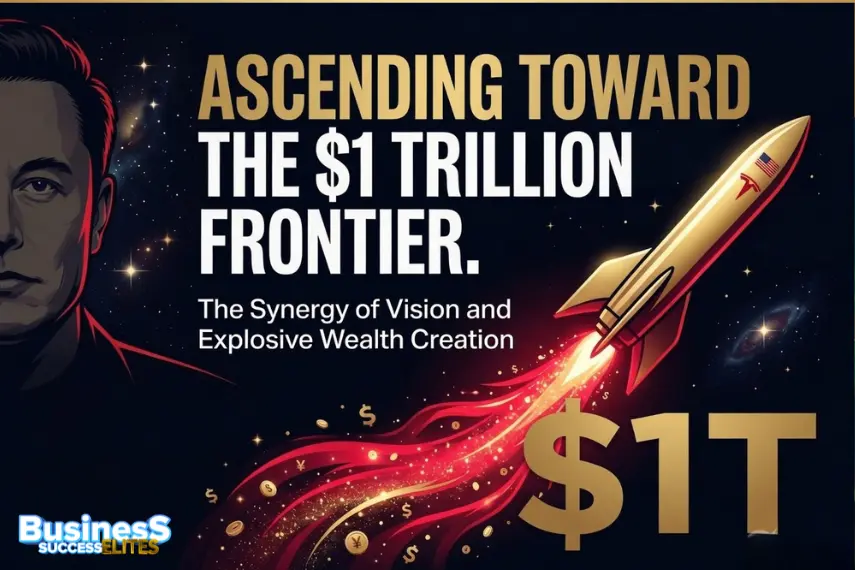
Elon Musk is officially the world’s first trillionaire, or will be by the time Friday’s closing bell rings on Wall Street, assuming the universe cooperates. When SpaceX debuts on the Nasdaq stock exchange on June 12, 2026, the controversial tech titan will almost certainly step into the history books as the wealthiest individual who has ever lived. Not the wealthiest alive. Ever. Just let that sink in between your morning chai and afternoon scroll.
Based on SpaceX’s updated IPO prospectus, Musk owns shares in the company worth more than $866 billion, and that’s before adding his $350 billion-plus stake in Tesla. SpaceX will begin trading at a valuation of $1.77 trillion, selling 555.6 million shares at $135 each. The result? A combined fortune that puts Musk firmly past the $1 trillion mark, a milestone that no government, no emperor, no Mughal dynasty patriarch, no Gilded Age robber baron ever crossed.
$1 trillion is a number so large it stretches the limits of human comprehension. If Musk spent $1 million every single day, it would still take him 2,740 years to exhaust $1 trillion, according to UK charity Oxfam. To be clear, that’s longer than the entire history of Islam, Christianity and most modern nation-states combined. But sure, he’ll figure out something to do with it.
Ranked alongside his billionaire peers, Musk will be more than three times richer than Google co-founder Larry Page, currently the world’s second-richest person with a fortune of $304 billion. Sergey Brin sits third at approximately $285 billion. These men are not broke by any definition of the word. But next to Musk, they’re practically clipping grocery coupons.
To really appreciate how absurd this all is, historians are now reaching back two centuries for comparisons, and still coming up short. John Jacob Astor, widely regarded as America’s first multimillionaire, was worth between $20 million and $30 million, roughly 1 percent of US GDP, when he died in 1848. Steel magnate Andrew Carnegie amassed around $380 million, equivalent to about 0.5 percent of US GDP at the time of his death in 1919. Oil tycoon John D. Rockefeller was worth roughly 1.5 percent of US GDP when he died in 1937.
As a trillionaire, Musk would be worth roughly 3 percent of US GDP. That’s not a flex. That’s a structural problem. One man owning 3 percent of the world’s largest economy is the kind of thing that used to spark revolutions.
Guido Alfani, a professor of economic history at Bocconi University in Milan, put it bluntly: “If we do this, we can surely conclude that Elon Musk might be the wealthiest person who has ever lived, excluding emperors or other rulers whose wealth is not easily distinguishable from that of the state.”
Alfani went further with a thought experiment rooted in labour. Musk could command the work of 557,800 people in 2025. Rockefeller, at his peak, could afford the labour of 116,000. Carnegie managed 48,000. The numbers don’t lie; they just make you profoundly uncomfortable at dinner.
SpaceX went public on June 12, 2026, with a projected valuation ranging from $1.5 trillion to $1.8 trillion, making it one of the largest IPOs in history. The company also disclosed holdings of 18,712 Bitcoin, valued at approximately $1.29 billion as of Q1 2026, because apparently building rockets, launching satellites, running an AI company and owning a social media megaphone wasn’t quite enough for the portfolio.
But not everyone’s popping the champagne. The nonprofit newsroom More Perfect Union published a report alleging that Musk convinced Nasdaq to forgo the usual waiting period to include SpaceX in its index fund, potentially exposing retirement savers to what many professional investors believe will be an overinflated stock price. The report’s author, business reporter Eric Gardner, described it as “a massive wealth transfer from everyday investors to insiders.” So while Musk crosses into trillionaire territory, your 401(k) might be quietly doing the heavy lifting.
Much like the industrialists he’s now eclipsed, Musk has never exactly shied away from political theatre. Since staging a $40 billion hostile takeover of Twitter in 2022, since renamed X, Musk has used the platform as a personal megaphone, promoting right-wing views on immigration, transgender rights and culture war issues. His stint leading the Trump administration’s Department of Government Efficiency was, depending on your politics, either visionary or catastrophic.
Richard Wright, professor of history emeritus at Stanford University, noted that the Gilded Age tycoons were “very good at making and keeping money” but left little else as a legacy: “Some admired them for their wealth. Most of their contemporaries despised them.” Sound familiar?
Where Musk diverges from his predecessors, and perhaps not in the flattering direction, is in giving. Carnegie famously donated 90 percent of his wealth during the last two decades of his life, a sum equivalent to at least $42 billion in today’s money. Musk joined the Giving Pledge in 2012, but the bulk of his philanthropic efforts have been funnelled through the Musk Foundation toward causes that conveniently intersect with his own business ventures. Billionaire investor Peter Thiel, who co-founded PayPal with Musk, reportedly urged him to abandon the pledge entirely, arguing the funds would go to “left-wing nonprofits.” How noble.
Before anyone starts drafting the coronation speech, a word of caution: Daniel Waldenström, a professor of economics at the Research Institute of Industrial Economics in Stockholm, noted that while Musk is likely the richest person who has ever lived, his wealth is not carved in stone: “It may well be that some of Musk’s assets will lose value if reality changes.” Tesla’s stock sank 65 percent in 2022 before soaring again in subsequent years, a reminder that paper trillions have a habit of blowing away in the wrong wind.
SpaceX’s compensation structure for Musk is tied to two milestones: achieving a $7.5 trillion market cap and colonising Mars with at least 1 million inhabitants. So the man’s next pay cheque depends on, among other things, building a human colony on another planet. Normal Tuesday.
What’s undeniable is the broader picture this paints, of a world where one man’s rocket company can manufacture more wealth in a single trading day than most nations accumulate in decades. Whether that’s a triumph of human ambition or a damning indictment of how grotesquely wealth has concentrated in the 21st century is, of course, entirely a matter of perspective.
CXMT Becomes China’s Most Valuable Listed Firm
July 27, 2026White House AI Research Funding Squeezes Colleges
July 23, 2026