Sat, Jul 25, 2026 -
Subscribe & never miss our best posts. Subscribe Now!
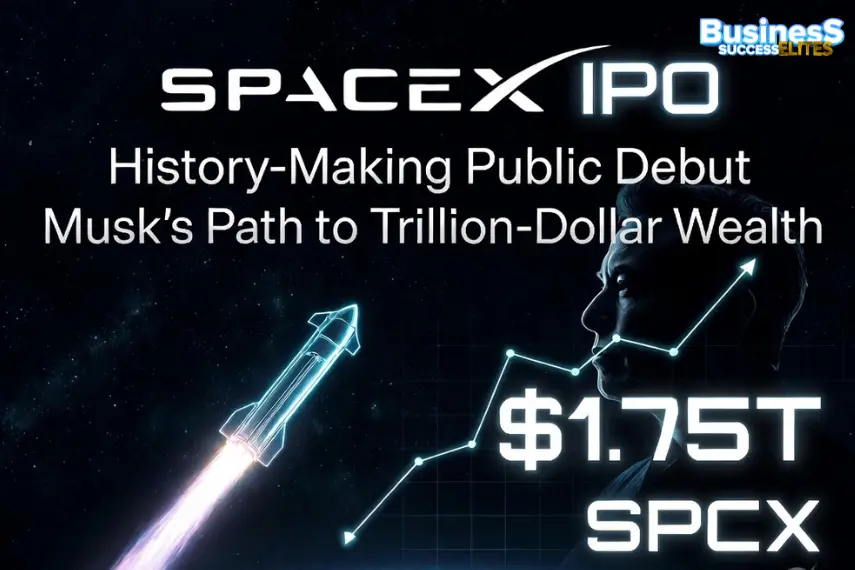
It happened on May 20, 2026, the day Elon Musk finally opened SpaceX’s books to the world. A nearly 300-page prospectus landed at the SEC, marking the beginning of what Wall Street insiders are calling the biggest initial public offering in human history. The SpaceX IPO filing is not just another corporate milestone; it’s a watershed moment that’s already rewriting the rulebook for what a mega-cap company can be.
The numbers tell a story that even Musk’s most ardent believers might find staggering. SpaceX is targeting a valuation of around $1.75 trillion. This figure would instantly cement the rocket company as one of Earth’s five most valuable enterprises, sitting alongside Apple, Microsoft, and Nvidia. To put that into perspective, the last record-breaking IPO was Saudi Aramco’s $29 billion debut back in 2019. This time around, we’re talking about a potential raise of up to $75 billion. That’s roughly three times larger.
Here’s what makes this story so compelling: Elon Musk could become the world’s first trillionaire if SpaceX reaches a $1 trillion valuation. His current net worth hovers around $662 billion. Add the wealth from his SpaceX stake, he controls roughly 42 percent of the company through a combination of Class A and Class B shares, and suddenly, the math starts working in his favour. The filing reveals something that flew under the radar for years: Musk controls 85.1 percent of the company’s voting power, a lock-tight arrangement that basically guarantees he’ll maintain control after going public.
While everyone was focused on Starship and Mars colonisation dreams, Musk quietly built something far more immediately profitable: Starlink. The satellite internet division has become SpaceX’s financial engine, and the IPO filing pulls back the curtain on just how powerful that engine really is.
In 2025 alone, Starlink generated more than $11 billion in revenue, a staggering 50 percent jump from the previous year. But here’s the really impressive part: operating income for that segment grew by more than 120 percent. That’s not just growth; that’s explosive profitability. As of the first quarter of 2026, Starlink boasts 10.3 million subscribers across 164 countries, pulling in $3.26 billion in quarterly revenue while throwing off $1.19 billion in operating profit every three months.
Think about that for a second. Starlink is essentially functioning like a global, satellite-powered internet company with no competitors at scale. In emerging markets where terrestrial infrastructure is sparse, it’s a game-changer. This is the asset that makes investors take a $1.75 trillion valuation seriously.
Let’s not sugarcoat it: SpaceX’s overall financials are messy. The company reported total revenue of $18.67 billion in 2025, but also posted a net loss of $4.9 billion. In the first quarter of 2026 alone, SpaceX racked up $4.69 billion in revenue alongside a staggering operating loss of $1.94 billion.
Why the losses? Much of it traces back to SpaceX’s merger with xAI, Elon’s artificial intelligence company, which closed in February 2026. That all-stock deal valued SpaceX at $1 trillion and xAI at $250 billion, creating a combined entity worth $1.25 trillion. The problem: xAI burned through $6.4 billion in operating losses during 2025 on just $3.2 billion in revenue. In Q1 2026, the bleeding continued, $2.47 billion in losses on $818 million in revenue.
This merger fundamentally transformed what SpaceX is. It’s no longer just a rocket company or even a satellite internet provider. Musk is betting big that SpaceX can become an AI infrastructure giant, with plans to scale Grok into a system with “multiple trillions of parameters.” That requires enormous computing capacity and capital spending. The filing shows xAI represented a whopping 76 percent of SpaceX’s $10.1 billion in first-quarter capital expenditures.
Some investors see this as visionary. Others see it as reckless. The truth probably lies somewhere in between.
Here’s something the filing makes crystal clear: SpaceX isn’t operating with the conventional playbook. The company isn’t one business; it’s actually three, each performing radically differently.
The Space segment generated $4.1 billion in 2025, up just 8 percent year-over-year. Why the modest growth? Because of those 165 Falcon 9 launches SpaceX completed, only 43 were for outside customers. The rest? Reserved for Starlink. This creates an interesting dynamic where SpaceX’s own rocket capacity is partially monopolised by its own satellite service.
The Starlink segment is the money-maker we’ve already discussed, growing fast, profitable, and increasingly essential to people worldwide.
The AI infrastructure segment, born from the xAI merger, is the wildcard. It’s losing billions today but could become the driver of unprecedented value creation if Musk’s bet on orbital AI data centres pays off.
The prospectus reveals that SpaceX signed Anthropic (one of the leading AI labs) to pay $1.25 billion monthly for computing power from its Colossus and Colossus II clusters in Memphis, Tennessee, a deal running through May 2029. That’s $45 billion in committed revenue right there, though it does come with complications given Anthropic’s ties to potential competitors.
Let’s be frank: at $1.75 trillion against $18.7 billion in 2025 revenue, SpaceX is asking investors to pay roughly 95 times trailing revenue. There’s literally no direct comparable in public markets. Apple trades around 5 times revenue. Tesla trades around 10 times. SpaceX is operating in an entirely different universe.
ARK Invest, one of SpaceX’s most vocal supporters, argues the valuation is “grounded in a plausible trajectory” for Starlink, Starship, and orbital AI combined. They project SpaceX could hit $2.5 trillion in enterprise value by 2030, implying roughly 38 percent annual growth from current private valuations. That’s optimistic but not impossible if everything breaks right.
Scottish Mortgage Investment Trust, which holds SpaceX as 19.3 percent of its portfolio, values its stake at a $1.25 trillion implied company value, a full $500 billion below the IPO target. So even friendly shareholders think the IPO price is stretched.
The filing contains something almost poetic: performance-based compensation for Musk that reads like science fiction written into equity documents. Musk was granted 1 billion performance-based Class B shares in January 2026, with vesting conditional on SpaceX establishing a permanent human colony on Mars with at least one million inhabitants. That’s not a traditional bonus plan; that’s literally making his fortune conditional on becoming a multiplanetary civilisation.
More immediately, SpaceX expects Starship to begin payload delivery to orbit in the second half of 2026. The company then plans to use the rocket to launch Starlink V2 satellites beginning in late 2026 and early 2027. These aren’t trivial milestones—they’re make-or-break moments for the entire valuation story.
The prospectus was filed publicly on May 20, 2026, with pricing expected around June 11, 2026, and first trading around June 12. Goldman Sachs, Morgan Stanley, Bank of America, Citigroup, and J.P. Morgan are joint book-running managers, essentially making every major Wall Street firm a stakeholder in making this historic offering work.
Here’s where it gets interesting: SpaceX will trade under the ticker SPCX on the Nasdaq. Importantly, it qualifies for Nasdaq’s new fast-entry rule, meaning it will automatically join the Nasdaq-100 index after just 15 days of trading. This drives what Wall Street calls “forced buying” from ETFs and funds tracking the index, an automatic boost in demand that could fuel a powerful opening.
If the IPO prices at or near the $1.75 trillion target, Elon Musk’s personal wealth will skyrocket. Depending on dilution and his actual shareholding, he could be looking at a net worth pushing toward $1 trillion or beyond. That would make him not just wealthy beyond compare but also the first person to control two separate trillion-dollar publicly traded companies, SpaceX and Tesla.
The broader implications are equally significant. This IPO will rewrite how Wall Street values capital-intensive companies with long-term visionary missions. It validates, in spectacular fashion, the bet on reusable rockets, global satellite internet, and space-based infrastructure. It also bets everything on Elon Musk’s ability to execute, to deliver on Starship, to scale Starlink profitably, and to make orbital AI data centres a real business.
For investors, it’s simultaneously one of the most exciting and most uncertain opportunities in a generation. For Musk, it’s the moment when a private vision becomes a very public test of his ability to change the world.
The May 20, 2026, filing opens SpaceX’s books and opened a window into the future of space exploration, artificial intelligence, and how far one visionary can push the limits of what a company can be.