Sun, Jul 5, 2026 -
Subscribe & never miss our best posts. Subscribe Now!
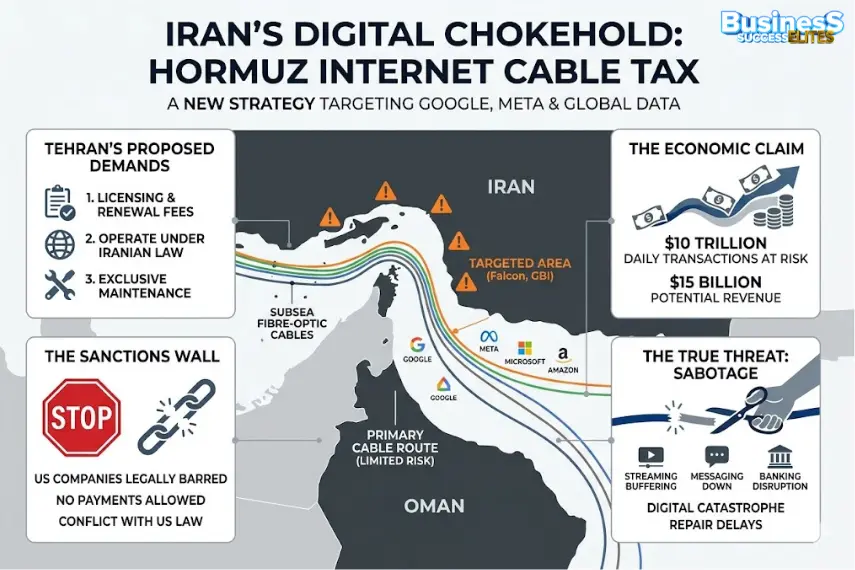
Iran’s military spokesperson declared last week that Tehran will impose fees on the submarine fibre-optic cables beneath the Strait of Hormuz — issuing demands that US companies Google, Meta, Microsoft, and Amazon are legally barred from meeting under American sanctions law. The move is being seen not just as an economic manoeuvre, but as Tehran’s deliberate attempt to turn its geography into something far more durable than a wartime bargaining chip. Iran’s plan to tax Google, Meta, and others over Hormuz internet cables signals that the Islamic Republic has found a second chokehold — one that reaches into the living rooms, bank accounts, and data centres of the entire connected world.
IRGC-affiliated Tasnim News Agency, in an article titled “Three practical steps for generating revenue from Strait of Hormuz internet cables,” wrote that submarine fibre-optic cables passing through the strait carry more than $10 trillion in financial transactions each day, but said Iran has been deprived of economic and sovereign benefits from this critical communications infrastructure.
The outlet said the Islamic Republic should take three steps: charge foreign companies initial licensing and annual renewal fees; require major technology companies such as Meta, Amazon and Microsoft to operate under Iranian law; and give Iranian companies exclusive control over maintenance and repair of the cables. Mostafa Taheri, a member of Iran’s parliamentary Industries Commission, put potential revenues from transit fees at up to $15 billion.
Fars, a second IRGC-linked outlet, described Iran as the ruler of a “hidden highway” in Hormuz, noting that more than 99% of international internet communications are carried through undersea cables and calling disruption to the cables for only a few days something that could cause tens to hundreds of millions of dollars in damage to the regional and global economy.
Tasnim claimed at least seven major communication cables serving Gulf countries pass through the strait, including the FALCON, GBI and Gulf-TGN systems, which connect data centres across Asia, Europe and the Middle East. However, Alan Mauldin, research director at TeleGeography, confirmed that the vast majority of cables traverse the Omani side of the waterway, a deliberate routing choice by international operators who have long treated Iran’s coastline as a security risk. Only the Falcon network and Gulf Bridge International (GBI) run through Iranian territorial waters, primarily serving Gulf states, India, and parts of East Africa.
TeleGeography assessed that cables through the Strait of Hormuz represent less than 1% of global international bandwidth as of 2025. That percentage is relatively small in global terms, but it masks a regionally devastating potential. Countries across the Gulf could face internet and banking disruptions, while India’s outsourcing and technology sectors could suffer major losses if critical data flows are interrupted.
Iran is leaning on the 1982 United Nations Convention on the Law of the Sea to justify its position. Article 79 of UNCLOS says coastal states have the right to establish conditions for cables or pipelines entering their territory or territorial sea. Iranian media outlets have pointed to Egypt as a precedent; Cairo has leveraged the Suez Canal’s strategic location to host many subsea cables, generating hundreds of millions of dollars annually in transit and licensing fees.
Legal experts reject both arguments. UNCLOS Articles 37-44 separately govern international straits like Hormuz, establishing transit passage rights that protect the uninterrupted flow of international navigation and communications, rights that cannot be suspended even in armed conflict, as the 1949 Corfu Channel ruling affirmed. The Egypt analogy fails because the Suez Canal is an artificial waterway excavated through Egyptian land; the Strait of Hormuz is a naturally occurring international strait subject to a different legal framework.
Then there is the sanctions wall. US companies Google, Meta, Microsoft, and Amazon are legally barred from making any payments to Iran under American sanctions law. Isik Mater, director of research at London-based internet monitoring group NetBlocks, described the proposals’ biggest red flag as the call for international tech firms to be forced to formally operate under Iranian law. Under Iranian law, “communications are typically controlled and monitored, before even considering sanctions and geopolitical barriers,” she said — making Iran’s demand “more of a ‘protection’ fee, similar to what they’ve been doing with tankers.”
For all the legal bluster, the deeper fear among analysts is not a licensing dispute. It is a cable cut. Armed with combat divers, small submarines, and underwater drones, the Islamic Revolutionary Guard Corps poses a risk to underwater cables, with any attack potentially triggering a cascading “digital catastrophe” across several continents. Complicating matters further, only one of five cable maintenance ships is currently operational within the Persian Gulf region, meaning repairs, which can typically take weeks or even months, would be severely delayed.
If the submarine cables running through Hormuz were severed, streaming services would buffer or fail, messaging apps would slow or go dark, video calls would drop, and online banking and card payments could be disrupted. Mater noted that “Iranian authorities haven’t hesitated to cut off their own citizens’ connectivity and may well seek to sever external links if demands are unmet.”
Dina Esfandiary, Middle East lead at Bloomberg Economics, framed Tehran’s strategy plainly: “It aims to impose such a hefty cost on the global economy that no one will dare attack Iran again.” That sentiment has found its way inside the halls of the Iranian parliament, with the deputy speaker describing the Strait of Hormuz as “our nuclear weapon.”
The strait, which separates Iran from Oman, is roughly 22 kilometres wide at its narrowest point. Under normal conditions, approximately one-fifth of the world’s oil and liquefied natural gas passes through it. A ceasefire has been in place since April 8 but remains fragile, with President Trump describing it this week as having a “one percent chance” of surviving.
Whether this cable-tax plan is a serious policy or a pressure tactic, Tehran has made one thing unmistakably clear: it is finished thinking of Hormuz as only an oil route. The data flows beneath it, it now believes, are just as powerful a lever, and it intends to use them.
10 Best Marketing Leaders From Asia 2025
July 4, 202610 Most Impactful Women Leaders From Asia 2025
July 4, 202610 Best Tech Leaders From Asia 2025
July 4, 2026