Sun, Jul 12, 2026 -
Subscribe & never miss our best posts. Subscribe Now!
Building People Systems that Outlast Growth Cycles
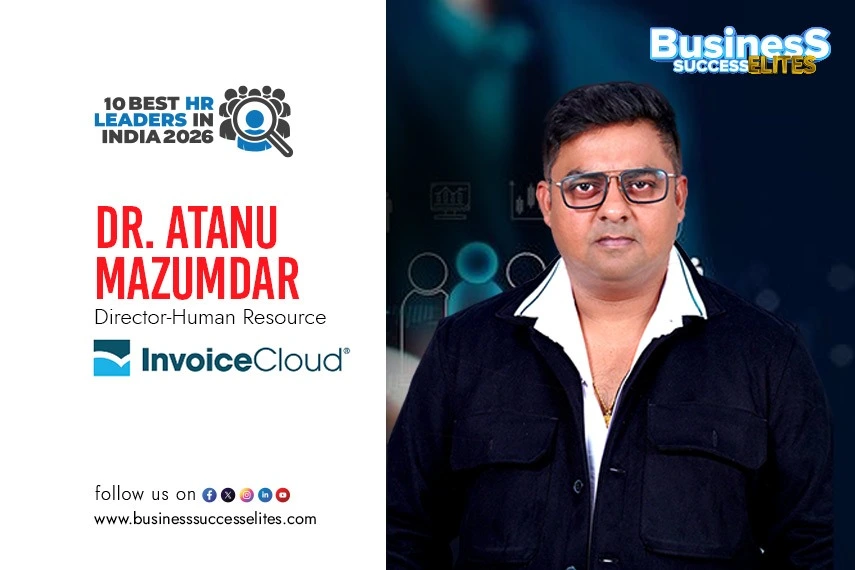
Dr. Atanu Mazumdar, Head of HR at InvoiceCloud India, recently sat down for an insightful conversation with Business Success Elites to share his journey. A strategic leader with 25 years of experience at Amdocs, Avaya, and Sears, he specialises in building high-growth SaaS organisations and leveraging evidence-led talent management to fuel business success.
Please walk us through your career trajectory so far, from your early roles at companies like Amdocs and Avaya to your current leadership position at InvoiceCloud India? What motivated each shift?
Starting from the ground up in operational roles, my career has evolved into a strategic leadership position where I now build and lead talent strategies that fuel business success.
I began my career with KPIT Cummins in their BPO arm, where I laid the foundation in volume hiring, process excellence, service delivery, and workforce operations. My move to Amdocs was a pivotal inflection point. Here, I gained deep exposure to IT hiring, large-scale
campus recruitment, and HR systems (HRIS). I built pipelines for niche skills and realized how data and systems should power long-term workforce strategy.
At Avaya, I specialised in product and engineering hiring within a global tech environment. This role enhanced my leadership hiring experience and my ability to align recruitment with business growth and innovation.
A defining chapter in my career was my 12+ years long at Sears/Transformco India, where I built and scaled the Talent Acquisition function and expanded my role to oversee broader HR functions. I focused on people analytics, workforce planning, policy design, organisational transformation, and large-scale hiring across diverse teams. Most recently, I joined InvoiceCloud India as one of the founding leaders to build the India Global Capability Center from scratch. I oversee all aspects of HR and talent strategy, including hiring, compensation frameworks, culture building, analytics, policies, and leadership development. My motivation in this role is to create a greenfield organisation, scale a high growth SaaS business, and align the workforce with global priorities.
Reflecting on your journey, what unexpected lessons from your time building campus and agency relationships have influenced how you lead teams today?
Looking back on my early experiences building campus pipelines and working with agencies, I realised that true, sustainable growth comes not just from filling roles but from thoughtfully building capabilities over time.
Success at scale isn’t about transactional hiring. It’s about developing talent ecosystems, nurturing campuses into long-term feeders, and partnering with agencies to continuously upgrade skills while emphasising quality over speed. This approach influences how I lead today.
I’ve also learned that rapid growth without maturity leads to fragility. Finding the balance between speed and strength is key to long-term success. The key takeaway is that trust accelerates growth. The ecosystems I built outside the organisation now serve as the framework for designing people systems within it, ensuring long-term business growth.
What do you consider your most significant milestone in talent acquisition, and why does it stand out?
A defining moment in my career came when I led the large-scale ramp-up at Sears/Transformco during 2018 2019. Sears had filed for Chapter 11 bankruptcy, the market was highly competitive, and the company was under intense scrutiny. Despite these challenges, the business needed to rebuild confidence, stabilise operations, and secure critical talent to drive its turnaround.
Over the course of a year, we hired nearly 1,000 professionals. The difference came from our approach–executing continuous hiring drives across cities, engaging over 10,000 candidates while maintaining rigorous standards, transparency, and a consistent candidate experience.
I wasn’t just overseeing from afar–I was on the ground with the recruiters, meeting candidates, supporting difficult conversations, and leading by example. This hands-on leadership kept the team motivated and aligned with our mission, even when skepticism was high.
The Special Supernova Team Award we received was particularly meaningful because it celebrated collective ownership, endurance, and leadership maturity. This milestone continues to shape my leadership approach – focused on humility, hands on execution, and a strong belief in the power of people.
How have you leveraged technology or data driven approaches in HR to enhance employee management and engagement in tech environments?
When I started using AI and data in HR, I realised these tools don’t replace human judgment, they amplify it. By building dashboards to track key metrics like hiring velocity and engagement, we shifted from reacting to issues to predicting and preventing them.
AI-driven recruitment improved our quality of hires and reduced bias, while automation streamlined administrative tasks, freeing up the HR team for strategic work.
Real-time insights from pulse surveys allowed us to address employee concerns as they arose, rather than waiting for annual feedback. AI also positioned HR as a strategic partner, providing insights on workforce trends, skill gaps, and retention risks to guide business growth. Technology gives us the data, but leadership sets the course. Used thoughtfully, AI fosters transparency, trust, and a thriving workplace.
In the fast-paced tech and software billing industry at InvoiceCloud, what are the biggest HR challenges you’ve encountered and what was your approach to overcome them?
At InvoiceCloud, our HR strategy has been designed to leverage data and technology to support our rapid growth and high-performance culture. By using integrated dashboards to track key metrics like hiring velocity, attrition, and engagement, we’ve been able to stay ahead of potential challenges and maintain a proactive approach to HR.
As we scaled, we faced the challenge of ensuring strong alignment across global teams. To address this, we established clear role definitions, shared performance metrics, and encouraged seamless cross-border collaboration.
We also recognised the need to evolve our policies, compensation frameworks, and people processes to keep pace with growth.
What key gaps do you observe in HR practices within the tech sector, particularly around talent management or employee development, and why do they persist?
Reflecting on my experience in the tech sector, one key insight I’ve gained is the disconnect between the rapid pace of business growth and the slower evolution of people systems. In many organisations, hiring often takes precedence over capability building, with growth measured by headcount rather than skill depth or leadership readiness. Employee development is another challenge I’ve observed, where learning is treated as an event instead of an ongoing process. This often results in a misalignment between individual aspirations and the evolving needs of the organisation. Additionally, while HR technology has brought major improvements, I’ve seen that many organisations fail to equip managers with the tools they need to effectively activate talent frameworks.
To bridge these gaps, HR must step up as a strategic partner.. Talent decisions should be part of long-term business planning, with leaders held accountable for people’s outcomes.
What emerging trends in global HR do you believe will most impact tech companies in India, and how are you positioning your strategies accordingly?
From a leadership perspective, I see AI as an enabler of better people’s decisions. One emerging trend that will strongly impact tech companies in India is the move toward evidence-led talent management. This allows leaders to act earlier, design teams more intentionally, and build capability ahead of demand rather than reacting to attrition or skill gaps.
Another important shift is the evolution of employee engagement from programs to signals. Instead of relying on annual surveys or generic initiatives, leaders are beginning to use continuous listening, participation patterns, and sentiment cues to understand how teams
are really doing. The unconventional part is not the data itself, but the expectation that managers respond quickly and visibly, making engagement a leadership responsibility rather than an HR-owned activity.
AI is also subtly influencing how we think about performance and growth. Traditional role definitions and linear career paths are giving way to more fluid models where learning velocity, adaptability, and impact matter as much as experience.
As a young leader, I believe the future of HR lies in challenging rigid frameworks. AI supports this shift, but it does not replace human intent or accountability.
Tech Mahindra Acquires Alyis in Brazil IT Push
July 9, 2026