Sun, Jul 26, 2026 -
Subscribe & never miss our best posts. Subscribe Now!
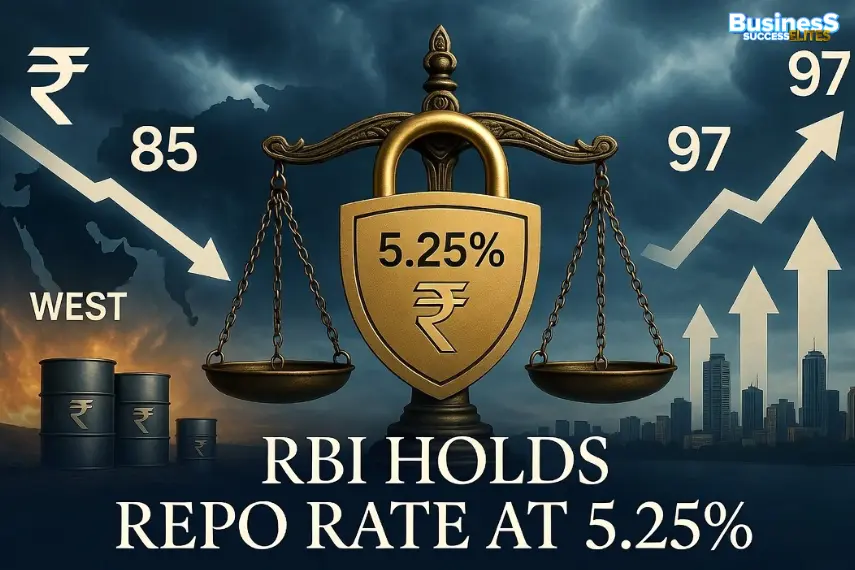
The RBI Monetary Policy Committee has, once again, looked at the chaos around it and done the most bureaucratic thing possible: absolutely nothing. On June 5, 2026, Governor Sanjay Malhotra announced that the six-member MPC unanimously decided to hold the repo rate steady at 5.25 per cent, with the neutral policy stance firmly intact. This is the second consecutive policy review in which the rate has been left untouched, with the committee citing rising crude oil prices, West Asia conflict-related supply disruptions, and a depreciating rupee as key concerns.
To be fair to the RBI, it is not an easy call when the world is actively conspiring against you.
Let’s rewind a bit, because the RBI did not always play it this cautiously. The central bank had reduced the repo rate by a cumulative 125 basis points since February 2025, bringing it down from 6.5 per cent all the way to 5.25 per cent. That was a reasonably bold easing cycle, three 25-basis-point cuts and one aggressive 50-basis-point slash, all while keeping a careful eye on inflation and growth.
The MPC’s previous rate cut came in December 2025, when it unanimously reduced the benchmark rate by 25 basis points to 5.25 per cent from 5.5 per cent, projecting GDP growth for FY26 at 7.3 per cent and slashing the inflation forecast to 2 per cent. At that point, things looked genuinely promising. Inflation was well under control, food prices were soft, and the Indian economy was humming along. Then came 2026.
Nothing quite kills a rate-cut party like a geopolitical crisis on the other side of the world that directly hits your fuel import bill. A three-month-long conflict in West Asia has disrupted energy supplies, leading to a surge in crude oil prices and creating fiscal and inflationary pressures for import-dependent countries like India.
India, which imports the bulk of its crude oil requirements, is particularly exposed. Higher energy costs don’t just show up at the petrol pump; they creep into the prices of everything from vegetables to plastic to freight. The RBI knows this playbook well, and it is not about to cut rates and hand inflation a running start.
The MPC raised its retail inflation projection for FY27 to 4.6 per cent from 4.2 per cent, a sign that the committee sees the price pressure building in the months ahead. That alone is enough reason for any sensible central banker to keep the powder dry.
Then there is the rupee problem, which deserves its own paragraph and possibly its own therapy session. The rupee settled at a record closing low of 96.86 against the US dollar on May 20, 2026, dropping 33 paise in a single session. Once considered among Asia’s more stable currencies, the rupee has become one of the worst-performing emerging market currencies this year, pressured by expensive oil, capital outflows, widening trade deficits, and a surging US dollar. It has depreciated about 7 per cent so far in 2026 and is down roughly 6 per cent since the outbreak of the Iran conflict in late February.
A rate cut at this moment would likely accelerate those outflows further. According to Reuters, rate hikes by oil-importing peers such as Indonesia, the Philippines, and Sri Lanka have reinforced bets that the RBI could eventually be forced down a similar path, though India’s central bank does not favour using monetary policy action to defend the rupee. Governor Malhotra has been clear that the RBI won’t raise rates just to prop up the currency. That’s a principled stance. Whether markets buy it is another matter.
Here is the twist in the story: current inflation is actually quite well-behaved. The Consumer Price Index-based headline retail inflation came in at 3.48 per cent in April 2026, well within the RBI’s medium-term target of 4 per cent. That number alone might have justified a cut in calmer times.
But the MPC is not looking at April’s numbers in isolation. It is squinting at the horizon, and what it sees there is not particularly reassuring. There is fear of inflation inching up due to expectations of a weak monsoon and fuel price rises in the coming months. Add to that the rupee’s depreciation feeding into imported inflation, and the committee’s caution starts to make a lot of sense.
To the RBI’s credit, it has not entirely abandoned its optimism about growth. The MPC projected GDP growth for FY27 at 6.9 per cent and revised FY26 growth to 7.6 per cent. Those are solid numbers for an economy navigating external headwinds of this magnitude.
The neutral stance, maintained since the June 2025 meeting, signals that the MPC is neither in panic mode nor in party mode. It is watching. It is waiting. And it is telling the market, in the most diplomatic language possible, that the next move could go either way depending on how the next few months unfold.
For the millions of Indians paying home loans, car loans, and personal loans, the conclusion is simple and slightly anticlimactic: nothing changes today. If the RBI leaves the repo rate unchanged, there is no immediate impact on loan EMIs. However, experts advise households to remain financially prepared, maintain adequate emergency savings, and avoid taking on excessive debt at a time when inflation and interest-rate uncertainties remain elevated.
In other words, don’t go on a borrowing spree just yet. The RBI may have held fire this time, but if West Asia does not stabilise and energy prices remain elevated, a rate hike in H2 FY27 can no longer be dismissed as a tail risk; it is a scenario markets may not be fully pricing in.
What the June 5 decision ultimately reflects is an RBI caught between two uncomfortable truths: domestic economic fundamentals are broadly healthy, but the external environment is genuinely treacherous. Governor Sanjay Malhotra and his committee have chosen to stand still, not out of indecision, but out of a deliberate reading that the risks of acting outweigh the risks of waiting.
That may not be the exciting rate-cut headline that borrowers were hoping for. But in a year where the rupee is flirting with 97 to the dollar and crude oil is playing havoc with emerging market budgets, a central bank that holds its nerve is arguably doing exactly what it should.
The MPC will meet again in August 2026. By then, hopefully, the monsoon will have behaved itself, West Asia will have calmed down, and the committee will finally have something more cheerful to announce. For now, it is 5.25 per cent.