Mon, Aug 3, 2026 -
Subscribe & never miss our best posts. Subscribe Now!
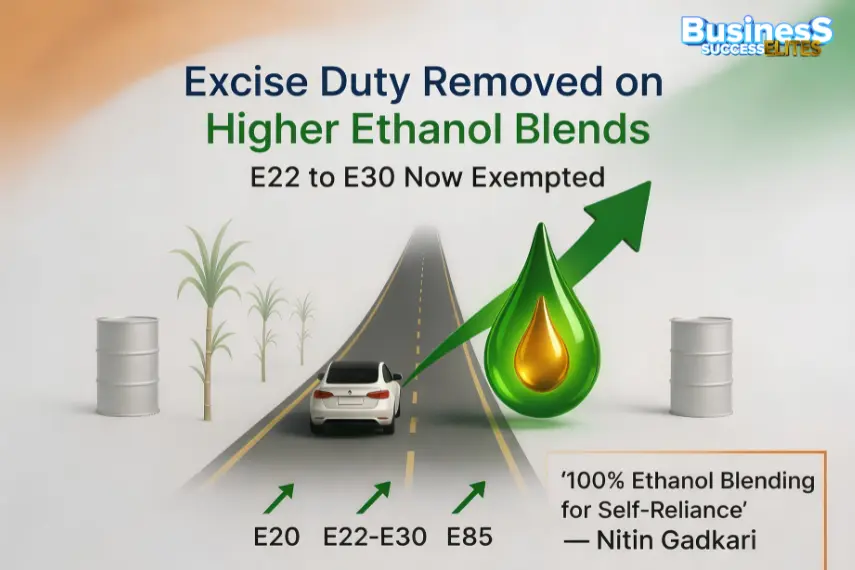
The Centre has officially removed excise duty on higher ethanol fuel, and if you thought that meant cheaper petrol by the weekend, well, bless your optimism. The Finance Ministry quietly issued a gazette notification on June 11, 2026, exempting petrol blended with 22 to 30 percent ethanol central excise duty under Section 5A of the Central Excise Act, 1944. The blends covered are E22, E25, E27, and E30, all conforming to Bureau of Indian Standards specifications.
So yes, it’s a big deal. Just not the kind that immediately makes your wallet feel lighter at the pump.
Let’s break down what these blends actually look like in the tank. E22 will contain 78 per cent motor spirit and 22 per cent ethanol, E25 will consist of 75 per cent motor spirit and 25 per cent ethanol, E27 will have 73 per cent petrol and 27 per cent ethanol, while E30 will contain 70 per cent petrol blended with 30 per cent ethanol.
These are not your neighbourhood petrol pump varieties, yet. The revised structure includes E22, E25, E27, and E30 petrol, defined as mixtures of motor spirit and ethanol in specified proportions, with applicable central, state, Union Territory or integrated taxes on ethanol and duty-paid petrol components. In plain English: the excise duty component on the final blended product is now nil. Whether the oil marketing companies pass this on to you is, as always, their call.
India has been on an ethanol blending march for over a decade now, with varying degrees of seriousness and success. The share of ethanol in petrol has risen from 1.5 per cent in 2014 to 10 per cent in June 2022, with the 20 per cent blending target achieved ahead of schedule. “From 2014 until now, we have increased ethanol blending from 1.5 per cent to 10 per cent, which was achieved in November 2022. Our target was to achieve 20 per cent blending by 2030, but we completed it in 2024 itself,” Union Petroleum and Natural Gas Minister Hardeep Singh Puri said.
That’s genuinely impressive, regardless of your views on government policy. Going from 1.5 per cent to 20 per cent blending in roughly a decade is not something that happens by accident; it takes regulatory nudges, procurement pricing adjustments, and yes, excise duty exemptions exactly like this one.
The government had earlier advanced the 20 per cent blending target to ethanol year 2025-26, scrapping the earlier 2030 deadline. The government has also advanced the target of 20 per cent ethanol blending in petrol to ethanol in the year 2025-26 from the earlier target of 2030.
And now that E20 is essentially done and dusted, the next frontier is E22 to E30, which is precisely what this exemption is designed to unlock.
Nobody in Indian politics has spoken about ethanol fuel with as much enthusiasm and frequency as Union Minister for Road Transport and Highways Nitin Gadkari. He has repeatedly argued that greater ethanol adoption can help reduce pollution, lessen India’s dependence on fossil fuel imports, and create an additional revenue stream for farmers through the use of agricultural produce and residues for fuel production.
Gadkari recently said India should aspire to achieve 100 per cent ethanol blending in the near future to become self-reliant in the energy sector. That’s a goal that would have sounded like fantasy ten years ago. Given India’s trajectory, it no longer sounds completely insane.
Farmers supplying sugarcane, maize, and other raw materials have been direct beneficiaries of the programme. Indian farmers received around Rs 40,000 crore for supplying sugarcane, maize, and other raw materials for the ethanol blending programme, according to figures Gadkari has cited. That’s not a rounding error; that’s a meaningful transfer of resources to the agricultural economy, and it’s exactly the kind of thing the BJP government likes to trumpet, for good reason.
In a parallel development that further signals the direction of travel, India launched E85 fuel, a high-ethanol blend designed for flex-fuel vehicles, at a ₹20 per litre discount to normal petrol. The fuel will initially be available at select petrol pumps and can be used only in vehicles with flex-fuel engines. The government plans to expand its availability to 500 outlets by December 2026 and to about 5,000 outlets by December 2027. E85 contains 80 to 85 per cent ethanol and 14 to 19 per cent petrol, and can be used only in flex-fuel vehicles capable of operating on ethanol blends ranging from E20 to E100.
So the roadmap is clear: E20 is mainstream, E22 to E30 is the next rung being incentivised today, and E85 is already on petrol station forecourts for those with compatible vehicles. The government is essentially building a ladder, one exemption at a time.
Here’s where expectations need a reality check. The announcement does not immediately translate into lower retail petrol prices for consumers. The exemption primarily seeks to incentivise the production and distribution of higher ethanol blends, with any impact on pump prices likely to depend on broader pricing decisions by oil marketing companies.
In other words, don’t hold your breath at the pump. The excise waiver makes it more economically attractive for oil marketing companies to blend and distribute higher-ethanol fuels. What they do with that margin is another story entirely.
This is the question most car owners will have, and it’s worth addressing honestly. Vehicles sold after April 1, 2023, are manufactured to be compatible with E20 standards. Vehicles sold before April 1, 2023, are compatible with E10 fuel, while those sold after this date are made with materials compliant with E20 standards. Compatibility with E22 and beyond will depend on when the next generation of flex-fuel vehicles enters the mainstream market.
If you’re driving an older car, the higher-blend fuels being incentivised today aren’t for you yet. But for anyone purchasing a vehicle in the next two to three years, the flex-fuel infrastructure the government is building will increasingly matter.
India is the world’s third-largest oil importer. Every percentage point of ethanol blending achieved translates into real savings on the import bill and reduced exposure to global crude price volatility, something that has stung the Indian economy badly in recent years. The government’s own figures suggest that the ethanol blending programme has already saved significant foreign exchange. Gadkari has been pushing for promoting green fuel like ethanol to reduce India’s huge Rs 8 lakh crore crude import dependence.
That Rs 8 lakh crore figure is worth sitting with. That’s how much India spends importing crude oil annually, money that could otherwise stay within the domestic economy, strengthen the rupee, and fund everything from highways to hospitals.
The excise duty exemption on E22 to E30 petrol blends is a significant, if unglamorous, policy move. It won’t make headlines for long, and it won’t reduce the pain at the petrol pump this week. But as part of India’s steady, decade-long push toward ethanol blending, it represents another credible step in a programme that has, against considerable scepticism, actually delivered results.
Whether the oil marketing companies price these blends attractively, whether the vehicle ecosystem catches up fast enough, and whether India can sustain the agricultural feedstock supply for these ambitions, those remain the real questions. For now, the tax barrier is down. The rest is execution.
Hitesh Agarwal, COO, ACE | Business Success Elites
August 1, 2026