Mon, Aug 3, 2026 -
Subscribe & never miss our best posts. Subscribe Now!
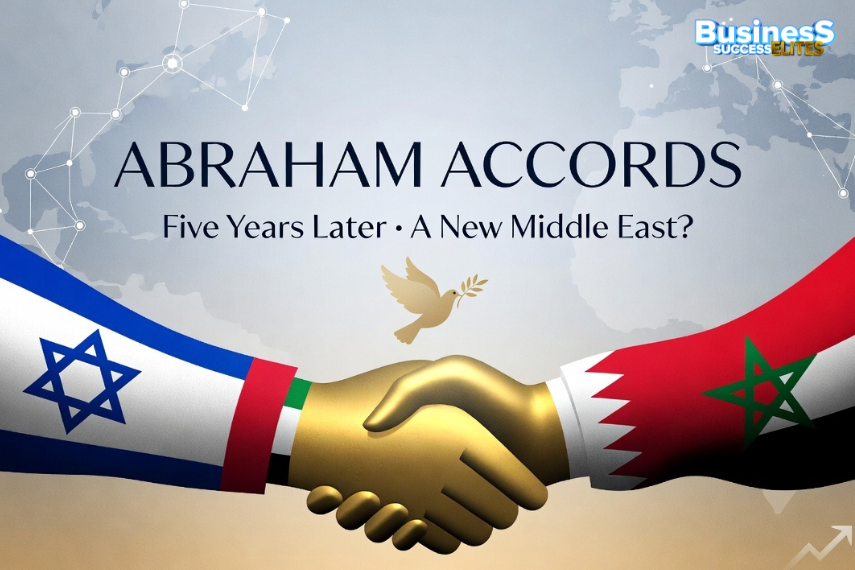
The Abraham Accords caught the world off guard. On a sunny afternoon at the White House on September 15, 2020, something remarkable happened: two Arab nations officially agreed to normalise relations with Israel. Not Egypt, not Jordan (who’d already done so decades earlier), but the United Arab Emirates and Bahrain. The flags of three countries flew side by side in front of cameras as diplomats signed documents that shattered a geopolitical taboo that had held firm for over 70 years.
“This is the most significant thing we can do,” declared Emirati Foreign Minister Sheikh Abdullah bin Zayed, standing in the Rose Garden. For a moment, it felt like the impossible had become inevitable.
Five years later, the Abraham Accords remain a complicated legacy—one that generated both genuine economic opportunities and simmering resentment across the Arab world.
Four countries formally signed up to the Abraham Accords framework. Let’s break down who they are and what their signatures meant:
The United Arab Emirates stepped up first. For the Emirates, the decision made strategic sense. The leadership wanted to counter what they saw as Iranian regional influence, and Israel’s advanced military technology and intelligence capabilities offered protection. But there was a catch: it meant abandoning the longstanding Arab position that normalisation with Israel couldn’t happen without solving the Palestinian crisis first. That’s a massive shift in Arab diplomacy, one that had held for generations.
The UAE’s move opened the floodgates. If Abu Dhabi could take this leap, others reasoned, maybe they could too.
Bahrain joined within weeks. The tiny island kingdom, sandwiched between Saudi Arabia and Qatar, saw an opportunity for economic partnership and security cooperation. But here’s the reality: Bahrain has a predominantly Shia Muslim population, and Iran sits right across the Gulf. Normalising ties with Israel meant hedging against Tehran’s influence. That’s geopolitics speaking louder than public sentiment.
Morocco came aboard in December 2020, but with a twist. The US officially recognised Moroccan sovereignty over Western Sahara, a contested territory, as part of the bargain. This was diplomacy and transactional horse-trading at its finest. For Rabat, the payoff included direct flights to Israel and potential trade in agriculture and tourism.
Sudan signed the general declaration but never quite sealed the deal with a bilateral agreement. Why? The country descended into civil war in 2023, and domestic instability made formal normalisation impossible. Sudan remains in limbo, technically a participant but practically sidelined.
Kazakhstan became the most recent joiner in November 2025, during Trump’s second presidential term. But here’s what caught observers off guard: Kazakhstan had already maintained diplomatic relations with Israel since 1992. Its formal accession felt more ceremonial than revolutionary.
The refusals matter just as much as the signings. The big one everyone was watching? Saudi Arabia.
Crown Prince Mohammed bin Salman had every reason to normalise ties with Israel. The shared fear of Iran’s growing regional power created natural alignment. In September 2023, the deal seemed tantalisingly close, so close that MBS told Fox News “every day we get closer” to normalisation, calling it “the biggest historical deal since the end of the Cold War.”
Then came October 7, 2023. Hamas attacked Israel, and Israel responded with devastating force in Gaza. In the months that followed, more than 69,000 Palestinians died, triggering global outrage and reigniting Arab public fury.
Suddenly, Crown Prince bin Salman’s political calculus shifted. Saudi Arabia remains the custodian of Islam’s two holiest sites, Mecca and Medina. For him to normalise with Israel without a concrete pathway to Palestinian statehood would spark a firestorm among Saudi citizens and across the Muslim world. When Trump met with MBS in November 2025 and pressed hard for Abraham Accords membership, the Crown Prince pushed back. “Saudi public opinion is highly anti-Israel,” MBS explained, according to White House officials.
The truth? Saudi Arabia is playing the long game. It can afford to hold out because it doesn’t need Israel economically; it’s already got US protection, weapons sales, and its own Vision 2030 development plan. Unlike the UAE, which moved quickly to build commercial ties with Israel, Riyadh can negotiate from strength.
Pakistan also said no, and the reasons are straightforward. Islamabad maintains strong ties with both Saudi Arabia and the Palestinian cause. For Pakistan’s government to recognise Israel while Gaza was burning would trigger domestic political chaos. Public opinion in Pakistan remains deeply sympathetic to Palestinians, and any government that normalises relations with Israel without Palestinian statehood would face a massive backlash.
Egypt and Jordan, the only Arab nations with existing peace treaties with Israel, never signed the Accords. They didn’t need to; they’d already formalised relations decades earlier. Most other Arab states, meanwhile, remained spectators rather than participants, watching how events unfolded.
Palestinian Authority President Mahmoud Abbas didn’t mince words. He called the Abraham Accords “a stab in the back of the Palestinian people.” His anger wasn’t theatrical; it reflected a genuine strategic shift in Arab politics.
For decades, the Arab League had maintained a unified position: no formal relations with Israel until there was a Palestinian state with East Jerusalem as its capital. The Accords demolished that consensus. Suddenly, Arab governments were saying normalisation could happen independently of Palestinian interests. The Palestinian cause wasn’t front and centre anymore; strategic national interests were.
Abbas condemned the agreements because they reinforced a core belief among Palestinians: they’d been abandoned. The Arab states that were supposed to be their allies had struck deals without them at the table. It felt like the Arab world had moved on.
If you’re keeping score by trade volumes and business partnerships, the Abraham Accords actually delivered.
The Israel-UAE relationship has been the star performer. In 2021, bilateral trade reached over $570 million. By 2025, Israel-UAE trade hit approximately $4 billion annually, making it one of the fastest-growing bilateral economic partnerships in the region. Direct commercial flights started operating between Tel Aviv and Abu Dhabi, and Israeli tourists began flooding into the Emirates. Israeli companies found new markets; Emirati investors found Israeli tech startups.
Morocco opened its doors to the Israeli agricultural and tourism sectors. Bahrain and Israel signed security cooperation agreements, including intelligence sharing and drone sales. These aren’t ceremonial gestures; they’re functioning economic relationships.
The real explosion came in 2025. Private investment activity surged. According to StartUp Nation Central research, private funding across Abraham Accords countries jumped from $35 million in 2024 to $186 million in 2025, a whopping 431% year-over-year increase. That’s technology companies collaborating, venture capital flowing, and innovation accelerating.
A $2.3 billion defence contract for Elbit Systems to provide air defence solutions to the UAE shows that even military-industrial cooperation is deepening. These are the tangible economic outcomes that the Accords’ architects pointed to when defending the deal.
The economic momentum hit a wall in October 2023 when Hamas attacked Israel and Israel launched its retaliatory campaign in Gaza. Arab publics were outraged, the images of Palestinian suffering dominated headlines and social media across the Arab world.
The signatories didn’t formally withdraw from the Accords, but they publicly criticised Israeli military operations. The UAE’s officials warned that Israeli plans to annex parts of the occupied West Bank could jeopardise bilateral relations. Morocco expressed concern. Bahrain maintained its agreements, but the enthusiasm evaporated.
Here’s the brutal honesty: the Accords were designed for government-to-government diplomacy, not for mass public support. They were insulated from popular sentiment by design. When millions of Arabs were mourning Palestinian deaths on social media, their governments were still signing trade agreements with Israel. That contradiction didn’t collapse the agreements, but it exposed their fragility.
The Abraham Accords matter because they represent a fundamental realignment of Middle Eastern geopolitics. For the first time in decades, Arab states are pursuing their national strategic interests independent of the Palestinian cause. That’s a seismic shift.
Originally, the Accords were framed around countering Iranian influence. Israel and the Gulf states shared a common adversary. But that strategic alignment has cracked. Israel pursued a maximalist military approach against Iran and its allies, while Gulf states sought stability and normalised ties with Tehran. These divergent paths suggest the original glue holding the Accords together may be weakening.
The Accords sidestepped rather than solved the Palestinian problem. Palestinian statehood remains a distant prospect. Israeli settlements in the West Bank have actually expanded since 2020. The Oslo Accords framework for Israeli-Palestinian peace, signed in 1993, has been dormant since 2014. Nothing fundamental has changed for Palestinians except that they’ve lost Arab diplomatic support.
President Trump has made expanding the Accords a priority of his second term. His administration is pursuing Saudi Arabia, Syria (after the toppling of Bashar al-Assad in December 2024), Lebanon, and potentially Azerbaijan. Whether these attempts succeed depends on whether the conditions that favoured the original signings still exist—or whether the Gaza war and Palestinian suffering have permanently altered the political calculus.
Arab street sentiment toward the Accords has soured significantly since 2020. What initially seemed like visionary leadership now feels to many like a betrayal. Emirati officials and diplomats have faced criticism at home. For future expansion to succeed, governments will need either to find ways to build public consent or to accept that their normalisation with Israel will remain unpopular domestically.
The Abraham Accords didn’t create peace in the Middle East; no fighting has stopped because of them. None of the signatories was at war with Israel in the first place. What they did was formalise a shift that had been happening quietly for years: Arab states prioritising their national interests over pan-Arab solidarity.
That’s not necessarily bad for regional stability. Trade, tourism, technology partnerships, and security cooperation can build relationships that reduce misunderstandings and create mutual interests in avoiding conflict. The UAE and Israel have developed genuine ties that go beyond diplomatic documents.
But it’s also incomplete. A region that hosts over 400 million people can’t achieve sustainable peace if a significant portion of the population feels abandoned by their governments. Palestinians watching from Gaza or the West Bank, seeing Arab governments normalise with Israel while their own situation deteriorates, feel that abandonment viscerally.
The big question hanging over 2026 is whether the Accords can expand beyond their current membership. Saudi Arabia is the prize everyone wants but can’t get. The kingdom’s crown prince has made clear that public opinion and Palestinian statehood remain obstacles he can’t overcome, at least not in the immediate term.
Syria’s government transition under new leadership has opened a door to potential discussions, but Syria faces massive domestic reconstruction needs. Lebanon remains consumed by economic crisis and political paralysis.
The real test may come if the Gaza conflict resolves and humanitarian conditions improve. That might reset the political calculations for countries like Saudi Arabia. Conversely, if Palestinian suffering continues and Israeli annexation plans proceed, the Accords may struggle to attract new members.
Japan, US Yen Intervention Signals Historic Currency Truce
August 3, 2026