Fri, Jul 24, 2026 -
Subscribe & never miss our best posts. Subscribe Now!
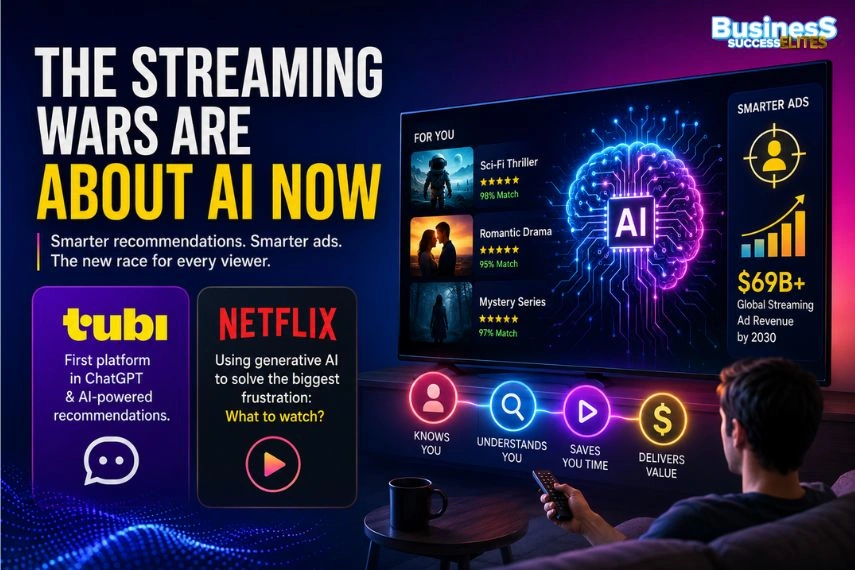
The streaming wars are about AI now. Not about who owns the biggest content library. Not about who can outbid whom for the next big franchise.
For years, streaming platforms competed by stockpiling shows and movies. That race has quietly given way to something else. Companies from Netflix to Tubi are now racing to embed AI into every corner of the viewing experience, from what gets recommended to which ads show up mid-episode.
Tubi made the first big move. It became the first streaming platform to plug its app directly into ChatGPT earlier this year. The free, ad-supported service also leans on large language models to predict what viewers will want to watch next, building what it calls hyper-personalised recommendations.
Netflix is chasing the same goal from a different angle. Elizabeth Stone, the company’s chief product and technology officer, told the Bloomberg Tech conference last month that generative AI helps ease a common frustration: not knowing what to watch. It’s a small line, but it says a lot about where the industry’s priorities have shifted.
Here’s the part most headlines miss. The push toward AI isn’t really about entertainment. It’s about advertising.
PwC’s Global Entertainment & Media Outlook projects that global streaming video ad revenue will hit close to $69 billion by 2030. That would make up over 22% of total streaming revenue. Better AI-driven personalisation means better-targeted ads, and better-targeted ads mean more money.
Viewers, it turns out, are willing to play along. Nearly 70% of respondents in a Hub Entertainment Research survey said they’d tolerate ads if it meant paying less for their subscriptions. Gen Z was even more open to the trade-off, preferring targeted ads over a flood of irrelevant ones.
Jon Giegengack, principal at Hub Entertainment Research, put it simply: audiences care less about AI making content and more about AI removing friction from the process of finding something good to watch.
Not everyone is sold on AI’s growing role, though. A Gartner-published survey found that 49% of U.S. consumers believe generative AI has made content quality worse. Among Gen Z and millennials, that number climbs to 57%.
Kate Muhl, a vice president and analyst at Gartner Marketing, noted that AI-generated content is flooding feeds without necessarily adding value for viewers.
Reid Litman of Ogilvy Consulting sees a generational split forming. Younger audiences, he explained, are quick to embrace AI when it expands what they can create. But they grow resentful when it replaces the craft and judgment of actual people.
Also read – Hyundai EV Charging Points Hit 30,000+ On myHyundai
Despite the scepticism, media companies aren’t slowing down. Disney reportedly planned to roll out AI-generated TV ads this month, aimed at helping smaller brands produce spots on tighter budgets. That follows Disney’s earlier talks with OpenAI about bringing Sora-generated content to Disney+, a plan that stalled after OpenAI shut down its video app.
Amazon, meanwhile, launched its GenAI Creators’ Fund, handing creators both money and AI tools. Three animated series have already been greenlit under the initiative.
The next phase of the streaming wars won’t be won by whoever has the deepest content vault. It’ll be won by whoever can use AI to make viewers feel understood, without making them feel replaced. That’s a much harder balance to strike, and right now, nobody’s fully cracked it.