Fri, Jul 17, 2026 -
Subscribe & never miss our best posts. Subscribe Now!
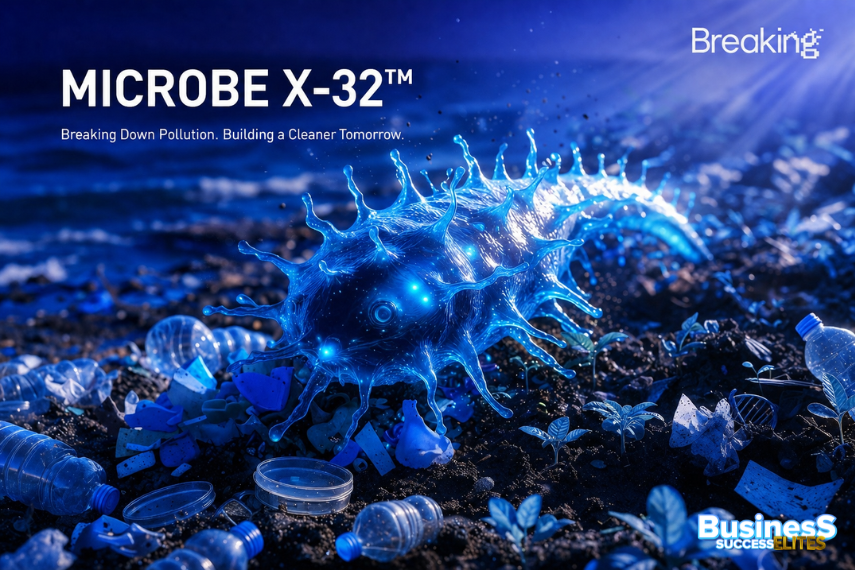
There are approximately 5,000 million tonnes of plastic already sitting in landfills, oceans, and ecosystems around the world. Every year, 390 million more tonnes are added. Scientists have found plastic particles in Antarctic sea ice, in the deepest ocean trenches, and in human blood. Bottled water alone contains almost a quarter of a million nanoplastic fragments per litre.
The plastic crisis is not approaching. It is already here. A startup called Breaking thinks biology is the answer, and it may be right.
Breaking is a plastic degradation and synthetic biology company. It was spun out of Colossal Biosciences, the world’s first de-extinction company, in April 2024. It launched publicly with $10.5 million in seed funding and a single, world-changing discovery: a naturally occurring microbe called X-32.
The company is headquartered in Boston, Massachusetts and Dallas, Texas. Its founding team is exceptional by any measure. Breaking was co-founded by:
X-32 was originally discovered by researchers at the Wyss Institute at Harvard, and Breaking was built specifically to turn it into a commercial product capable of operating at a global scale.
X-32 is a microorganism. In its natural state, it can degrade polyolefins, polyesters, and polyamides, three of the most common and most persistent plastic families on earth, leaving behind only carbon dioxide, water, and biomass. No toxic byproducts. No secondary pollution.
In testing, X-32 has broken down 90% of certain plastic samples in as little as 22 months. Breaking has demonstrated this across everyday plastic products, including paintbrush bristles, fishing wire, and dental floss, materials notoriously resistant to conventional degradation.
The team is not stopping at X-32’s natural capability. Using synthetic genetic engineering, they are actively working to make the microbe faster, more efficient, and effective across a wider range of plastics, while maintaining a harmless environmental footprint.
Early applications are focused on controlled environments: food waste facilities, industrial wastewater systems, and bioreactors, spaces where the microbe’s behaviour can be monitored and its safety guaranteed before wider deployment.
The scale of the problem Breaking is addressing is almost impossible to overstate. Plastic production has increased by 22,400% since 1950. Of all the plastic ever produced, only 9% has ever been recycled. Conventional recycling infrastructure cannot keep pace with production volume, cannot process all plastic types, and cannot reach plastic already dispersed in marine environments.
Breaking’s biological approach addresses what mechanical and chemical recycling cannot: the degradation of plastic already out in the world, in environments where traditional infrastructure will never reach.
If X-32 can be successfully commercialised and scaled, the implications extend well beyond plastics. The same biological platform has potential applications in food waste processing, compostable materials, and carbon reduction, because X-32’s byproducts include biomass that can be converted into energy.
CEO Sukanya Punthambaker has been direct about the ambition: “In the future, our solution will be able to work across terrestrial and marine environments to break down today’s greatest threat to humankind: the plastic that is choking our world.”
Breaking benefits from a founding team that is unusually credentialed, even by the standards of deep-tech startups. George Church is one of the most cited geneticists in the world. Donald Ingber built the Wyss Institute into one of the most productive bioinspired engineering research centres on the planet. Sukanya Punthambaker has spent decades in synthetic biology, specifically targeting this kind of application.
The Colossal connection matters too. Colossal was built around the premise that genetic tools powerful enough to restore extinct species can be redirected toward environmental restoration. Breaking is a direct application of that principle, turning the same CRISPR and synthetic biology toolkit toward plastic pollution rather than mammoth revival.
As Ben Lamm put it at launch: “Part of our core mission of ecosystem restoration at Colossal can only be achieved by removing plastic that plagues our ecosystems and negatively impacts biodiversity.”
Also Read – How An AI Copilot Is Fixing America’s Mental Health Crisis
Breaking is currently in the commercialisation phase, focusing on industrial pilot environments where X-32 can be deployed safely and monitored rigorously. The team’s near-term priority is scaling throughput and broadening the range of plastics X-32 can degrade through targeted genetic edits.
The regulatory pathway for environmental microorganism deployment is complex, particularly for marine use, and Breaking is approaching it with appropriate caution, building the safety and efficacy data needed to support broader deployment over time.
The startup remains one of the most watched names in synthetic biology and clean tech. In a sector crowded with incremental innovation, Breaking represents something genuinely different: a biological solution to a problem that chemistry and engineering have failed to solve for 70 years.
The plastic crisis created itself one discarded item at a time. Breaking intends to undo it the same way, one microbe at a time.
Founded: April 2024
Headquarters: Boston, MA and Dallas, TX
Funding: $10.5M seed round (Builders VC and others)
Core Technology: X-32 plastic-degrading microbe
Website: breaking.com
IEA Sees First Global Oil Demand Decline Since 2020
July 17, 2026Arcadis Names Jana Belyusova as Chief People Officer
July 16, 2026Xi’s AI Diplomacy Takes the Stage in Shanghai
July 16, 2026