Fri, Jul 17, 2026 -
Subscribe & never miss our best posts. Subscribe Now!
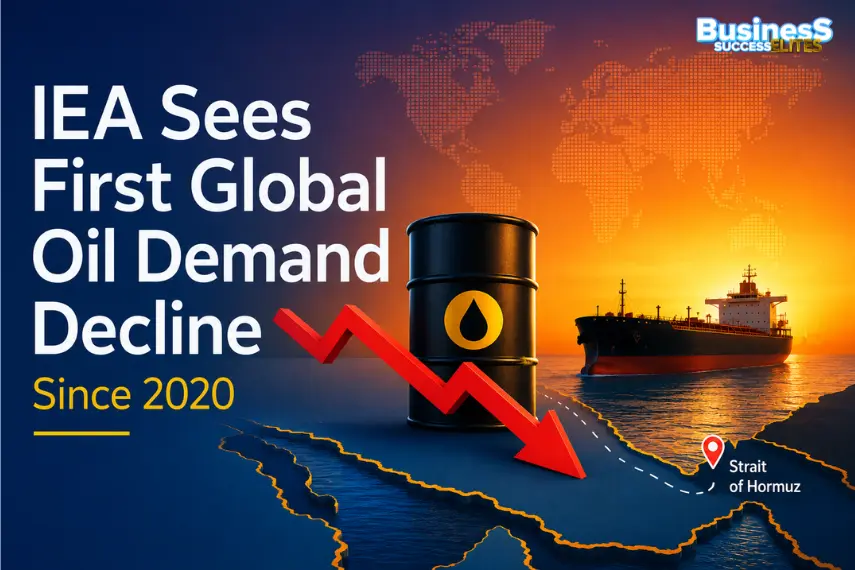
A global oil demand decline is coming, and it’s the kind of headline the industry hasn’t printed since 2020. The International Energy Agency says the world will burn roughly a million fewer barrels a day this year than last, the first such drop since COVID emptied airports and highways five years ago. Only this time, there’s no lockdown to blame.
The culprit, according to the Paris-based watchdog, is a lot closer to the Persian Gulf than to any hospital ward. The agency points squarely at the U.S.-Israeli campaign against Iran and the chaos it has unleashed across the Middle East, chaos that has choked off the Strait of Hormuz for months on end. That narrow stretch of water usually carries roughly a fifth of the planet’s oil. Lately, tankers have been giving it a wide berth.
Nobody quite knows when the strait reopens properly. Attacks on shipping continued through July, and traffic through the corridor has slowed to a trickle compared with normal months. The IEA’s entire forecast leans on one big assumption that a ceasefire eventually sticks and the shipping lanes come back to life gradually rather than all at once. Until that happens, the numbers stay shaky.
In its July report, the agency described a market that could tip back into surplus by year’s end, but only if tanker flows recover and refiners across the region get their supply chains running again. It also flagged a blunt warning: every fresh exchange of fire in the Gulf makes a lasting peace deal, the only real fix, harder to reach.
The supply side tells its own story. The IEA reckons global output could fall by 3.7 million barrels a day this year, leaving the market roughly 860,000 barrels short of what it needs. That gap is projected to balloon to 7.5 million barrels a day in 2027 if Hormuz stays open. Production did climb in June, up 4.1 million barrels a day to 98.8 million, once the strait partially reopened, but that’s still 9.4 million barrels below where things stood before the war began.
OPEC, for its part, is singing a similar tune, just in a lower key. The cartel trimmed its own 2026 demand growth forecast for the third month running, down to 780,000 barrels a day, in its July 13 report. Even so, OPEC remains noticeably rosier than the IEA on both this year and next, insisting the global economy has stayed resilient through the first half of 2026 and could pick up further if trade routes settle down. It’s still banking on 1.94 million barrels a day of growth in 2027, an upward revision from its last call. Meanwhile, OPEC+ output, which folds in Russia and its allies, averaged 36.28 million barrels a day in June, up about 3 million from May, even as the Hormuz closure kept the group from hitting its stated targets.
Whichever forecast turns out closer to reality, one thing looks certain: 2026 will end with the world using less oil than it did in 2025. What happens after that depends almost entirely on a strip of water barely 33 kilometres wide at its narrowest point. And after a year like this one, few in the industry are betting on it staying quiet for long.
Reporting based on IEA and OPEC monthly market reports, July 2026.
IEA Sees First Global Oil Demand Decline Since 2020
July 17, 2026Arcadis Names Jana Belyusova as Chief People Officer
July 16, 2026Xi’s AI Diplomacy Takes the Stage in Shanghai
July 16, 2026