Wed, Jun 17, 2026 - 12:45:47 AM
Subscribe & never miss our best posts. Subscribe Now!
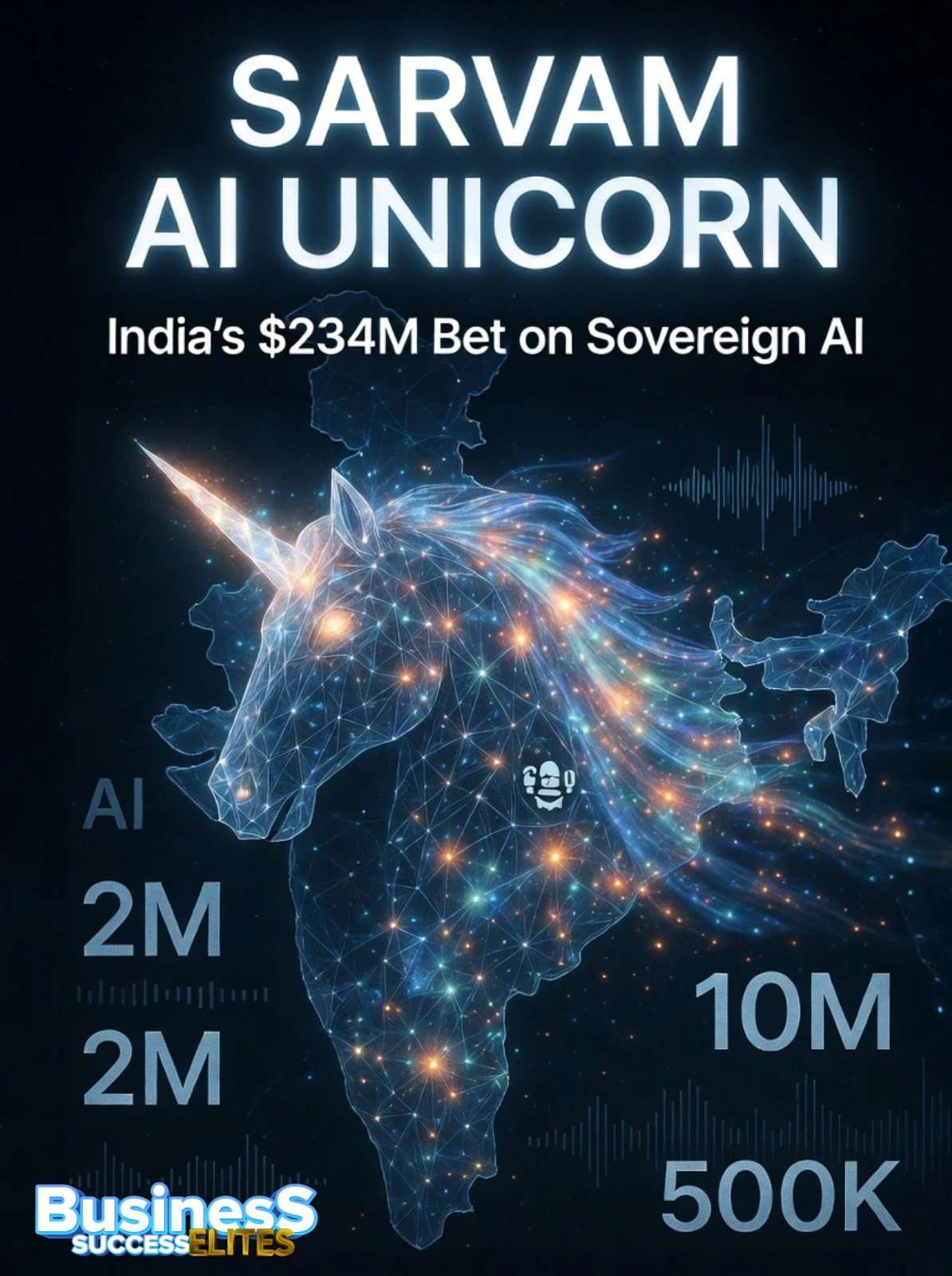
Sarvam AI unicorn is no longer a headline waiting to happen; it just did. The Bengaluru-based startup announced on Monday that it has raised $234 million at a $1.5 billion valuation, officially crashing through the unicorn threshold at a time when India’s appetite for homegrown artificial intelligence has never been more urgent or more politically loaded.
Because here’s the thing: India has been cheerfully consuming AI built in San Francisco for years, while its own startups quietly struggled for capital, compute, and credibility. Not any more.
$150 million of the total raise came from HCLTech, the IT subsidiary of Indian conglomerate HCL Group, which is now the round’s lead strategic investor. Bessemer Venture Partners also joined in, alongside existing backers Khosla Ventures and Peak XV Partners. Lightspeed Venture Partners, which led Sarvam’s earlier Series A, quietly sat this one out.
As part of the transaction, HCLTech will acquire a 10.46 per cent stake in the Bengaluru-based startup for ₹1,427.25 crore. That’s not a casual cheque — that’s a large Indian IT company planting its flag in the foundation model business, which, until recently, was considered the exclusive turf of OpenAI, Anthropic, and their Silicon Valley cousins.
Sarvam did not disclose the timeline for closing the remaining $66 million of the round, but the target is $300 million total for the Series B. In other words, the party isn’t over yet.
The investment comes more than two years after Sarvam raised $41 million across its seed and Series A rounds, and follows the startup’s launch of its open-source models in 30-billion and 105-billion parameters earlier this year.
The fundraise marks a sharp jump from Sarvam’s previous valuation of about $196 million in 2025, a nearly eightfold jump in valuation within roughly a year. That’s the kind of trajectory that makes investors look very smart in hindsight and makes everyone else wonder why they weren’t paying attention.
Glad you asked, because “AI company” has become one of the most meaningless phrases in business journalism. Sarvam is specific about its ambitions.
The startup is among a handful attempting to build a full-stack AI business, spanning model development, inference infrastructure, and enterprise applications. Its models are designed for Indian languages and use cases, while its products are being deployed across sectors including banking, insurance, government services, and defence.
The numbers behind that deployment story are, frankly, staggering. Sarvam’s conversational AI platform now handles more than 2 million interactions a day, while its inference platform processes roughly 10 million API calls daily. Its speech models transcribe more than 500,000 hours of audio each month, and its document AI systems are being used to digitise more than 35 million pages of records.
Those aren’t demo metrics. Those are at-scale numbers.
Sarvam’s real-world use cases read like a cross-section of India itself, rural, urban, financial, governmental.
The company’s multilingual voice agents have collected data from 17 million farmers for India’s Ministry of Agriculture and Farmers Welfare. A nationwide voice campaign for a leading insurer helped support policy renewals for 45 million policyholders.
The startup also partnered with SBI Life Insurance earlier this year to deploy generative AI applications for customer engagement and sales support.
And it’s not stopping at government and insurance. A large fintech company is using Sarvam’s agentic AI platform to support a sales force of more than 350,000 people. Three hundred and fifty thousand. That’s not a pilot. That’s infrastructure.
The timing of this funding wasn’t accidental, and let’s not pretend otherwise. The new funding reflects a broader push by countries and companies to develop sovereign AI capabilities amid growing concerns over access to advanced models and the computing infrastructure that powers them.
That concern became very concrete very recently. Last week, Anthropic disabled access to its latest models, Fable 5 and Mythos 5, after the U.S. government ordered the company to suspend their use by any foreign national, citing national security concerns. The message from Washington was unmistakable: advanced AI is a strategic asset, not a global utility.
For India, which both OpenAI and Anthropic describe as their second-largest market, that’s a wake-up call that lands harder than most. You can’t build a digital economy on borrowed intelligence with an on/off switch controlled elsewhere.
Sarvam joins Bhavish Aggarwal-founded Krutrim as only India’s AI startups to achieve unicorn status in this space. Two unicorns. One and a quarter billion people. The math still has a long way to go.
The fresh capital will be used to accelerate research and development of next-generation AI models focused on agentic AI, coding, and cybersecurity applications. The funds will also expand access to high-performance computing infrastructure and accelerate deployment across major industry verticals.
The plan is to combine Sarvam’s AI models with HCLTech’s enterprise relationships, engineering workforce, and software assets to build AI products for businesses and governments. It’s a marriage of a scrappy research-first startup with one of India’s most well-networked IT services giants, the kind of combination that can actually move at India’s scale.
Co-founder Pratyush Kumar put it plainly: “We are clear that research-led innovation to create AI that works at India’s scale is a very large opportunity. That means models that understand our voices, read our documents, and serve intelligence at a cost every enterprise and government can afford.”
Co-founder Vivek Raghavan added: “Our ambition is to diffuse this technology widely in India, creating significant value across sectors for citizens, small businesses, enterprises, and state and central governments. We are positioned to both help them adopt and innovate on AI.”
Both Raghavan and Kumar previously worked at AI4Bharat, an Indian-language AI initiative at IIT Madras backed by Nandan Nilekani. They didn’t stumble into this space; they built the academic foundation before building the company.
For a country that has long punched above its weight in software services while punching below it in deep tech, Sarvam’s unicorn milestone means something. It’s proof that India can build foundational AI, not just deploy someone else’s.
Whether the $1.5 billion valuation holds, grows, or faces the sobering gravity of market realities, well, that’s a story for another funding round. For now, the horn is on the unicorn. And it was made in Bengaluru.
Sarvam AI Unicorn: India’s $234M Bet on Sovereign AI
June 16, 2026