Sat, Aug 15, 2026 -
Subscribe & never miss our best posts. Subscribe Now!
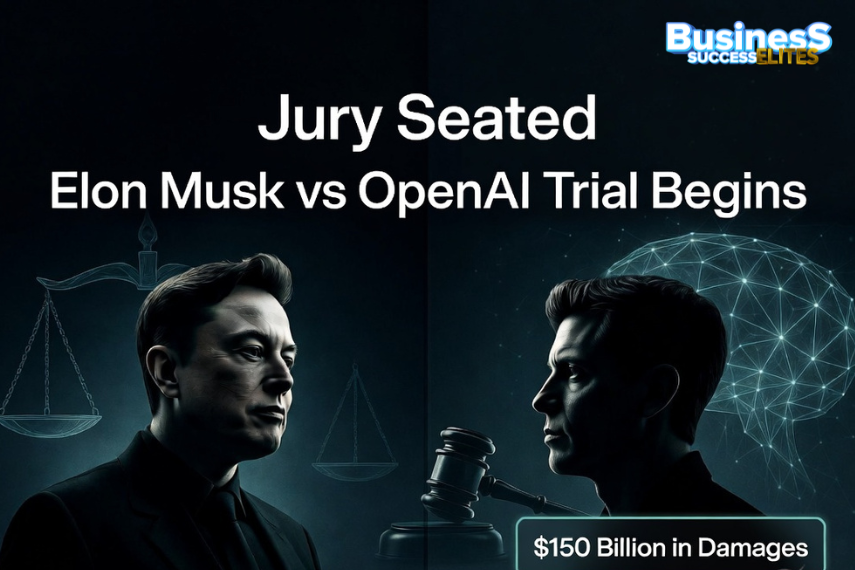
The Elon Musk OpenAI lawsuit trial officially got underway on Monday, April 28, 2026, when a nine-person jury was seated at the federal courthouse in Oakland, California, a moment that had been building for more than two years of legal manoeuvring, damaging document leaks, and very public mudslinging between two of the most influential figures in the history of artificial intelligence.
Opening arguments were scheduled to begin on Tuesday, April 29, with CNBC reporting its cameras inside the courtroom. The case, presided over by U.S. District Judge Yvonne Gonzalez Rogers, pits Elon Musk, the world’s wealthiest person and a co-founder of OpenAI, against his former collaborator Sam Altman, OpenAI’s CEO, and Greg Brockman, the company’s president and co-founder. Microsoft, one of OpenAI’s largest financial backers, has also been named as a co-defendant.
Jury selection kicked off with a pool of 40 prospective jurors. This number was gradually narrowed down over five hours of pointed questioning by Judge Gonzalez Rogers and attorneys for both sides. What made the day particularly unusual was the presence of the defendants themselves. Altman and Brockman attended the selection process. It was a rare sight, given that high-profile tech executives rarely set foot inside a courtroom unless they’re legally required to testify.
The final jury includes a nurse and a person who owns a painting company. Among others, a mix of ordinary Bay Area residents will be asked to weigh some extraordinarily complex questions.
The atmosphere outside the courthouse was anything but quiet. Protesters lined the streets, their signs expressing fear of artificial intelligence. One depicted a cartoon of Altman alongside the question: “Could AI destroy mankind?” A large balloon of Elon Musk giving a Nazi salute also dominated the scene. Few tech trials in recent memory have drawn this kind of public energy.
Judge Gonzalez Rogers was candid about the challenge of finding impartial jurors. Before the process began, she told Musk’s legal counsel directly: “There are a lot of people out there who don’t like your client.” During questioning, some prospective jurors expressed openly negative views about Musk, one flatly stating, “Elon doesn’t care about people”. Though most said they could put personal opinions aside and decide the case on evidence alone.
The judge reminded the room that the law doesn’t require jurors who have never heard of Elon Musk or AI. It requires jurors who can set aside what they’ve heard and decide the case based solely on what’s presented in court.
Musk co-founded OpenAI back in 2015, and in 2024, he sued the company, Altman, and Brockman, alleging they reneged on their commitments to keep the AI lab a nonprofit and honour its original charitable mission. He left OpenAI’s board in 2018 and, five years later, launched xAI as a direct rival.
Of the sprawling 26 claims Musk filed, the trial now centres on just two. Musk’s lawyers voluntarily dismissed the fraud and constructive fraud charges ahead of trial, describing the move as an effort to “streamline the case.” What remains are the claims for unjust enrichment and breach of charitable trust.
The charitable trust claim rests on the argument that OpenAI was formally chartered as a nonprofit corporation with the mission to develop artificial general intelligence for the benefit of humanity, not for private profit. Musk contends that under Altman’s leadership, the company has operated in clear violation of that charter. The unjust enrichment claim is grounded in the idea that the defendants received money and assets they were not entitled to and should not be permitted to keep.
After Musk’s departure, OpenAI created a for-profit subsidiary in 2019, which was later converted into a public benefit corporation overseen by the nonprofit foundation in 2025. The attorneys general of both California and Delaware signed off on the shift. Musk has always maintained that this structural transformation was a betrayal, a sleight of hand that turned a public good into a private windfall.
Musk is seeking $150 billion in damages from OpenAI and Microsoft, with any proceeds going to OpenAI’s charitable arm. He has told the court he does not want the money for himself. He also wants OpenAI forced back into its original nonprofit structure, with Altman and Brockman removed from their positions and from the board.
The stakes stretch far beyond courtroom drama. OpenAI’s valuation currently stands at around $852 billion. The company raised $122 billion in its most recent funding round and is laying the groundwork for a potential IPO in 2026 or 2027 that could value it at $1 trillion. It is also projecting $14 billion in losses this year.
If Musk wins, OpenAI’s IPO ambitions could fall apart entirely. Altman and Brockman could lose their positions, clearing a much easier runway for Musk’s own AI company, xAI, to gain ground.
According to court records, Musk contributed about $38 million in seed money to OpenAI between 2016 and 2020, mostly before he resigned from the board. (Musk himself has claimed the figure is closer to $44 million.)
Perhaps the most gripping subplot is the paper trail. Greg Brockman’s personal diary, written in the fall of 2017, sits at the centre of the case. In it, Brockman wrote: “This is the only chance we have to get out from Elon,” and, “Is he the ‘glorious leader’ that I would pick?” It’s the kind of candid private writing that lawyers dream of introducing at trial.
Musk’s legal team has also surfaced a 2017 email in which Altman claimed he was still “enthusiastic about the non-profit structure” just after Musk had threatened to cut off funding, a statement Musk’s attorneys argue was designed to keep donations flowing while leadership privately mapped out a different path. Hundreds of pages of discovery material unsealed in autumn 2025 include emails, text messages, and Slack conversations that Musk’s team says show leadership “said one thing publicly and planned something completely different privately.”
One of the more striking pieces of correspondence was personal in tone: a February 2023 text from Altman to Musk, sent after Musk had publicly attacked OpenAI, in which Altman wrote: “You’re my hero, and that’s what it feels like when you attack OpenAI.”
The witness list reads like a Silicon Valley tell-all: Musk, Altman, Microsoft CEO Satya Nadella, former OpenAI CTO Mira Murati, co-founder Ilya Sutskever, and Shivon Zilis.
Zilis, a former OpenAI board member who is also the mother of four of Musk’s children, is expected to be a particularly significant witness, with OpenAI’s lawyers arguing she funnelled confidential information about OpenAI to Musk. Her testimony, navigating both personal and professional entanglements, will be closely watched.
The jury is expected to begin deliberations by May 12. And while the nine jurors will deliver their verdict on liability, it’s important to note that they are serving only in an advisory capacity on that question. Judge Gonzalez Rogers alone will decide any remedies, including whether to award the $150 billion in damages or compel changes to OpenAI’s structure.
Both sides came into Monday’s proceedings with sharp, rehearsed narratives, and neither has shown any sign of softening.
On X, Musk wrote: “I started it, funded it, recruited critical talent and taught them everything I know about how to make a startup successful FOR THE PUBLIC GOOD. Then they stole the charity.”
OpenAI fired back in its own post: “This lawsuit has always been a baseless and jealous bid to derail a competitor.” The company argues that Musk himself pushed for a for-profit structure and that he only walked away because he could not assume total control.
Wedbush analyst Dan Ives summed up what Wall Street is seeing: “This is a tech soap opera that all investors will be watching as Musk vs Altman enters the MMA ring. We believe there will be a lot of dirt and slings thrown around in court between Musk and Altman, and that is not a good thing for anyone involved, but Musk has made this personal.”
Read More – Reliance Industries Plans India’s Largest Data Centre in AP
Beneath the courtroom theatre lies a genuinely important legal and ethical question, one that has implications far beyond Musk and Altman personally. “The underlying issue is real: Can a company sell a public-good mission and later evolve into something else?” legal analyst Lippy pointed out. “At the same time, jurors and the public are going to be weighing Musk’s motives. Is this about principle, or is it about competition? That tension is going to drive the entire case.”
Both Musk’s SpaceX and OpenAI are expected to pursue public offerings this year. The two companies combined are currently valued at over $2 trillion on the private market. The trial’s outcome could reshape the IPO timelines of both and rewrite the rules of how AI companies can, or cannot, pivot away from their founding missions.
For the nine ordinary people now seated in that Oakland federal courtroom, the weight of all that history lands squarely on their shoulders. A nurse. A painting company owner. And seven others, tasked with making sense of Silicon Valley at its most nakedly ambitious, and its most legally exposed.
Kalpesh Chauhaan, COO, Arham Secure | Business Success Elites
August 14, 2026Demis Hassabis Exit Google DeepMind | BSE Report
August 14, 2026Video Marketing: Why Returns Are Falling in 2026
August 13, 2026Bank of America Jio Credit Deal: $1.9 Billion India Bet
August 13, 2026