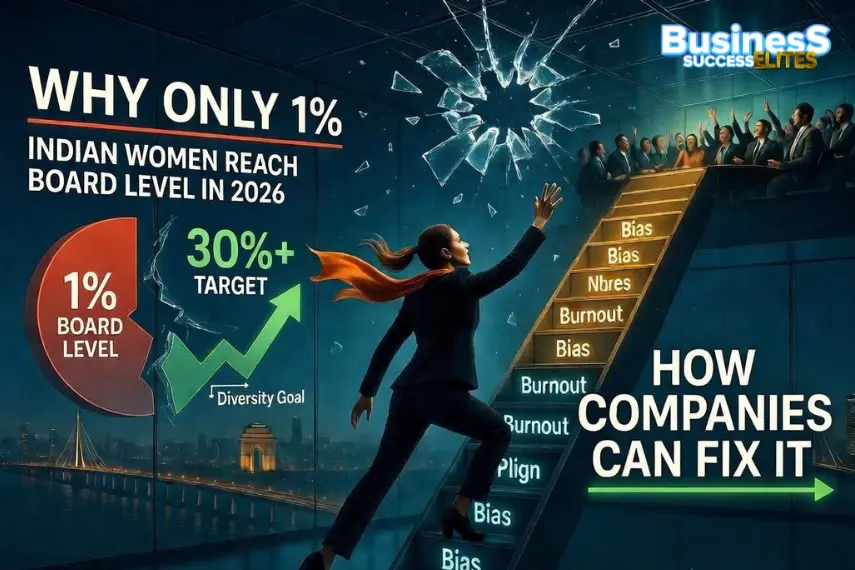
It is 2026. Indian companies are looking very good on paper. The Companies Act 2013 said that every listed company must have at least one woman on the board. Now 98% of NSE-listed firms have at least one woman director. Overall women hold 21% of board seats. Up from 5% in 2014.
If we look deeper the picture is different. According to the AIMA-KPMG survey of over 200 professionals 1% of women are on boards. At the time 79% of women want to be leaders with more than half wanting to be in the C-suite.
This gap between what women want and what they get is not new. It is getting worse. Progress at the top has slowed down. Thirty percent of companies said they have not increased the number of women leaders in the five years. This is nearly double the figure from the 2024 survey. The mid-career stage is where women are most likely to leave or get stuck.
Let’s be clear about what “1%” means. It does not mean that one in every hundred Indian women reaches a board seat. The KPMG data shows what is happening to qualified ambitious women professionals who should be on track for board roles but are hitting a wall.
Other data also shows this. Women make up 23% of the workforce in listed companies but this drops to 13–14% in senior management, 10% of executive directorships and just 5% of MD/CEO positions
Board seats are around 18–21% but most companies stop at the minimum of one or two women. 47% Have two or more women on their boards. Independent women directors are more common now. They still do not have much decision-making power.
If we ask women what is holding them back the answers are familiar.
The mid-career stage is very tough. Women often carry a load at home even when they are earning well. Companies may have policies but they still reward people who are always available. Add to this the fact that women are often left out of networks and talented women may step back or leave. It’s not that they lack ability. Studies show that boards with women actually do better financially and have stronger governance.
The good news is that there are things companies can do to fix this. Organisations that treat gender diversity as important. Not a checkbox. Are already seeing results. Here’s what actually works:
Mentorship is advice. Sponsorship is advocacy. Senior leaders opening doors and fighting for women. Make it part of every leader’s goals.
Redesign leadership jobs for outcomes, not face-time. Offer support for childcare or eldercare. Companies that do this report attrition.
Standardise promotion criteria. Use diverse selection panels. Every board vacancy should have at least 50% women candidates on the shortlist.
Aim for 30% women on boards and in executive committees. Tie it to executive compensation. Some companies are already doing this. Outperforming their peers.
Women like Kiran Mazumdar-Shaw, Falguni Nayar or Priya Nair did not get there by accident. Their journeys need to be celebrated and studied inside companies.
Link diversity outcomes to bonuses and board evaluations. Culture change happens when its measured.
Also Read –Breaking Down Barriers in Leadership: The Prospects for Women in Executive Positions
Indian women are not short on ambition. They are short on systems that let that ambition grow all the way to the boardroom. The 1% figure is not an accusation. It’s a wake-up call.Companies that treat this as a talent and performance issue will win. The rest will keep wondering why their boards look the same while the world outside changes.The ladder is not broken because of the lack of climbers. It’s missing rungs. And it’s on companies to build them. The data is clear. The ambition is there. The only question left is: who’s willing to act?