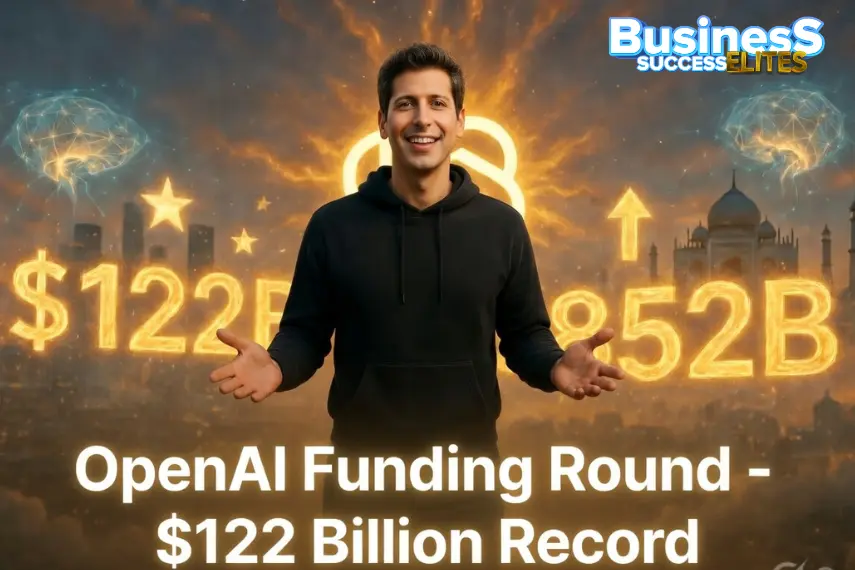
The OpenAI funding round has everyone talking for good reason. The company behind ChatGPT just closed a staggering $122 billion raise, pushing its post-money valuation to an eye-popping $852 billion as of March 31, 2026.
Beyond just another big check in Silicon Valley, it’s the largest funding round in the region’s history, and it signals how deeply investors believe AI is reshaping our daily lives. Whether you’re a small-business owner tinkering with tools to streamline operations or a student exploring new ideas, this moment feels personal because OpenAI keeps putting powerful intelligence into more hands every day.
The money comes from a who’s-who of tech and finance heavyweights. Strategic anchors include Amazon (up to $50 billion, with part tied to an eventual IPO or reaching artificial general intelligence), Nvidia ($30 billion), and SoftBank ($30 billion). SoftBank co-led the round alongside Andreessen Horowitz, D.E. Shaw Ventures, MGX, TPG, and T. Rowe Price accounts. Microsoft, a longtime partner, jumped back in, while a broad group of global institutions, from BlackRock affiliates and Sequoia to Temasek and ARK Invest, rounded out the list.
What really stands out, though, is the inclusive twist: for the first time, OpenAI opened the door to everyday individual investors, pulling in more than $3 billion through bank channels. The company is also joining several ARK Invest exchange-traded funds, letting even more people share in the upside before any IPO. They’ve expanded their revolving credit line to about $4.7 billion for extra breathing room on big infrastructure bets.
Numbers like these only make sense when you look at the momentum behind them. OpenAI is now generating $2 billion in revenue *per month*, four times faster growth than the companies that defined the internet and mobile eras, including Alphabet and Meta. ChatGPT boasts more than 900 million weekly active users and over 50 million paid subscribers. Enterprise customers now account for more than 40 percent of revenue (up from 30 percent a year ago) and are on track to match consumer revenue by the end of 2026. Search usage has nearly tripled in the past year, and their new ads pilot hit more than $100 million in annual recurring revenue in under six weeks.
It’s not abstract hype, but real traction. The official announcement puts it plainly: “This is commercial scale, and it is mission scale. The fastest way to widen the benefits of AI is to put useful intelligence in people’s hands early and let that access compound globally.”
With fresh capital, OpenAI is doubling down on the flywheel that’s already working: more compute leads to smarter models, which power better products, which drive faster adoption and more revenue. They’re building a unified “AI superapp” that brings together ChatGPT, coding agents like Codex (now serving over 2 million weekly users), browsing, memory, and agentic tools into one seamless experience. The goal? Make AI feel less like disconnected apps and more like a helpful partner that understands intent and gets things done across your workflow, whether you’re a solo creator, a teacher, or a global team.
The valuation puts OpenAI in a rare company. At $852 billion it’s roughly five times Disney’s market value and bigger than the combined worth of McDonald’s, Boeing, Uber, Spotify, and Ford. Analysts see it as a clear runway toward an IPO later this year, though Sam Altman and the team will face plenty of pressure to keep delivering on that sky-high bar.
For the rest of us, the bigger story is access and impact. More compute means lower costs over time. Stronger models mean better tools for scientific discovery, health breakthroughs, education, and small businesses that couldn’t afford custom AI before. OpenAI’s own words capture the spirit: the capital is “helping build the infrastructure layer for intelligence itself,” with value eventually flowing back “to companies, to communities, and increasingly to individuals.”
Read more – What Is Agentic AI and Why Does It Matter?
Of course, big raises come with big expectations. The company still burns cash at scale while racing to stay ahead. But the diverse investor base, retail participation, and explosive user growth suggest the bet is on AI becoming everyday infrastructure, something that lifts productivity for everyone from freelancers in Delhi to factories in the Midwest.
In short, this OpenAI is a bet that the next chapter of AI will be more useful, more widespread, and more human-centered than ever. And with the resources now in place, that future feels closer than it did yesterday.
Swish: The Late-Night Craving That Changed Everything
April 1, 2026Vedanta Drags Adani to Supreme Court Over JAL Takeover
March 31, 2026