Fri, Aug 14, 2026 -
Subscribe & never miss our best posts. Subscribe Now!
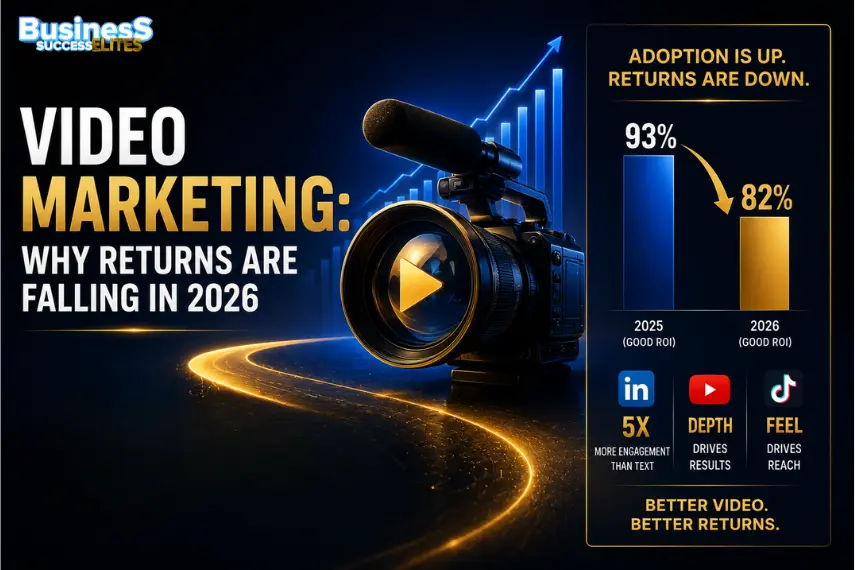
Video marketing has a problem hiding in plain sight. Adoption has never been higher. Ninety one percent of businesses now use video as a marketing tool, and 93 percent call it important to their strategy. By every adoption metric, video has won.
Yet something unusual just happened. The share of marketers reporting good ROI from video fell to 82 percent this year, down from 93 percent the year before. That is one of the sharpest year-over-year drops recorded in this category. Adoption is rising. Returns are falling. That contradiction is worth investigating.
Start with what is not in question. Video adoption has essentially plateaued at the top. Ninety one percent of businesses use it, up from 86 percent just two years ago. The remaining holdouts are concentrated in industries with regulatory constraints on visual content, not businesses simply unconvinced of video’s value.
At this level of saturation, using video is no longer a competitive advantage. Nearly everyone is already doing it. That single fact turns out to explain most of what follows.
When a tactic reaches near-universal adoption, the quality bar for standing out rises even as the average quality of what gets produced tends to fall. That appears to be exactly what happened.
The most plausible explanation for the ROI drop is not that video stopped working. It is that far more low-quality video entered the market at once, pulling the average return down even as top performers kept winning.
Two forces accelerated that flood:
Cheaper production and shorter formats mean more businesses can publish more video, more often, with less investment in strategy behind each piece. Volume went up. Care per video, on average, appears to have gone down.
Here is where the investigation gets useful. Despite the average ROI decline, a clear subset of marketers is not just holding steady; they are outperforming.
Short-form video, under 60 seconds, has ranked as the highest ROI format for three consecutive years, generating roughly 2.5 times more engagement per impression than any other content type. Landing pages with embedded video convert at 86 percent higher rates than text-only pages, with B2B SaaS pages seeing conversion lifts exceeding 100 percent in controlled testing.
The pattern is consistent. Teams that treat video as a strategic asset, matched to format, platform, and audience intent, are the ones absorbing the AI-driven cost savings and converting them into sharper output. Teams treating video as a volume game are the ones dragging the average down.
A second thread emerged in the data: businesses publishing one master video across every platform without adapting it are quietly underperforming everywhere.
LinkedIn video now earns five times the engagement of text posts on the platform, with uploads growing 34 percent year over year. But LinkedIn audiences respond to professional utility, not entertainment value. YouTube rewards depth. TikTok rewards feel. A single video repurposed across all three without rethinking the format for each is, in effect, three missed opportunities disguised as one efficient one.
Put together, the picture is less about video marketing losing effectiveness and more about a market correcting after a period of low-effort saturation. The businesses treating video as a checkbox are watching their ROI erode. The businesses treating it as a discipline, using AI to produce more thoughtful work rather than simply more work, are pulling further ahead.
Video marketing in 2026 is not failing. It is sorting. Adoption reaching a ceiling means the tactic itself no longer differentiates anyone. What differentiates now is execution: format-specific strategy, platform-native thinking, and using AI to raise quality rather than just cut costs. For businesses watching their video ROI slide, the data suggests the fix is not more video. It is better video, made with more intention than the rest of the market is currently putting in.
Video Marketing: Why Returns Are Falling in 2026
August 13, 2026Bank of America Jio Credit Deal: $1.9 Billion India Bet
August 13, 2026Creator Economy: Who Really Profits in 2026?
August 12, 2026N Chandrasekaran May Quit as Tata Sons Chairman
August 12, 2026