Sun, Aug 2, 2026 -
Subscribe & never miss our best posts. Subscribe Now!
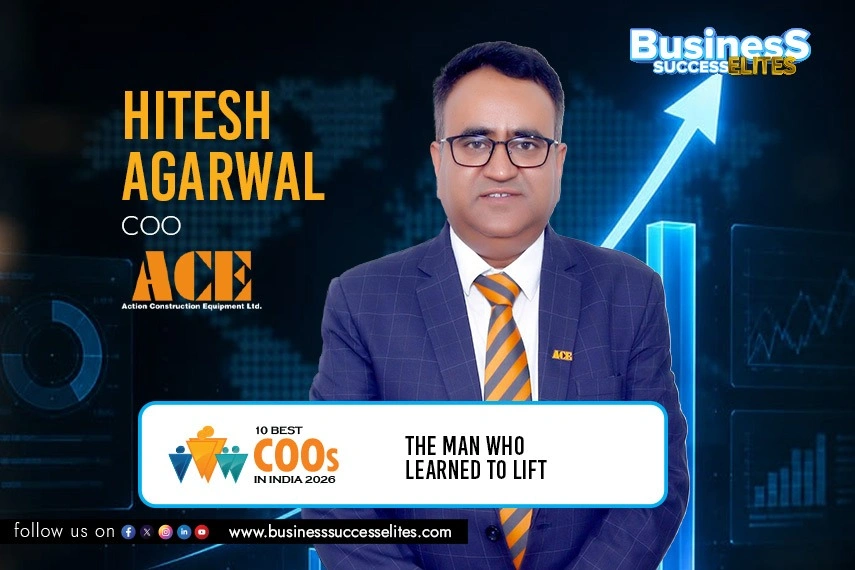
The Man Who Learned to Lift
Hitesh Agarwal joined his first factory floor in 1994 with a welding torch and no roadmap. Thirty years later, as COO of ACE, Action Construction Equipment, he runs the operations of India’s dominant crane maker, a company commanding over 63% of the Pick & Carry market. His journey is not a straight line. It is a weld bead: layered, load-bearing, and formed under pressure.
There is a story Hitesh Agarwal tells about a weld failure early in his career, a single crack that threatened to bring down a delivery commitment, a team without a playbook, and a plant head who, upon seeing the damage controlled by morning, said nothing. Just nodded.
It is telling that this is the moment he chooses. Not a promotion, not a P&L milestone. A nod from a plant head at dawn, in a shop that smells of flux and burnt metal.
“That silence meant everything,” he says. “It was the first time I truly understood that leadership is not about designation.”
Appointed COO of Action Construction Equipment in February 2024, Agarwal has spent three decades accumulating that kind of understanding in automotive plants, heavy engineering yards, and inside the rigorous process culture of a German MNC. His career reads less like a résumé and more like a masterclass in operations, written one factory at a time.
He discusses his journey, challenges, mindset, vision and many more valuable insights that matter, with Business Success Elites.
You started in a weld shop in 1994. Three decades later, you are steering operations at India’s largest crane manufacturer. What made you believe you could go all the way?
Honestly, I do not think there was one dramatic moment. My journey has been shaped more by small milestones and roadblocks than by any single breakthrough. But that weld failure stands out. I had no seniority, no authority. I stayed back, mapped the root cause, rallied the team, and we recovered the schedule overnight. Every subsequent role reinforced the same belief: if you remain curious, adaptable, and committed to excellence, growth becomes a natural outcome. Three decades on, the problems are larger. The principle has never changed.
You have worked across automotive, agri-construction, heavy engineering, and a German MNC before ACE. If each stint was a semester in an unwritten MBA, what did each one teach you?
Each organisation left a distinct imprint. The automotive years at Mahindra and Jay Bharat instilled one discipline I carry everywhere: that consistency and process control are not aspirational values; they are the price of entry. Escorts Kubota shifted my lens toward the customer. I began to understand that every operational decision, however internal it feels, eventually shows up in the customer experience. Isgec introduced me to a different kind of complexity: heavy engineering, long project cycles, and multiple functions that all have to move together. It taught me how to manage scale without losing precision.
Putzmeister-SANY was genuinely eye-opening. The German approach to process rigour was not a philosophy on a wall. It was visible in how decisions were made, how problems were documented, how standards were upheld even under pressure. It raised my bar for what operational excellence could look like.
Taken together, these stints taught me that the best operations leaders are translators. They speak the language of the shop floor and the boardroom equally fluently, and they know exactly when to switch.
ACE holds more than 63% market share in Pick & Carry cranes. When you are already dominant, what is the hardest operational discipline?
The hardest discipline is intellectual humility. When you are dominant, every system feels validated. The temptation is to standardise success and stop experimenting. That is precisely when mediocrity enters, dressed up as efficiency.
At ACE, we consciously try to operate with the urgency of an underdog, not the comfort of a champion. We guard against complacency through two mechanisms. First, we treat the remaining 37% of the market as a more demanding benchmark than our own performance. Understanding why a customer chose a competitor, even once, is more instructive than celebrating a hundred wins. Second, we deliberately set internal targets that the market has not yet demanded.
The threat I fear most is not a well-funded competitor. It is internal success blindness — the quiet consensus that what worked yesterday is sufficient for tomorrow. In a market moving toward smarter, greener, and more connected equipment, standing still is the only real risk.
What is the most counter-intuitive operation decision you have ever made?
Choosing process stability over production volume during a period of strong demand. There was significant pressure to maximise output. But I noticed that process inconsistencies were beginning to affect quality. So we deliberately slowed down certain activities and focused on eliminating root causes. The decision seemed risky because it temporarily affected production numbers. Within a few months, however, volumes recovered — and we had better quality, lower rework, and higher customer satisfaction alongside them. Sustainable performance comes from strong processes, not short-term acceleration. That lesson has never left me.
With AI-driven predictive maintenance entering heavy manufacturing, what is the most exciting application you have seen in the last 12 months?
The pitch that stayed with me was a digital twin for crane structural health monitoring, sensors across the boom, slew ring, and wire rope assemblies feeding an AI model that flags component fatigue weeks before anything looks wrong on the ground. For someone who started in a weld shop, that is extraordinary. What made it real for ACE is context. Our cranes work in ports, highways, and urban sites. Failure is never just a commercial problem. It is a safety one.
What genuinely excites me is where this is heading: predictive maintenance converging with parts planning and production scheduling in one loop. From spotting a problem to fixing it without disrupting the line. That is not just better maintenance. That is a fundamentally different value proposition to our customers.
Hitesh Agarwal, COO, ACE | Business Success Elites
August 1, 2026