Wed, Jul 15, 2026 -
Subscribe & never miss our best posts. Subscribe Now!
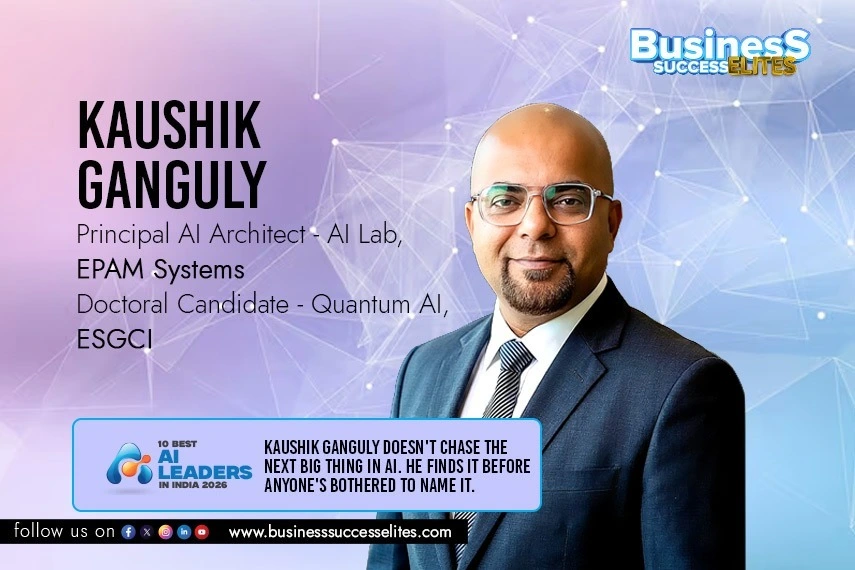
Kaushik Ganguly doesn’t chase the next big thing in AI. He finds it before anyone’s bothered to name it.
When pharmaceutical researchers were still debating whether AI could meaningfully accelerate drug discovery, Kaushik Ganguly was already asking a different question entirely: what happens when you let autonomous agents orchestrate quantum-enhanced protein folding workflows, and the agents simply don’t care whether the compute underneath them is classical or quantum?
That question became HelixAI and then Quantum HelixAI, the hybrid agentic pipeline at the centre of Ganguly’s doctoral research, which demonstrated something the quantum-AI conversation had been avoiding for years. The integration problem was never really about qubit count. It was about workflow. Build the right orchestration layer, and quantum becomes a swappable backend that a discovery team can route to without rewriting a single process. It’s a quietly radical idea, and it’s the kind Ganguly has been producing for most of his career.
Now Principal AI Architect at EPAM Systems’ AI Lab, Ganguly has traversed TCS, Cognizant, and Accenture across two decades, always arriving slightly ahead of the curve. We sat down with him to understand what drives that instinct, and what it means for the enterprises still figuring out what AI is supposed to do for them.
Mr Ganguly engaged with Business Success Elites, sharing his inspiration, innovations, research, thought-leadership and vision.
You’ve moved across some of the biggest names in tech, always at the frontier: Cloud, ML, GenAI, Agentic Systems, and now Quantum AI. Most technologists pick a lane. What keeps pulling you forward?
Honestly, it’s restlessness more than strategy. The moment a technology becomes a checklist item in an RFP, my attention has already drifted to whatever’s making early adopters uncomfortable. Cloud felt that way in 2012. ML around 2016. GenAI in late 2022. I operate on a belief that the next big thing announces itself twice, once to researchers and a handful of practitioners, and once to the market, by which point it’s already too late to lead. I try to be in the room during the first announcement. I read papers nobody’s citing yet, pay attention to what makes senior engineers say “this is weird.” That weirdness is usually the signal. Lanes are safer. I just find them claustrophobic.
You’ve been a Solutions Architect, Data Scientist, AI Scientist, Cloud Delivery Lead, and even a Blockchain Architect. Is the era of the deep specialist in AI effectively over?
Yes, unambiguously. The deep specialist won’t disappear, but they won’t lead. AI in 2026 is a stack: data engineering, model training, orchestration, evals, governance, infrastructure economics, and change management. Whoever can only speak one of those languages gets routed around by someone who can speak four. What I’ve found across every organisation I’ve worked with is that the real value lies in being the person who can translate between a CFO, a research scientist, a platform engineer, and a regulator, without losing the maths. That’s a polymath skill, not a generalist one. There’s a difference. Generalists know a little about everything. Polymaths go deep in three or four places and stitch them together. The problems worth solving live at the seams between disciplines. That’s where ROI hides.
Walk us through the ‘aha moment’ with Quantum HelixAI, when did it stop feeling like academic research and start feeling like something a pharma team could actually deploy?
The aha moment didn’t come from a benchmark. It came from watching the agentic layer behave identically regardless of whether the folding step ran classically or through quantum simulation. The agents orchestrated, validated, retried, and escalated, completely indifferent to what was happening underneath. That’s when it clicked. For years, the quantum-AI conversation has been stuck on hardware readiness. But the real bottleneck wasn’t just the qubits; it was the integration surface. How do you let a pharma researcher use quantum-enhanced folding without rewriting their entire workflow? Agentic orchestration answers that. ESMFold handles the bulk; quantum-assisted refinement steps in for the hard conformational subspaces. The moment those two things worked together seamlessly, Quantum HelixAI stopped being a research artefact.
Your thesis frames “AI ROI optimisation with quantum-inspired architecture.” To a CFO who sees quantum as a research toy, what’s your actual argument?
Straight answer: In pure infrastructure terms today, quantum AI does not pay for itself for most enterprise use cases. The qubits aren’t there. Anyone claiming otherwise is selling something. But that’s the wrong question. ROI in frontier technology starts with research, not deployment. The CFOs who’ll win the next decade are treating quantum AI as an option contract, not a capex line item. Build the scaffolding now, responsible tooling, governance, validated discovery pipelines, post-quantum cryptographic readiness, and the day hardware crosses the threshold, you’re not starting from zero. You’re deploying. At the enterprise layer, it’s already a game of organisational readiness.
Finally, what’s the single most dangerous assumption India’s top enterprise CXOs are making about AI right now?
That vibe coding will solve their AI delivery problem. The idea that you hand a developer a chat window, they describe what they want in casual prose, and you ship production systems on the other end, it’s a myth, and an expensive one. What it produces is fragile software with no architectural memory, no audit trail, and no governance handle. When something breaks at 2 AM, nobody can reconstruct why a decision was made, because no real decision was ever made. My recommendation is spec-driven development. Keep the speed of AI-assisted coding, but anchor it in human-authored specifications, architecture decisions, control flow, data contracts, and security boundaries. The AI fills in the implementation. CXOs who confuse “fast” with “unsupervised” will spend the next decade rewriting code their teams never truly understood. And that is already happening.
Dr Ranga Sudhakar, CEO, APEIRON Healthcare
July 14, 2026The Indian Healthcare Elites 2026
July 14, 2026