Thu, Jul 16, 2026 -
Subscribe & never miss our best posts. Subscribe Now!
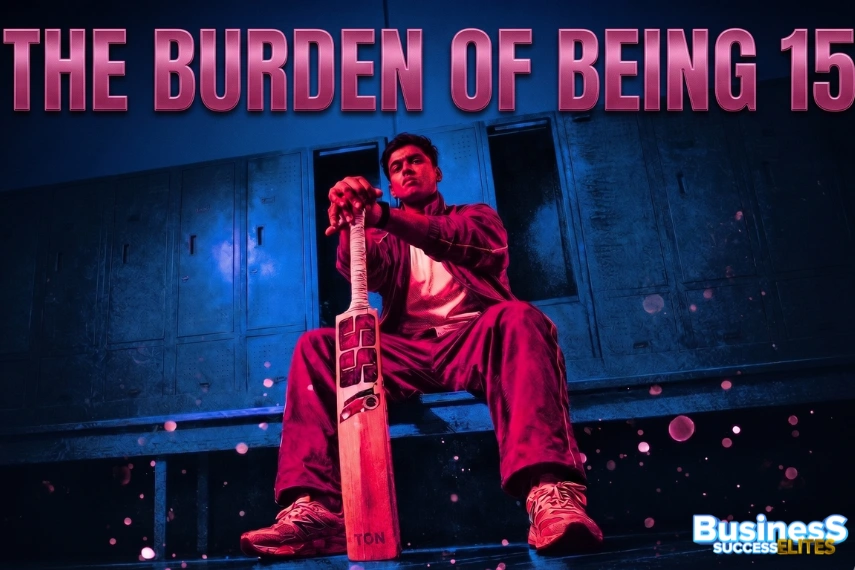
There’s something deeply troubling about the way cricket has embraced Vaibhav Suryavanshi in the past year. Not troubling because he doesn’t deserve the acclaim, he manifestly does. At 15 years old, in the current IPL Eliminator being played out in Chandigarh, he’s sitting in a Rajasthan Royals dressing room preparing for one of the biggest knockout matches in franchise history, and the weight of expectations in that room is palpable enough to choke on.
I’ve been thinking about something Arun Dhumal, the IPL chairman, said just a few days ago. He urged the BCCI and franchises to “protect” Suryavanshi from the pressures of stardom. It’s a statement that should unsettle anyone genuinely invested in Indian cricket’s future. Because it wasn’t a casual observation, it was a reality check masquerading as encouragement.
Here’s what nobody wants to acknowledge: we’ve already made him a legend. And he’s still a teenager who barely gets eight hours of sleep before the biggest matches of his life.
Let me rewind to the U19 World Cup final in Harare just weeks ago. India faced England in what was billed as a coming-of-age moment for the next generation of Indian cricket. Suryavanshi was India’s trump card. When you’re 15 years old and your country’s cricket hopes rest on your shoulders, sleep becomes a luxury you can’t afford.
He admitted it afterwards, and barely managed an hour or two of sleep the night before. Then he went out and hammered 175 off 80 balls, 15 fours and 15 sixes. A masterclass. An exhibition. A reminder that, yes, this teenager is genuinely special.
But here’s what keeps me awake at night: he shouldn’t have had to carry that burden. The India A squad selection, the comparisons to Sachin and Bradman, the stadium roars, the viral moments, the think pieces dissecting his technique, it’s all created this narrative where Suryavanshi has become a symbol of something larger than himself. He’s become the answer to a question nobody was asking: Can Indian cricket produce another generational talent?
The problem is that narrative has very little to do with what a 15-year-old actually needs to become a great cricketer.
I listened to Anil Kumble speak about Suryavanshi after the recent Eliminator win against Sunrisers Hyderabad. Kumble’s a man who’s seen everything in cricket, and he made an observation that struck me as unusually honest: “His mindset remains the same whether it’s a league game or a knockout.” That’s supposed to be reassuring, right? Here’s a teenager who doesn’t get rattled. The same ease that produces a 63 off 19 balls in a DY Patil Cup warm-up is the same ease that produces crucial knocks in playoff cricket.
Except here’s where the narrative becomes dangerous: we’re celebrating his lack of pressure precisely when we should be asking whether a 15-year-old should be in positions where he needs that kind of temperament. Sunil Gavaskar, in his blunt way, pointed out something everyone’s been skirting around: we shouldn’t be praising him to the skies because it creates a standard. “He’s someone we shouldn’t praise to the skies,” Gavaskar said. “That should not become something he feels he must live up to every time.” It’s a warning that’s fallen on mostly deaf ears.
Here’s what nobody wants to say plainly: Suryavanshi will have bad performances. Not because he’ll lose talent, but because everyone eventually does. Form fluctuates. Bowlers learn. Opposition adjusts. Cricket, unlike mathematics, doesn’t have permanent solutions.
He managed only 4 runs against the Mumbai Indians recently. Was it a crisis? No. Was it portrayed as a crisis in some quarters? Absolutely. Because we’ve created a standard where 4 runs from a 15-year-old is somehow a disappointment. We’ve made it so that anything less than brilliance registers as failure.
AB de Villiers, who knows something about being a generational talent himself, praised Suryavanshi’s composure under pressure. But there’s an unsaid caveat in that praise: the fact that a teenager has to have that kind of composure means we’re asking too much of him too early.
The cruel mathematics of expectation works like this: early success × media attention × comparisons to legends = crushing psychological burden for a 15-year-old.
This IPL season has been fascinating precisely because it’s exposed something real about Suryavanshi. He’s phenomenal, yes. But he’s also human. He’s had explosive innings and quiet ones. He’s had moments of pure genius and moments where the sheer weight of carrying a franchise’s hopes has been visible in his body language.
The Qualifier 2 against the Gujarat Titans is coming up; this is where the real test begins. Not a test of talent, but a test of whether a system designed for experienced professionals can actually accommodate a teenager without burning him out.
Rajasthan Royals have done something remarkable by building a team around him, but it raises an uncomfortable question: are we pushing him forward too fast because he’s genuinely ready, or because the IPL’s commercial machinery demands fresh narratives and young sensations? I suspect it’s a bit of both.
There’s a real debate happening in Indian cricket right now, and it’s one we need to have seriously. On one side, you have people like Arun Dhumal saying, “Protect him.” On the other hand, you have franchise owners and selectors who believe exposure is the fastest pathway to greatness.
Greg Chappell raised it beautifully when he warned against confusing “early genius with invincibility.” The cautionary tales are there, Vinod Kambli, Prithvi Shaw in his early days, talents who burned bright too early and then faced the cruel test of sustainability.
But there’s also the Tendulkar precedent. Sachin burst onto the international scene as a teenager, carried immense pressure, and built a career that transcended all expectations. The difference was that Tendulkar had a family cocoon, wise counsel, and a media ecosystem that was less frenzied.
Suryavanshi has Instagram fans, viral moments, and comparisons to Don Bradman. He has a different kind of pressure.
Here’s my honest assessment: Vaibhav Suryavanshi is genuinely one of the most talented batters India has produced in recent years. Not because of the records, though they’re astounding. But because of something rarer, he has a calmness under pressure that most 30-year-old cricketers don’t possess. That’s not hype. That’s an observable fact.
But I also believe we’re asking the wrong questions. We’re asking “When will he play for India?” when we should be asking “Is he ready to play for India without it destroying him?”
We’re asking “Will he be better than Sachin?” when we should be asking “What kind of person will he become after carrying the hopes of 1.4 billion people as a teenager?”
The IPL season right now is important not because it’s a launching pad to international cricket, but because it’s a testing ground for whether Indian cricket has learned anything about managing young talent. Can he have bad games without it being portrayed as a crisis? Can he have ordinary performances without it feeding a narrative of “he’s lost it” or “he’s just a short-format player?” Can we, as a cricket-watching nation, let him be just 15?
Also read – Romi Bhinder Phone Dugout Controversy: BCCI Notice & Medical Twist in IPL 2026
Tomorrow or whenever that Qualifier 2 happens, Suryavanshi will walk out to bat against the Gujarat Titans, and the expectations will be the same as they always are, extraordinary. He’ll either deliver another spectacle or have a more modest contribution. Either way, what matters is not the outcome of that one match, but whether the system around him, the franchise, the board, the media, allows him to grow without the suffocating pressure of constant validation.
The truth is, I’m rooting for him. Not because he’s a symbol of Indian cricket’s future, but because he’s a 15-year-old kid from Bihar who loves batting and happens to be good at it. But I’m also deeply uncomfortable with what we’ve made him into. A deity. An answer. A prophecy.
He should just get to be a teenager who plays cricket and dreams. That’s never been too much to ask for any talented kid, has it? Yet somehow, for Vaibhav Suryavanshi, in the IPL of 2026, it feels like everything except what should matter has become the focus.
Dr Ranga Sudhakar, CEO, APEIRON Healthcare
July 14, 2026The Indian Healthcare Elites 2026
July 14, 2026