Tue, Jun 23, 2026 -
Subscribe & never miss our best posts. Subscribe Now!
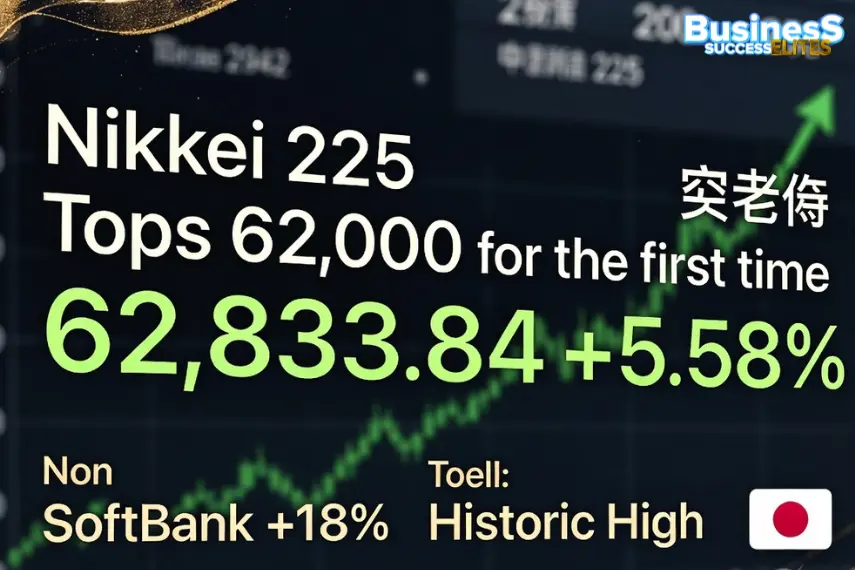
Japan’s Nikkei 225 tops 62000 for the very first time, closing Thursday’s session at an extraordinary 62,833.84, a milestone that felt less like a gradual climb and more like a dam finally breaking. The index surged 3,320.72 points from the previous week to breach the 62,000 threshold for the first time on a closing basis, eclipsing the previous record single-day point gain of 3,217 set in August 2024, a figure that had stood untouched for nearly two years.
The timing is significant. Tokyo markets had just reopened after the Golden Week holidays, and traders returned to a very different global landscape, one shaped by surging AI earnings, a weakening yen, and surprisingly resilient investor appetite despite fresh warnings from Washington about the ongoing Middle East conflict.
The Nikkei 225 advanced over 5% to end the trading day at 62,833.84, led by gains in basic materials, technology and financial stocks. When you break that number down, it reflects something broader than just a bullish trading session; it signals a shift in where global capital is choosing to park itself.
Trading value on the Tokyo Stock Exchange Prime Market reached ¥10.8448 trillion (approximately $69.4 billion), the highest this year. Put simply, money was moving into Japan with unusual conviction.
The sectoral breakdown tells the same story. Thirty of 33 industry sectors advanced, led by nonferrous metals, electric machinery, and information and communications, while mining and oil/coal sectors declined on lower crude prices.
If one name dominated the headlines on Thursday, it was SoftBank. Among the top gainers was SoftBank Group Corp., whose shares jumped 18% and hit the daily upper trading limit. Investors showed renewed confidence in the Japanese conglomerate due to its strong exposure to the artificial intelligence industry through investments in OpenAI and chip designer Arm Holdings.
This wasn’t random. The rally reflects increasing market enthusiasm for AI-related companies expected to benefit from the rapid expansion of AI infrastructure and services. Japanese semiconductor stocks also posted significant gains after Advanced Micro Devices delivered stronger-than-expected earnings earlier this week.
SoftBank’s rise is arguably the clearest signal of the broader narrative at play. SoftBank has become a major player in the AI industry after investing billions of dollars. It is part of the Stargate project, which plans to invest over $500 billion in data centres. It has also invested heavily in OpenAI. Thursday’s session was, in many ways, the market pricing all of that in.
Beyond SoftBank, other heavyweights had a field day. Electronics company Ibiden was the top performer, climbing over 22%. Semiconductor company Sumco Corp surged 19.74%, while manufacturing and metals company Mitsui Kinzoku gained 19%. Chip-testing equipment maker Advantest and semiconductor equipment firm Tokyo Electron also posted sharp gains.
The backdrop was anything but calm. Investor sentiment remained upbeat after U.S. President Donald Trump warned that Iran would face bombing “at a much higher level” if it failed to agree to a peace deal. These are not the sort of headlines that typically invite risk-on behaviour. And yet, the markets did exactly that.
Why? Because behind the bluster, there were signs of progress. Market sentiment was further lifted by reports that the US and Iran are nearing a one-page, 14-point memorandum of understanding aimed at ending the conflict, with measures that could eventually reopen the Strait of Hormuz and establish a framework for broader nuclear negotiations. Trump himself told PBS that a deal could land before his upcoming visit to China — a statement that carried weight with traders who have been watching oil shipping routes and energy costs closely.
Trump also said the U.S. military campaign, dubbed “Operation Epic Fury,” could end if Iran agrees to the proposed terms, potentially reopening the Strait of Hormuz to all shipping.
Japan was not alone in rallying. In Australia, the S&P/ASX 200 rose 0.96% to 8,878.1. South Korea’s Kospi jumped 1.43% to 7,490.05 while the small-cap Kosdaq Index slid 0.91% to 1,199.18. Hong Kong’s Hang Seng Index rose 1.47%, and China’s CSI 300 edged 0.38% higher, modest gains, but moves that suggest regional sentiment is broadly tilted toward optimism rather than caution.
Read More – Global Supply Chain Resilience: Navigating Risks & Opportunities in 2026
JP Morgan recently raised its year-end Nikkei target to 70,000 due to strong AI-driven demand and better corporate earnings forecasts. That is a bold call, but given Thursday’s performance, it no longer sounds as far-fetched as it might have a fortnight ago.
The Nikkei 225 Index jumped to 62,836, bringing the year-to-date gains to 16.67%. A cup-and-handle chart pattern is also being flagged by technical analysts as pointing toward further upside, potentially as high as 69,000.
Of course, risks remain. Iran negotiations could unravel. The Bank of Japan’s next move on monetary policy is still uncertain. And AI sentiment, however powerful right now, is not immune to disappointment if earnings begin to miss. Some experts warn that short-term volatility could return if geopolitical tensions rise again.
But for one Thursday in May, none of that mattered. Japan’s stock market made history, and the world took notice.